Clear Sky Science · en
Meta-topological hydrogel enables multisource and frequency-tailored artefact mitigation for bioelectronics
Why cleaner body signals matter
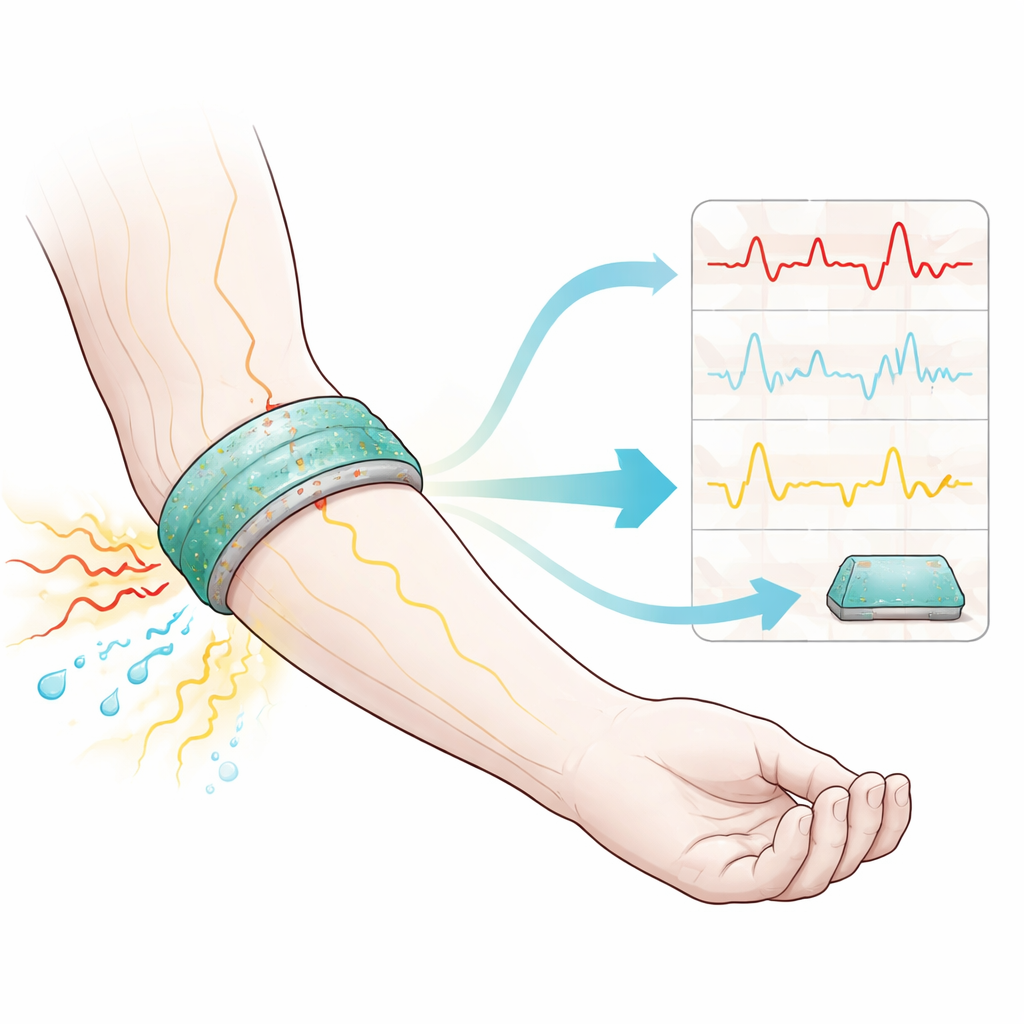
Many of us now wear gadgets that track heart rate, sleep or stress during everyday life. Yet these devices struggle when we move, because muscle twitches, shifting skin and other body motions create "artefacts" that can swamp the faint signals doctors care about. This study introduces a new soft material that sits between the body and electronics to quiet that noise, aiming to make continuous, real-world health tracking far more reliable, especially for problems like fatigue that unfold over long, active days.
A soft shield for wearable sensors
The researchers designed a special hydrogel, a water-rich, skinlike material, to act as a smart buffer between the body and sensors. Instead of treating all disturbances the same, this hydrogel is built to target different kinds of unwanted signals across selected frequency ranges. It tackles both mechanical noise from movement and electrical noise from muscles, while still letting through the slow pressure pulses and subtle heart signals that reveal how the cardiovascular system and nervous system are behaving.
How the gel tames motion and muscle noise
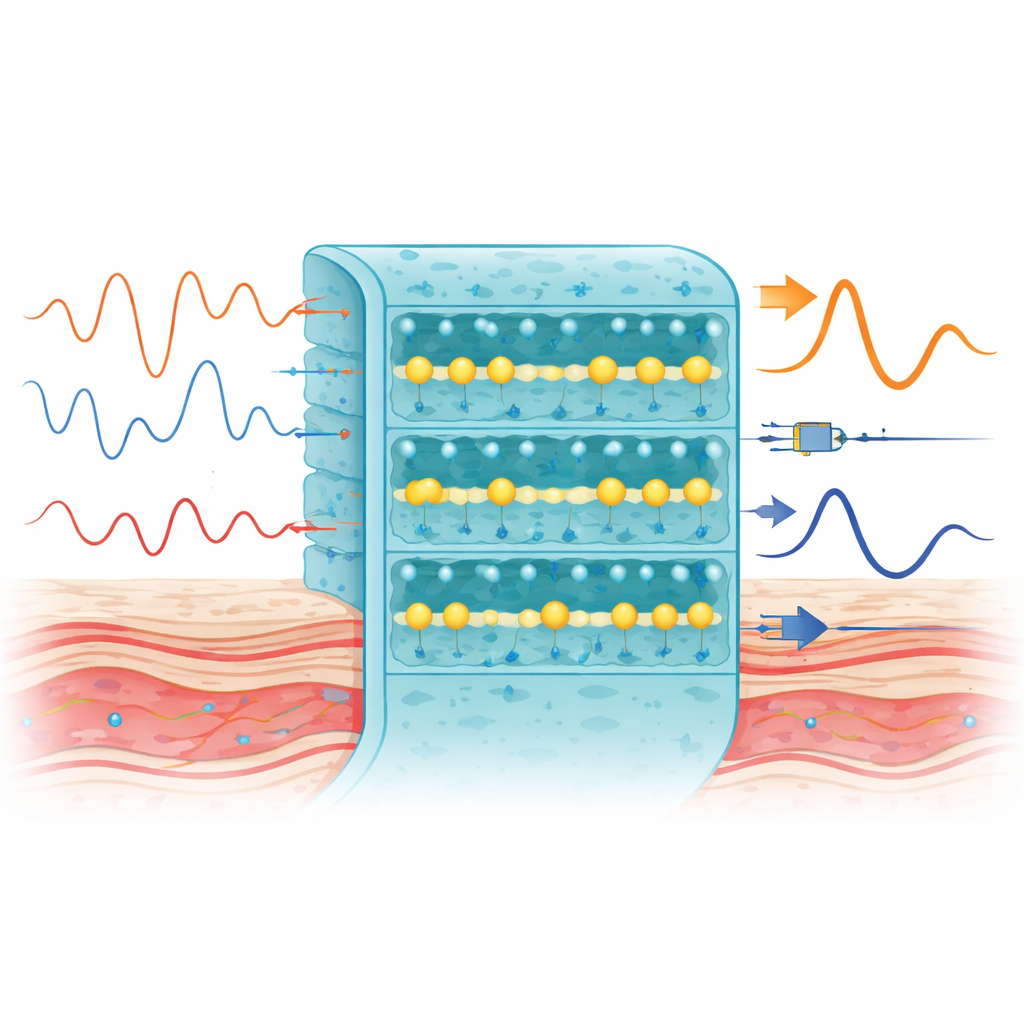
Inside the hydrogel, the team created a repeating pattern of tiny particles that behave like built-in shock absorbers. When vibrations travel through the material, these particles resonate and soak up mechanical energy in chosen frequency bands instead of passing it to the sensor. At the same time, the liquid inside the gel is tuned so that ions, the charged atoms that carry electrical signals, can easily follow slow changes such as heart rhythms but cannot keep up with faster muscle activity. By adjusting the chemistry, the researchers matched this electrical filtering to the typical ranges of heart and muscle signals, blocking most muscle interference while preserving the core shape of electrocardiogram waves.
Turning noisy pulses into clear health data
To test the material in realistic use, the team combined it with thin pressure sensors and heart electrodes worn on the wrist and arm. During everyday movements, the hydrogel sharply reduced false swings in blood pressure readings and boosted the clarity of heart signals. It brought blood pressure measurements close to clinical reference standards, with errors less than a millimeter of mercury, and increased the signal-to-noise ratio of heart recordings to levels usually seen only in controlled lab settings. A learning algorithm called an autoencoder was then used on top of the hardware filtering, further scrubbing residual noise while preserving the distinctive peaks doctors use for diagnosis.
From cleaner signals to fatigue tracking
With these steadier signals, the researchers followed volunteers over days of work and simulated driving to explore how heart patterns change as people grow tired. They extracted features such as heart rate variability, blood pressure trends and subtle timing shifts within each heartbeat. These measurements reflect how the body’s "rest and digest" and "fight or flight" branches of the nervous system balance each other. By training deep learning and regression models on these patterns, along with questionnaire scores, the system could sort different fatigue levels and estimate a person’s fatigue score with over 92 percent accuracy, even while the wearers were in motion.
Beyond fatigue to everyday health checks
Finally, the team showed that the same hydrogel layer can clean up a wide range of other biosignals, including heart and lung sounds, speech vibrations and brain and eye activity, all of which are normally distorted when people move. The work suggests a future in which a single, comfortable patch could give doctors and users continuous, trustworthy readings during real life, not just in a quiet clinic. In simple terms, the study demonstrates that carefully structured soft materials can act as noise-cancelling seats for sensors, turning jumbled body signals into clearer information for monitoring fatigue and many other aspects of health.
Citation: Tian, G., Huang, L., Pan, X. et al. Meta-topological hydrogel enables multisource and frequency-tailored artefact mitigation for bioelectronics. Nat. Sens. 1, 413–424 (2026). https://doi.org/10.1038/s44460-026-00055-x
Keywords: wearable bioelectronics, motion artefact, hydrogel interface, fatigue monitoring, physiological signals