Clear Sky Science · en
Hybrid ray-tracing-QuaDRiGa/FDTD method for realistic 28 GHz exposure with 6G CF-MaMIMO in 3D outdoor environments
Why this matters for everyday phone users
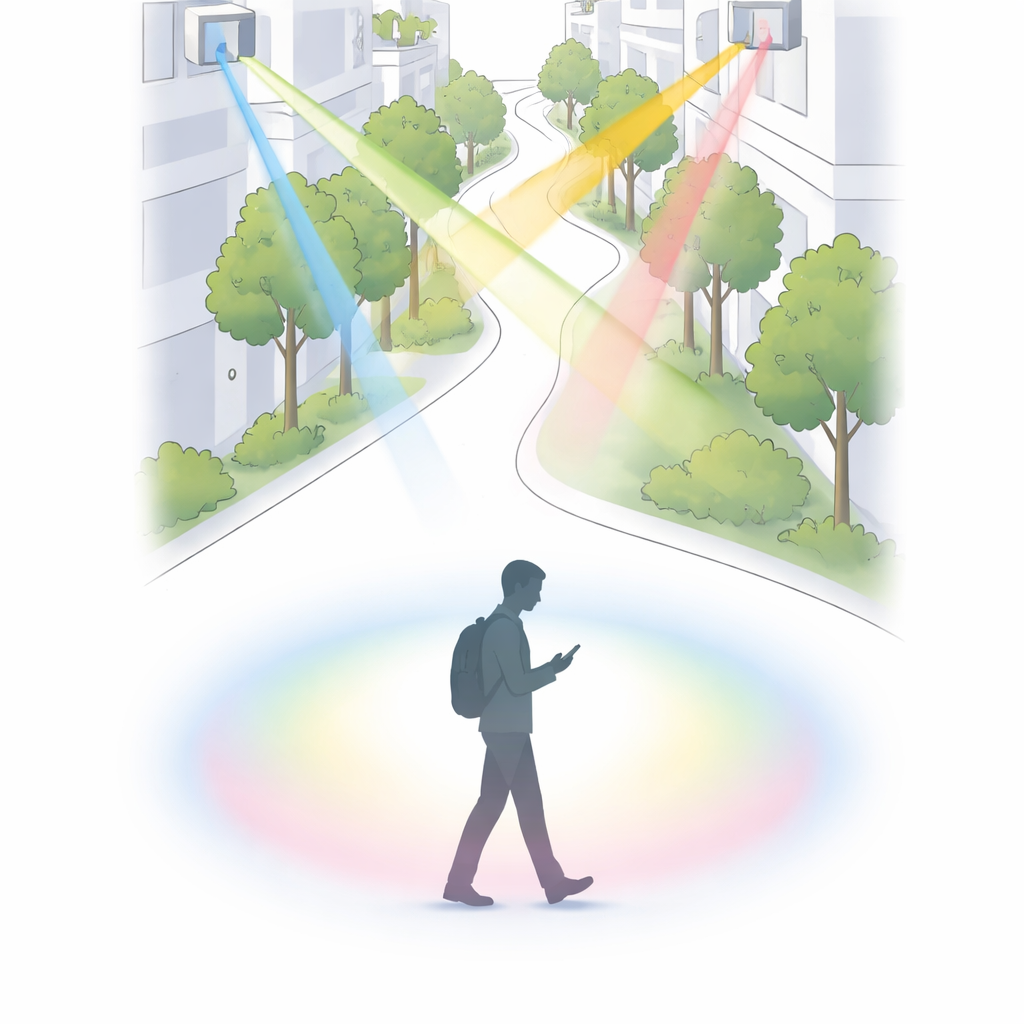
As 5G and upcoming 6G networks roll out, many people worry about how much radio energy their bodies actually absorb while walking down the street with a smartphone. This paper tackles that everyday question in a rigorous way: it combines detailed 3D models of real cities, advanced wireless network simulations, and virtual human bodies to estimate realistic exposure to high‑frequency signals around 28 GHz, a key band for future networks. The work focuses on the newest antenna concepts for 6G, where many small antennas are spread across buildings instead of bundled in one place, and asks: how strong are the fields around us, how do tiny “hotspots” form near the head, and how do these levels compare with international safety limits?
Turning the world into a digital test lab
The authors build a numerical pipeline that starts from something as simple as a walking route between two street addresses and ends with a detailed estimate of how much power is absorbed in a human body along that walk. They use Google’s photorealistic 3D city models, which capture buildings, trees, cars, and street furniture in fine detail, and then apply deep learning to classify the different surfaces (such as walls, roads, or foliage). This rich virtual environment is used to place current‑style 5G base stations and future 6G “cell‑free massive MIMO” access points—many small antenna units distributed over facades—around realistic pedestrian paths.
Following radio waves from tower to tissue
The core of the method tracks how radio waves travel, scatter, and interfere before they reach a person. First, a ray‑tracing program launches many virtual rays from each transmitter and follows their reflections and diffractions through the 3D city to build up the large‑scale pattern of signal strengths. Next, a well‑established wireless channel tool, QuaDRiGa, adds the fine‑grained, small‑scale fluctuations that occur as the person moves by fractions of a wavelength. These combined fields are then wrapped onto a “Huygens box” surrounding the region near the user’s head or torso. Finally, a Finite‑Difference Time‑Domain (FDTD) simulation places a realistic anatomical model (a so‑called phantom) inside that box and calculates how much power is actually absorbed in skin and tissue, using the new surface‑absorbed power density metric recommended by international guidelines.
City case studies: Helsinki streets and New York towers
To show what this method can reveal, the team runs two large case studies. In Helsinki, they compare a traditional 5G‑style base station with many antennas located together on a church tower to a 6G‑style “cell‑free” setup where hundreds of small access points are spread across nearby buildings. Both serve a walking smartphone user. They find that the distributed 6G system makes exposure along the route much more even: the variation in absorbed power drops by about 20 decibels compared with the collocated antenna, meaning fewer sharp peaks and valleys. In New York City’s World Trade Center area, they include full ray‑tracing and examine a user walking outdoors and briefly indoors. They show that an actively served user experiences, on average, about 20 decibels higher exposure than a nearby non‑user, but still at very low absolute levels compared with safety limits.
Zooming in on tiny hotspots around the head
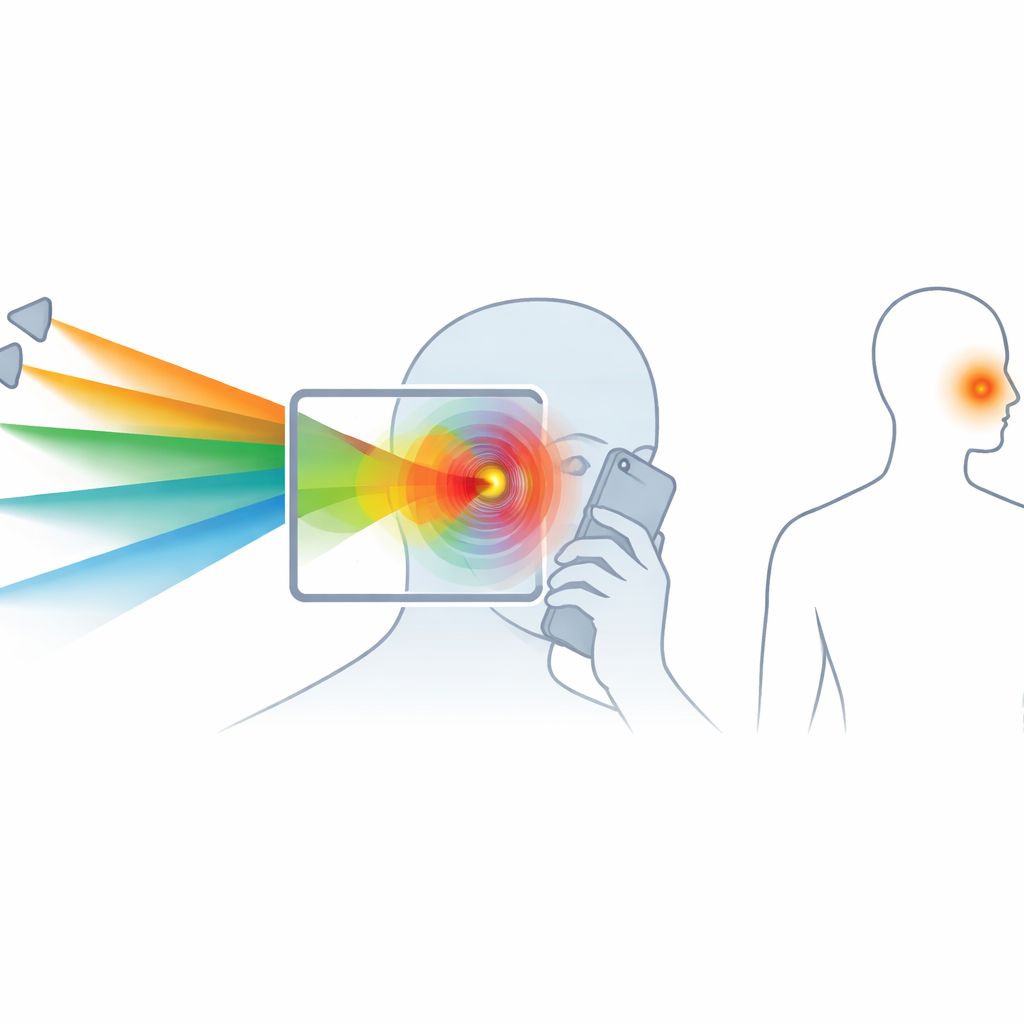
A key concern with modern antenna arrays is that they can “beamform,” adding signals from many elements so they reinforce at the user’s location. The study therefore examines small hotspots—wavelength‑sized regions of intensified field—around a virtual ear when a phone is held to the head. By scanning a few‑centimeter‑wide volume, the authors show that these hotspots typically have a roughly spherical or ellipsoidal shape about one wavelength across and often exhibit one to three surrounding rings, or sidelobes, where the field briefly rises again. On average, the electric field inside the main hotspot is about 12 decibels higher (roughly four times stronger) than the surrounding background produced by the larger beam. These patterns shift smoothly as the user walks and as reflections change, and they disappear when beamforming is turned off, confirming that they are a direct result of coordinated transmission.
What the study says about safety
Across all simulations at realistic transmitter powers, both the incident power density in air and the surface‑absorbed power density in the body remain far below the limits recommended by the International Commission on Non‑Ionizing Radiation Protection. Even under conservative assumptions—comparing short walks with limits defined for 30‑minute averages—the maximum simulated values stay under about 1 percent of the allowed levels. At the same time, the method reveals subtle structure in how exposure varies in space and time, showing that upcoming 6G cell‑free systems can smooth out large‑scale variations while still creating tiny hotspots near the user. The authors argue that this end‑to‑end digital twin of the environment, network, and human body can help regulators, engineers, and the public better understand realistic exposure, plan safer networks, and refine safety guidelines if needed.
Citation: Wydaeghe, R., Shikhantsov, S., Vermeeren, G. et al. Hybrid ray-tracing-QuaDRiGa/FDTD method for realistic 28 GHz exposure with 6G CF-MaMIMO in 3D outdoor environments. npj Wirel. Technol. 2, 13 (2026). https://doi.org/10.1038/s44459-026-00031-4
Keywords: 5G and 6G exposure, millimeter-wave safety, cell-free massive MIMO, electromagnetic hotspots, wireless network dosimetry