Clear Sky Science · en
Volumetric beam focusing: a new paradigm in extreme MIMO
Sharper Signals for a Data-Hungry World
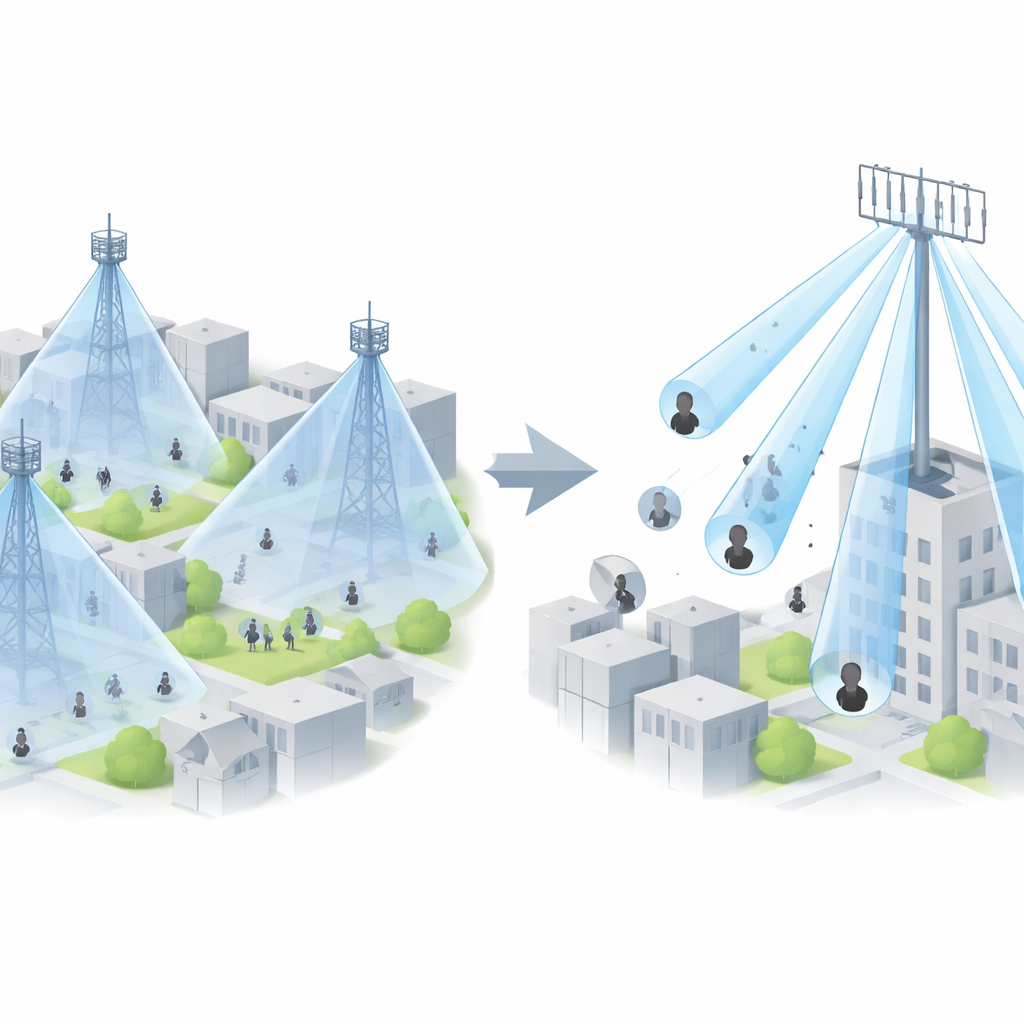
As our phones, laptops, and sensors compete for wireless bandwidth, today’s networks are straining under the load. This paper explores a new way to send radio signals that could dramatically boost capacity: instead of sweeping broad beams across a neighborhood, future base stations could sculpt radio energy into small three‑dimensional pockets around each user. The authors call this approach “volumetric beam focusing,” and they show how special wave patterns can make it practical for the next generations of wireless, including 6G.
From Wide Beams to Tight Pockets of Energy
Mobile networks have long tried to increase capacity by shrinking cells, dividing coverage into sectors, and then using many antennas to steer narrow beams toward users. This strategy, known as massive MIMO, works well when users are far from the antennas, because radio waves look like flat sheets sweeping across the array. But as arrays grow to several meters wide and operate at higher frequencies, many users move into the “near‑field,” where waves curve significantly. In this regime, simply steering beams by angle no longer suffices: two users in the same direction but at different distances can interfere with each other. Volumetric beam focusing turns this drawback into an opportunity by using both angle and distance to separate users, aiming energy at compact 3D regions rather than along broad lines through space.
Special Beams That Refuse to Spread
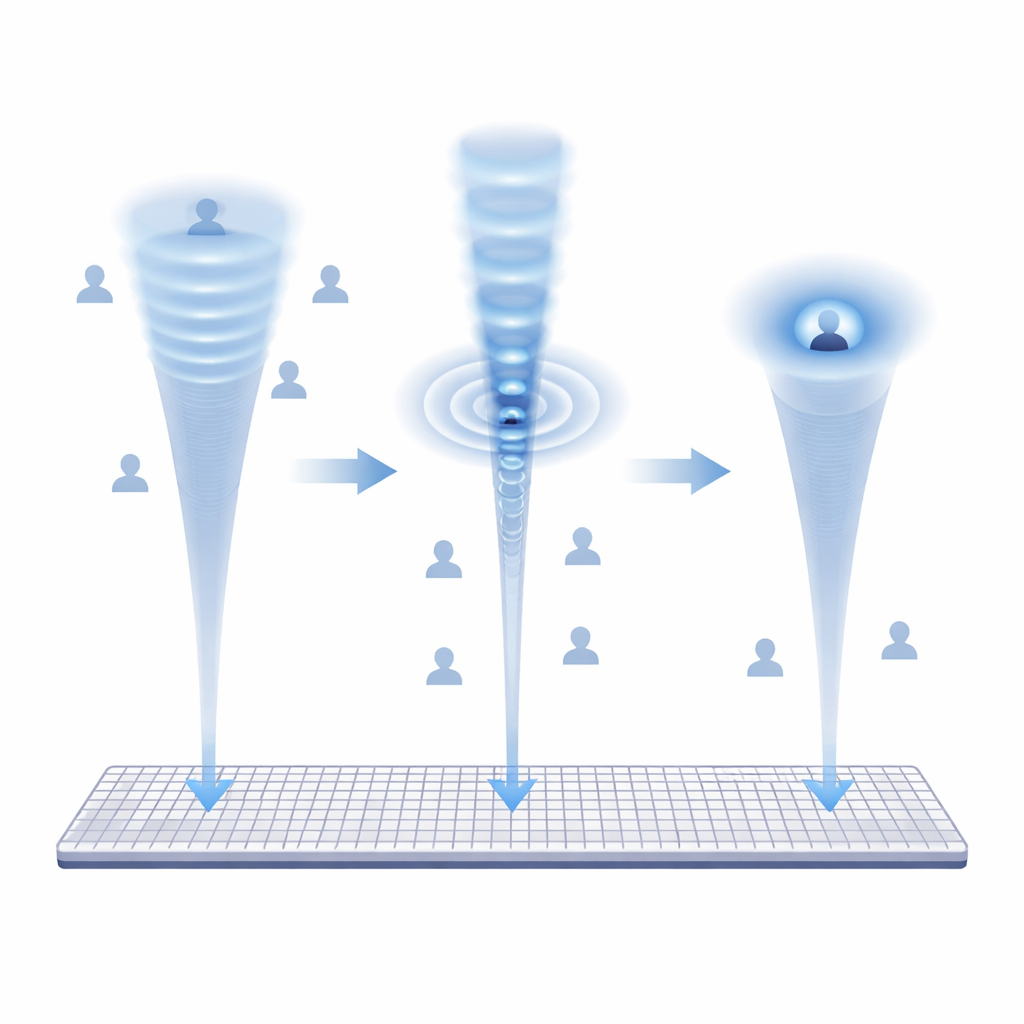
The key building blocks of this new approach are so‑called non‑spreading beams, especially Bessel beams. Unlike ordinary beams that blur as they travel, a Bessel beam maintains a sharp core over a long distance, surrounded by concentric rings of weaker intensity. This makes it attractive for keeping energy focused on a user over tens or hundreds of meters. However, those rings also create deep “dead zones”: if a user moves slightly off the center line, they may fall into a low‑power ring and lose signal. To fix this, the authors design a modified beam, the Padé–Bessel beam, which gently reshapes the radial profile of a Bessel beam. By mathematically approximating the Bessel pattern near the focus, they fill in the deepest nulls and smooth the oscillations, trading a tiny bit of sharpness for a much more uniform and robust central lobe.
Focusing in Planes and in Volumes
Using these beams, the researchers first study “areal” focusing—concentrating energy within a plane—then extend it to true 3D volumes. They compare three methods: standard near‑field focusing used today, pure Bessel beams, and Padé–Bessel beams. In 2D simulations with a long antenna line, conventional focusing produces a strong spot at the user but spreads substantial energy sideways and in depth, creating interference for others. Bessel beams tighten the focus but still show many bright rings away from the target. Padé–Bessel beams achieve the narrowest and cleanest focus: the main lobe is as tight as in the Bessel case, but the surrounding rings are strongly suppressed. In 3D scenarios with a rectangular antenna panel, the difference is even starker. Conventional focusing generates an elongated energy tube, while superposed Bessel beams form a much smaller bright region. Padé–Bessel beams shrink the useful volume by roughly a factor of 1,900 compared with standard focusing, confining both strong and weak energy much closer to the target point.
More Users, Less Interference
Sharper focusing only matters if it boosts real network performance. The authors therefore model multi‑user cellular layouts with hundreds of users and compare how many bits per second each method can deliver per unit of bandwidth. With the same total transmit power, Padé–Bessel and Bessel beams dramatically outperform conventional beams: average rates per user increase by an order of magnitude in some cases, and interference remains low even as the number of users rises into the hundreds. When the focusing patterns are implemented on practical digital antenna arrays, the gains largely persist: Padé–Bessel beams consistently beat simple maximum‑ratio transmission and even rival more complex interference‑cancelling schemes, without needing heavy real‑time matrix inversion. The authors also test robustness to hardware limits, scattered reflections, and imperfect user locations, finding that the new beams still provide clear advantages so long as arrays are not too small and location estimates are reasonably accurate.
What This Means for Everyday Connections
In everyday terms, this work shows how future base stations could “light up” only a small 3D bubble around your device instead of flooding a whole block with radio energy. By creating these tight pockets with Padé–Bessel beams, networks can serve many more users on the same frequencies, reduce wasted power, and even pinpoint user positions with centimeter‑scale precision. While the ideas still need hardware prototypes and real‑world testing, volumetric beam focusing offers a compelling path for 6G systems: rather than just adding more towers or more spectrum, they can use smarter physics to place each watt exactly where it is needed.
Citation: Banerjee, B., Parvini, M., Nimr, A. et al. Volumetric beam focusing: a new paradigm in extreme MIMO. npj Wirel. Technol. 2, 12 (2026). https://doi.org/10.1038/s44459-026-00026-1
Keywords: extreme MIMO, volumetric beam focusing, Bessel beams, near-field wireless, 6G networks