Clear Sky Science · en
Indoor positioning with multi-domain CSI-based deep attention networks for MIMO wireless systems
Finding Your Way Indoors
GPS works wonders outdoors, but step into a shopping mall, factory, or warehouse and its accuracy quickly breaks down. Yet many emerging technologies—from warehouse robots and delivery drones to augmented reality headsets—need to know their position indoors to within just a few centimeters. This paper explores how to turn ordinary signals from advanced Wi‑Fi and cellular systems into a highly accurate indoor positioning tool using modern artificial intelligence.
Listening Closely to Wireless Echoes
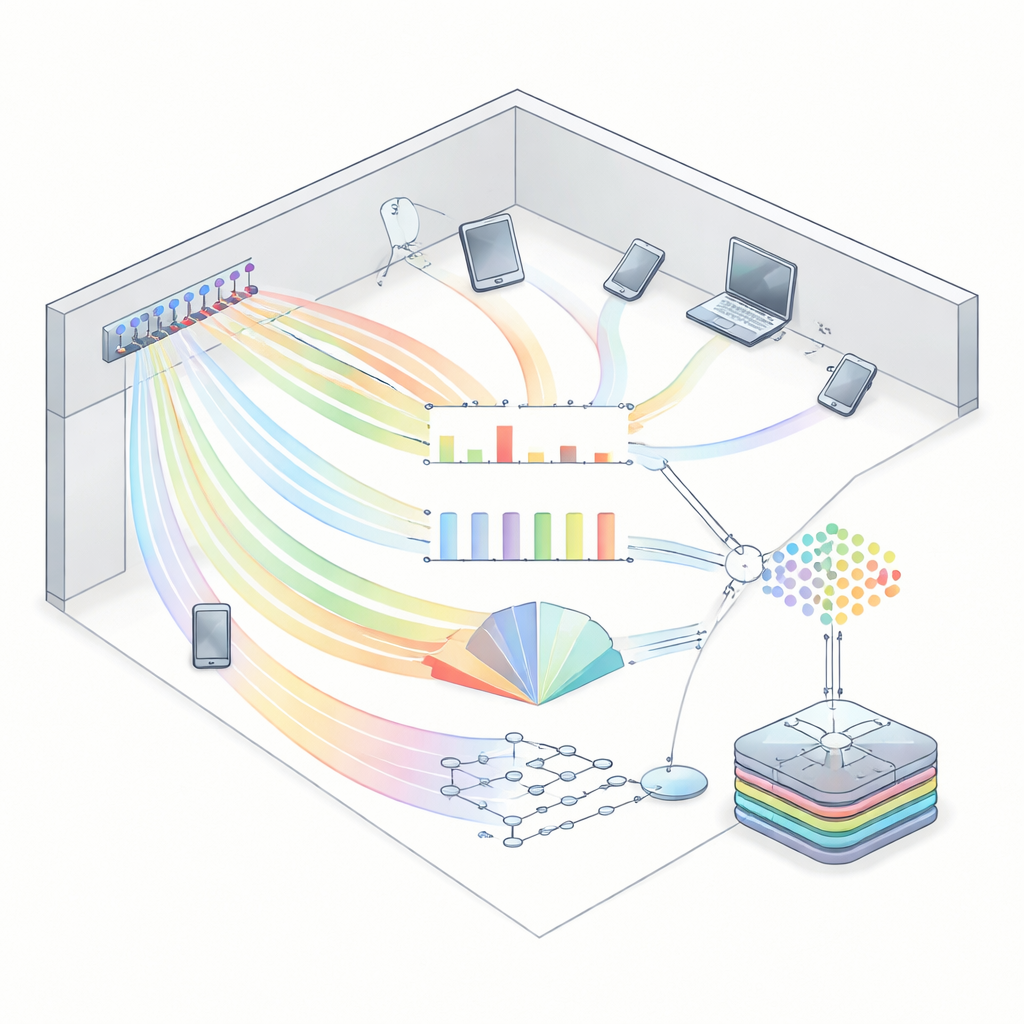
When your phone talks to a base station, the signal bounces off walls, machines, and people before it arrives. Engineers capture a detailed “fingerprint” of this journey called channel state information, or CSI. CSI describes how the signal’s strength, timing, and direction change along the way. Modern massive MIMO base stations, which use dozens of antennas, collect CSI as part of normal communication—no extra beacons or sensors are needed. The idea behind this work is to mine those rich fingerprints to infer exactly where a device is located inside a room.
Seeing the Same Signal in Many Ways
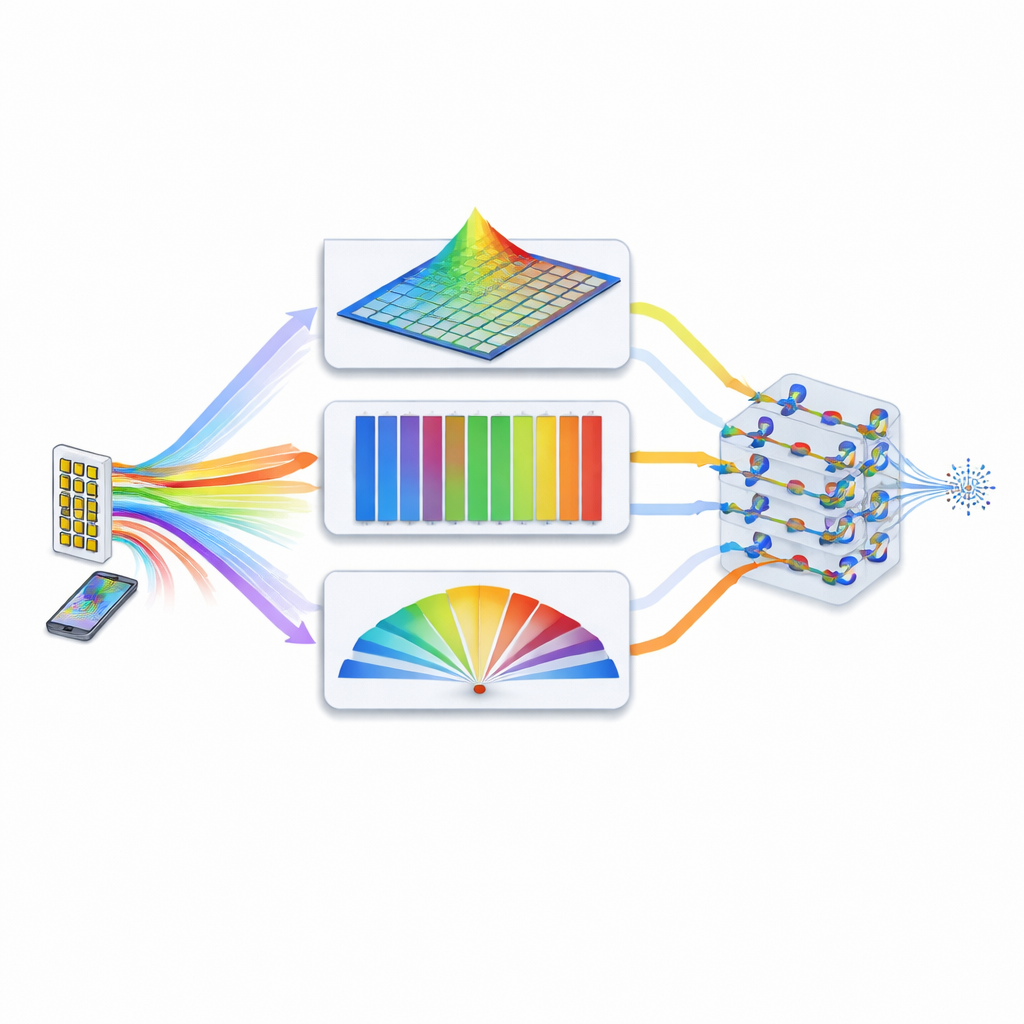
The authors show that CSI becomes more informative when viewed from several angles. They transform the raw data into three complementary “domains.” One view emphasizes how signals arrive over time, capturing echoes and delays. A second highlights how the signal behaves across different radio frequencies. A third focuses on arrival angles, revealing how energy spreads across different directions, much like a spotlight pattern. For each view, the data are represented in two simple mathematical forms, roughly corresponding to splitting a wave into its size and its orientation. Combining all these views produces a multi‑layered description of the wireless environment that is strongly linked to the user’s position.
Teaching Neural Networks to Pay Attention
Earlier research mainly relied on convolutional neural networks, a class of AI models well suited to pattern recognition in images, to process CSI. While effective, these models treat all parts of the input more or less equally. In this study, the researchers design a new architecture called a deep attention network. It still uses convolutional layers to extract basic patterns, but then adds attention blocks that learn to focus on the most informative parts of each CSI view and to weigh the different views against one another. In essence, the network learns which echoes, frequencies, and angles matter most for pinpointing location in a cluttered indoor space.
Testing Accuracy and Speed
The team evaluates their approach on a public dataset recorded in a lab equipped with a 64‑antenna base station scanning a few‑meter‑wide indoor area at fine spatial steps. They compare different combinations of CSI views and network architectures. Using all three domains together consistently beats using any single one. The deep attention network provides the lowest typical errors, often around two centimeters, and maintains this high accuracy across different antenna layouts and different amounts of training data. However, this improvement comes at a cost: the attention model takes roughly twice as long to process the same number of samples as a simpler convolutional network, because its focusing mechanism adds extra computation.
Balancing Precision and Practicality
In everyday terms, the study shows that we can turn existing advanced wireless networks into a kind of indoor “GPS” that works down to a few centimeters, by letting AI carefully combine multiple perspectives on how radio waves bounce around a room. The deep attention network delivers the sharpest location estimates, but requires more computing power and time, making it better suited to applications where reliability and fine precision matter more than split‑second responses. Future work aims to streamline these attention mechanisms and to test them in more complex, changing indoor spaces, bringing ultra‑precise indoor positioning closer to real‑world deployment.
Citation: Susarla, P., Mukherjee, A., Bulusu, S.S.K.C. et al. Indoor positioning with multi-domain CSI-based deep attention networks for MIMO wireless systems. npj Wirel. Technol. 2, 23 (2026). https://doi.org/10.1038/s44459-025-00021-y
Keywords: indoor positioning, massive MIMO, channel state information, deep learning, attention networks