Clear Sky Science · en
Solar poverty alleviation program raises local incomes and lowers air pollution in rural China
Sunlight as a Tool against Poverty
In many rural areas of the world, families still struggle with two linked problems: low incomes and dirty, unhealthy energy. This study looks at how a large solar power program in China’s poorest counties tried to tackle both challenges at once. By turning village rooftops and unused land into small power stations, the program aimed to put money in people’s pockets while cleaning up the air they breathe.
How the Solar Support Program Works
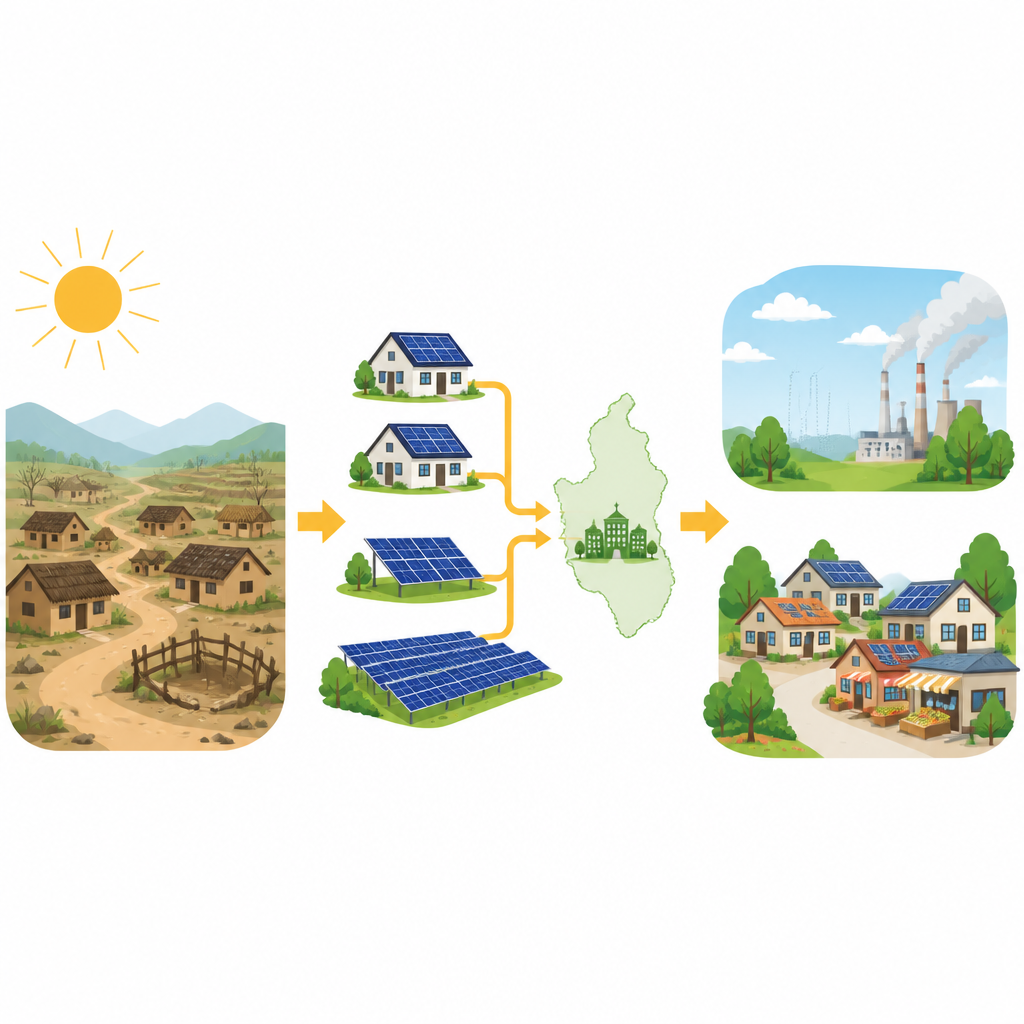
China’s Photovoltaic Poverty Alleviation Program helps low income counties build small solar power systems on homes and village land. Households use some of the electricity themselves, and the extra power is sold to the national grid at favorable prices. The income from these sales is shared with poor families, and the clean electricity displaces part of the coal and other fossil fuels that normally supply power. In this way, the program links village-level solar development directly to both higher earnings and cleaner energy use.
Measuring Changes in Money and Air
To find out whether the program truly worked, the researchers treated its staggered rollout as a kind of natural experiment. Among 832 officially designated poor counties, 236 took part in the solar program while the rest did not. The team combined county economic records from 2010 to 2020 with satellite-based maps of sulfur dioxide in the air, a gas strongly tied to coal burning. By comparing how participating and non-participating counties changed over time, they could separate the effect of the solar policy from broader trends in the national economy and environment.
Gains for Local Economies
The analysis shows that counties covered by the solar program experienced about 3 percent higher gross domestic product than similar poor counties without the program, and about 5 percent higher income per person. These gains did not come only from selling electricity. Households saved more and spent more, which boosted local markets for goods and services. Building and running the solar stations created jobs, especially in non-farm sectors, and helped attract new businesses. Counties that received more solar capacity or supported more households saw even larger economic improvements, suggesting that the intensity of the program matters.
Cleaner Skies and Who Benefits Most
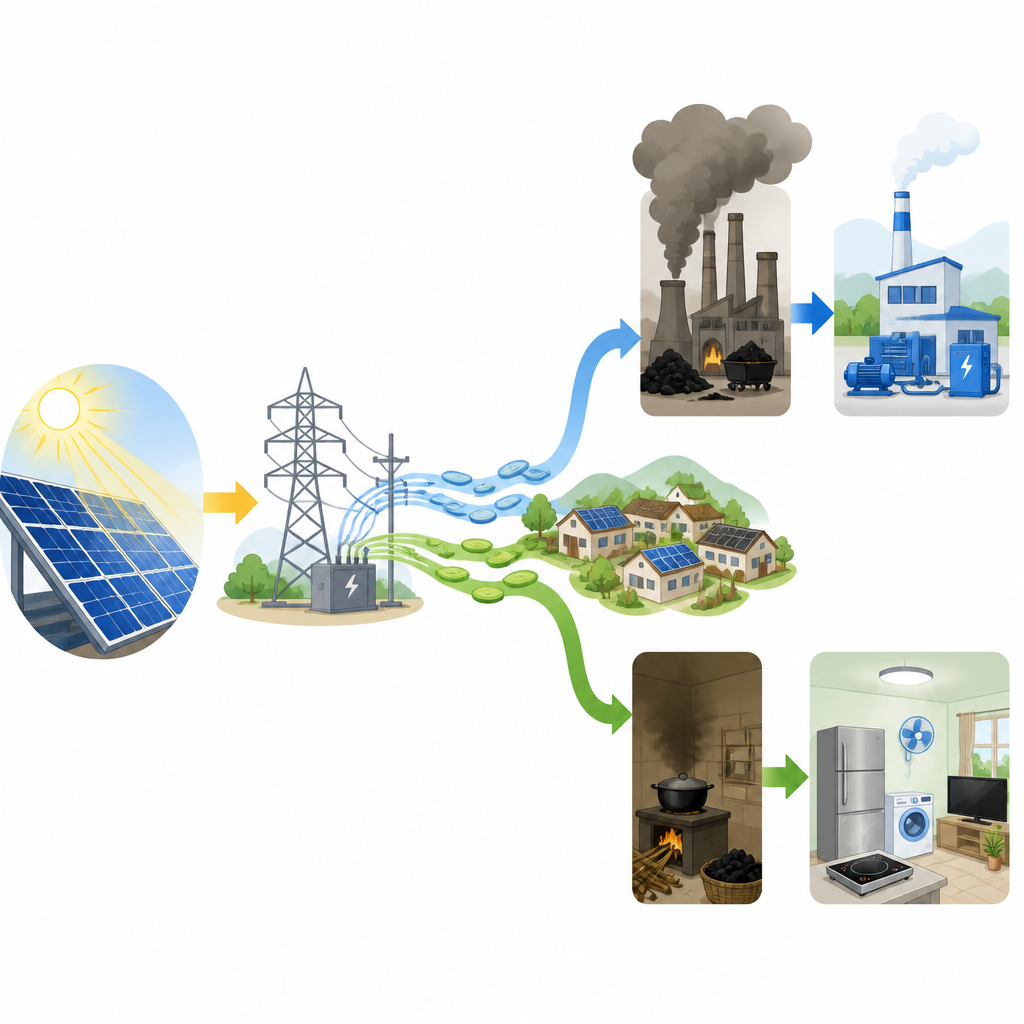
On the environmental side, the study finds that sulfur dioxide levels fell by roughly four micrograms per cubic meter in counties with the solar program. The reductions were strongest in regions with a lot of factories, where cheap, clean electricity made it easier for firms to use less coal. Poorer rural areas also saw bigger drops, likely because families could afford to switch away from coal and crop residue for cooking and heating. In places where industry was already weak, the added power mainly supported new economic activity, so the income gains were larger while the pollution cuts were more modest.
Limits and Lessons for the Future
Although the program raised incomes and lowered air pollution, the study notes that building and maintaining solar stations requires heavy upfront investment and ongoing subsidies. In the short term, the money returned to local economies does not fully cover these costs, so the policy works more like social support than a profit-making venture. Over the longer term, the authors argue that pairing solar with other local industries and shifting toward more self-sustaining business models will be crucial. For other countries facing serious energy poverty, especially in Africa and South Asia, the key lesson is that carefully designed solar programs can ease both poverty and pollution, but their success depends on local markets, skills, and the ability to keep projects financially stable.
Citation: Yuan, Y., Sun, L. & Chen, J. Solar poverty alleviation program raises local incomes and lowers air pollution in rural China. Commun. Sustain. 1, 87 (2026). https://doi.org/10.1038/s44458-026-00091-1
Keywords: solar poverty alleviation, rural China, clean energy transition, air pollution, sustainable development