Clear Sky Science · en
Environmental DNA-informed modeling improves water diversion for cyanobacterial bloom mitigation in urban river-lake networks
Why city water channels and green scum matter
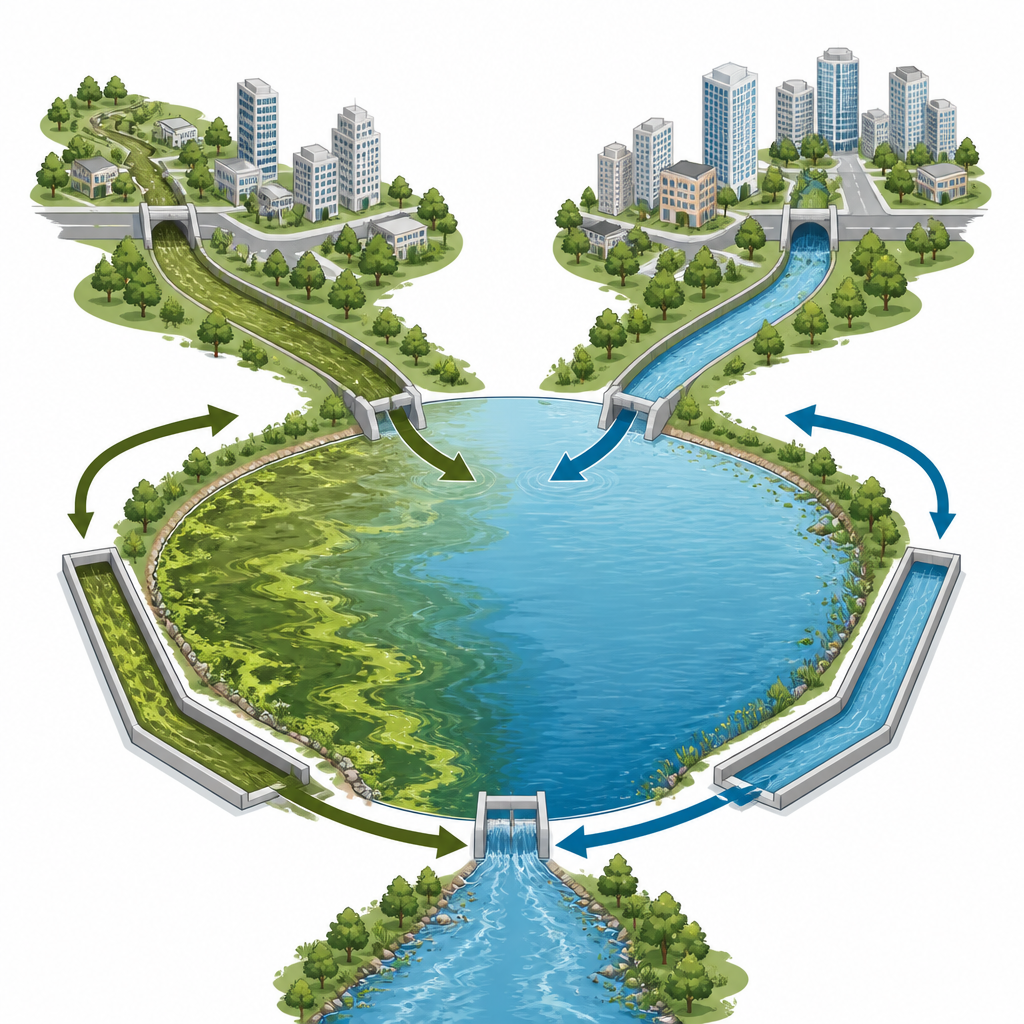
Cyanobacterial blooms, often seen as green scum on rivers and lakes, can release toxins, foul smells, and threaten drinking water. Many cities try to fight these blooms by diverting water through canals and pumps, hoping faster, fresher flow will flush the problem away. This study asks a simple but pressing question: can we tune those diversions so they actually reduce bloom risk, instead of accidentally pushing more harmful algae into urban lakes?
Green tides in city waterways
The research focuses on a maze-like river and lake system in the middle–lower Yangtze Plain near Lake Taihu, where summers often bring dense cyanobacterial blooms. Unlike large open lakes, these urban river–lake networks are laced with pumps, gates, and bifurcating channels that constantly reshape how water moves. Such regulation can either create stagnant, warm pockets where algae thrive or flush them away. The team monitored this system for a full year, measuring flow, nutrients, and algae, and tracking how two main diversion routes fed a central “recipient” lake.
Reading the water’s DNA
To see which cyanobacteria actually drive the blooms, the researchers combined classic microscope counts with environmental DNA, or eDNA. By filtering water and amplifying specific genes, they could track toxigenic Microcystis, a key toxin producer, and a filamentous group linked to earthy off-flavours. Gene copy numbers served as a sensitive proxy for how abundant each group was across seasons and locations. The data revealed that from June to October, blooms in the lake were dominated by these two groups, with Microcystis often forming dense surface colonies and the filamentous cyanobacteria frequently co-occurring alongside.
Building a digital twin of flow and blooms
Armed with these measurements, the team built a coupled hydrodynamic–ecological model, a kind of digital twin of the river–lake network. It simulated how water currents, mixing, and nutrient levels interact with cyanobacterial growth and movement. Instead of relying on a generic chlorophyll signal, the model represented Microcystis and the filamentous group separately, capturing traits such as Microcystis’s tendency to float upward and the filament’s tendency to sink or travel in aggregates. Gene copy numbers at boundaries were used to feed realistic “seed” populations into the model, which was then calibrated against several months of observed data.
When flushing helps and when it hurts
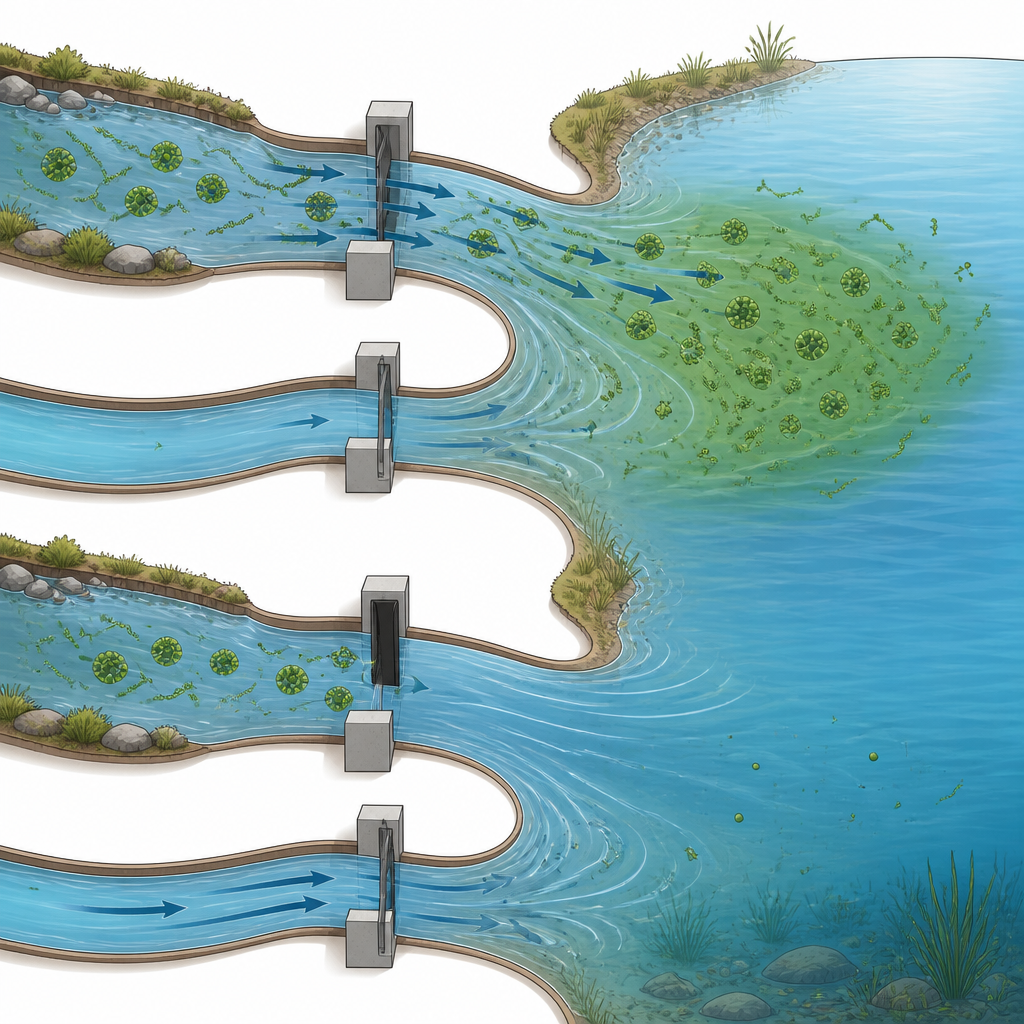
The model allowed the researchers to test seven diversion schemes that differed in route and flow rate. A single direct channel (R1) was very efficient at pushing water into the lake, but when its source water carried high cyanobacterial loads, stronger pumping also meant faster delivery of blooms. A bifurcated route (R2) spread water more widely and boosted circulation but could still import algae if its own source was contaminated. The sweet spot under observed conditions was a mixed strategy: diverting 5 cubic meters per second along the more polluted single route and 15 cubic meters per second along the cleaner, branched route. This combination raised flow speeds in over one-third of river sections above a target threshold, reduced stagnant zones, and limited the cyanobacterial gene copies reaching the lake compared with high-flow scenarios from the dirty source.
Balancing cleaner flow with lower bloom risk
In everyday terms, the study shows that “more water” is not always “better water.” If managers blindly crank up pumps from a dirty source, they may simply sweep harmful algae downstream and seed bigger blooms in lakes. By blending modest flows from riskier channels with stronger flows from cleaner ones, and by watching both nutrients and eDNA signals, cities can tilt the balance toward safer, clearer water. The approach demonstrated here offers a practical roadmap for tuning diversion schedules so they not only keep rivers moving but also cut the odds that green scum will spoil urban lakes.
Citation: Cao, Y., Yang, Y., Xia, J. et al. Environmental DNA-informed modeling improves water diversion for cyanobacterial bloom mitigation in urban river-lake networks. Commun. Sustain. 1, 83 (2026). https://doi.org/10.1038/s44458-026-00088-w
Keywords: cyanobacterial blooms, water diversion, urban river-lake networks, environmental DNA, hydrodynamic modeling