Clear Sky Science · en
Redefining soil health and food security through tropical conservation agriculture
Why soil health matters to dinner plates
For many people living in tropical regions, putting enough food on the table is a daily struggle, even though the land around them looks rich and green. This article explores how a set of farming practices known as conservation agriculture could help rebuild tired soils, support farmers’ livelihoods, and improve food security across the tropics.
A fresh look at farming in the tropics
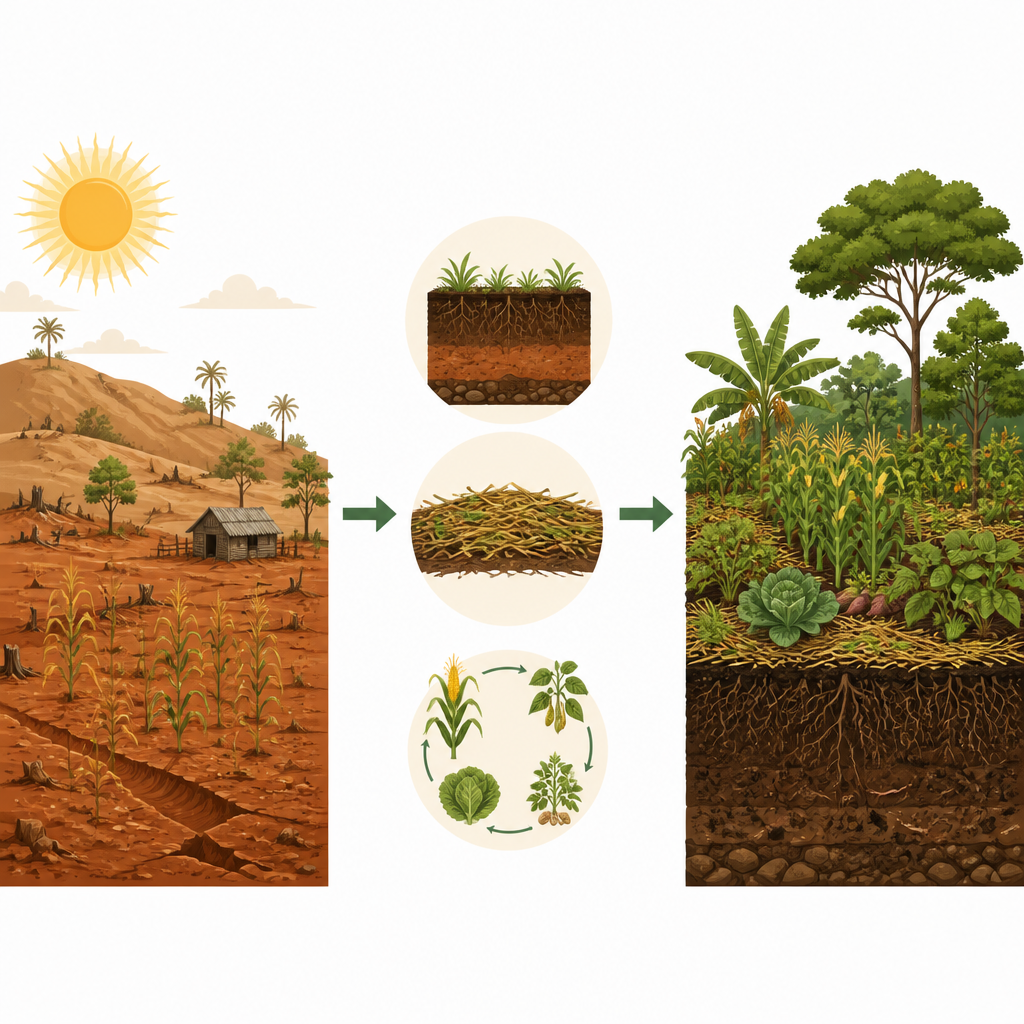
The authors review 50 years of research on conservation agriculture in tropical countries. Conservation agriculture rests on three simple ideas: disturb the soil as little as possible, keep it covered with plants or crop residues, and grow a mix of crops instead of the same one over and over. These practices are meant to protect soil from erosion, rebuild organic matter, and make fields more resilient to droughts and heavy rains. The study pulls together findings from 474 scientific papers to understand where these methods are being tested, how they affect soil, and what this means for food production.
Who leads the science and who is left out
The review reveals that research on conservation agriculture in the tropics has grown quickly, especially in the last decade, but it is far from evenly spread. About 40 percent of all studies come from Brazil, supported by strong public funding and national research institutes. Many other tropical countries, particularly in sub-Saharan Africa and parts of Asia, contribute very little to this research despite facing some of the highest levels of hunger. Collaborations are common between tropical and wealthy temperate countries, but partnerships among tropical nations themselves are rare. This imbalance means that the places that most need better soil management often have the least tailored scientific support.
What we really know about soil health
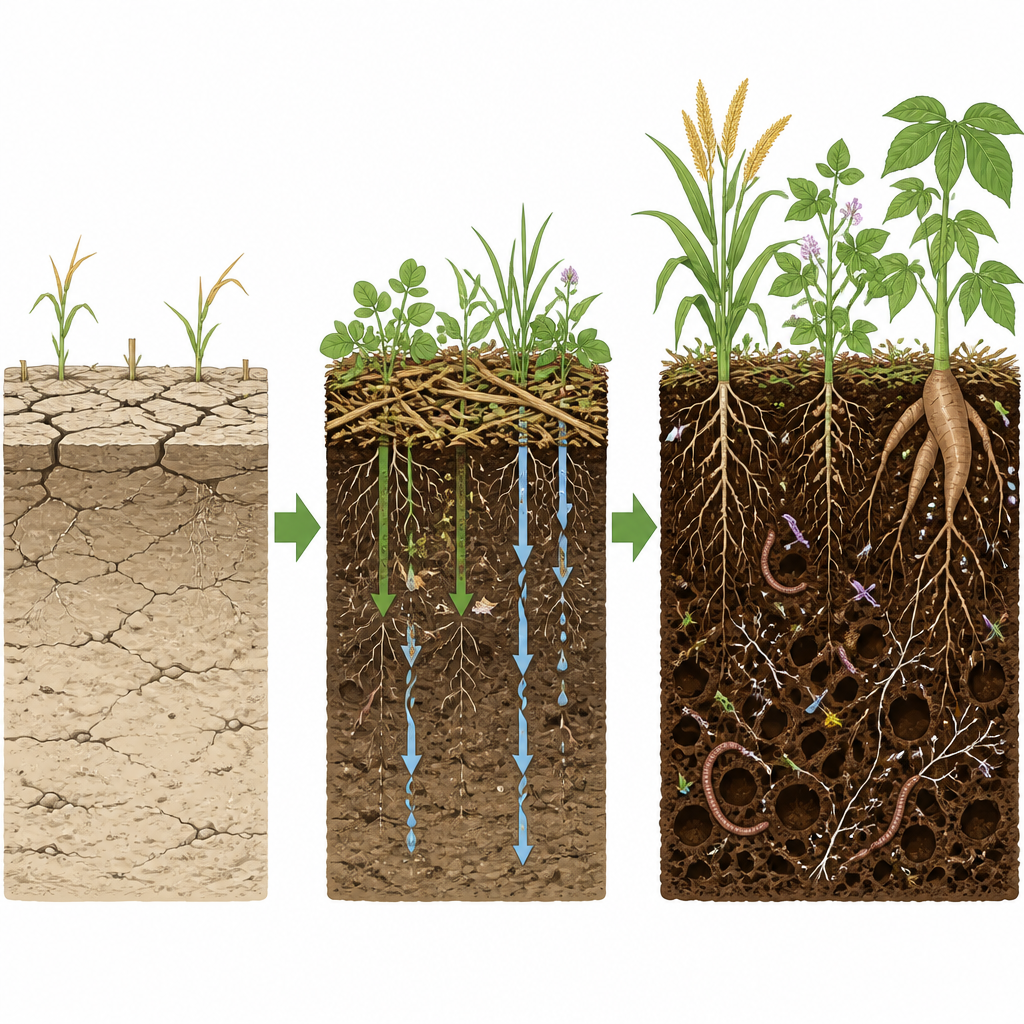
Most of the studies examined focus on just the top 20 centimeters of soil and mostly measure chemical and physical features such as soil carbon, nutrients, and bulk density. Only about one third of the studies look at living components of the soil, such as microbes and enzymes, and just a small fraction combine chemical, physical, and biological measures in a single soil health score. Because deep soil layers can store water and carbon and support roots during dry spells, ignoring them may underestimate the long-term benefits of conservation agriculture. The authors argue that the tropics need better soil monitoring systems, shared databases, and practical tools that bring together all aspects of soil health in a way farmers and decision-makers can use.
Crops, machines, and missing staples
The review also tracks which crops and farming systems are included in conservation agriculture trials. Pastures and cover crops are common, and among food crops, maize and soybean dominate. These are important for both local diets and export markets, and they fit well with large, mechanized farms that can easily adopt zero tillage equipment. Yet many vital tropical staples, especially root and tuber crops like cassava and yams, appear in very few studies. These crops feed millions of people and are well suited to a warming climate, but traditional ways of growing them often involve heavy soil disturbance and can worsen erosion. The lack of research on how to grow such crops under soil-friendly management leaves a major gap for smallholder farmers who depend on them.
Brazil’s path and lessons for others
Brazil stands out as a case where steady investment in research, education, and farm support turned a once marginal region into a major food-producing powerhouse. The spread of no-till practices, combined with cover crops and better nutrient management, has helped increase soybean harvests and is linked with reductions in poverty. While the review does not claim that conservation agriculture alone caused these improvements, it shows how aligning science, policy, and farmer adoption can transform both landscapes and livelihoods. Similar approaches, adapted to local cultures and ecosystems, could help other tropical countries close the gap between their natural potential and current food shortages.
What this means for people and the planet
Overall, the article concludes that conservation agriculture offers a promising way to rebuild tropical soils and support more reliable food supplies, but the evidence is still patchy and uneven. To realize its full potential, the tropics need more locally driven research, better tools to measure all parts of soil health, deeper studies that go below the surface, and stronger cooperation among countries facing similar challenges. For a layperson, the message is clear: healthy soils are the quiet foundation of food security, and smarter farming that protects them can help feed growing populations while caring for the environment.
Citation: Ologunde, O.H., Nunes, M.R. Redefining soil health and food security through tropical conservation agriculture. Commun. Sustain. 1, 82 (2026). https://doi.org/10.1038/s44458-026-00086-y
Keywords: conservation agriculture, soil health, tropical farming, food security, Brazil agriculture