Clear Sky Science · en
Magnesium silicate binder shows potential as a carbon-neutral route for cement manufacture
Why cleaner cement matters
Cement is the glue that holds our buildings, bridges, and roads together, but making it releases large amounts of carbon dioxide into the air. This article explores a new kind of cement made from magnesium-rich rock that could drastically cut these climate-warming emissions while still delivering the strength modern construction needs.
A fresh look at the world’s favorite building glue
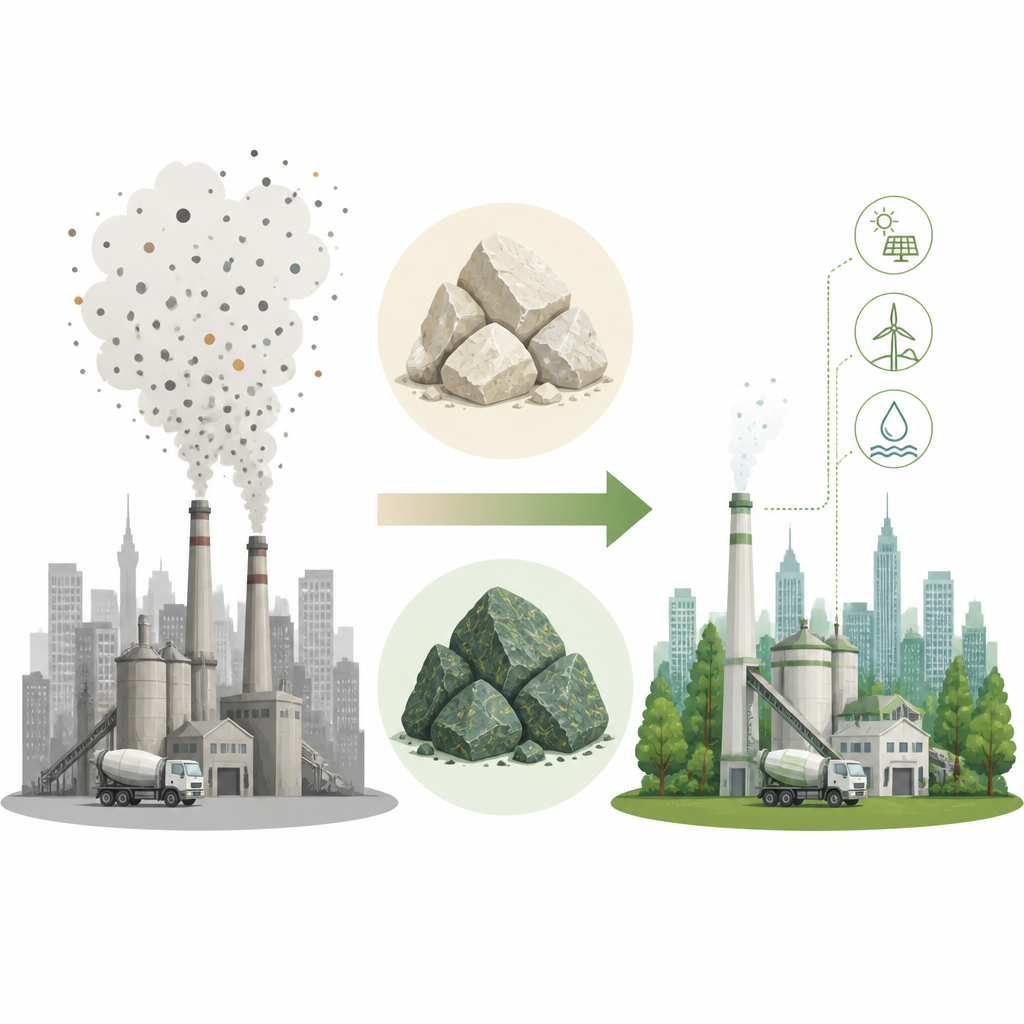
Concrete is made from stones, sand, water, and a powder called cement. Today, nearly all cement is based on limestone, which must be heated to very high temperatures. This process not only burns fuel but also breaks down the limestone itself, releasing carbon dioxide. Together, cement plants are responsible for about 8% of global carbon dioxide emissions, and these “hard to avoid” emissions from limestone are especially difficult to remove. Existing climate plans often rely on capturing and burying this carbon, but that technology is costly, slow to roll out, and raises long-term safety and legal questions.
Borrowing ideas from natural rock chemistry
The researchers turn to rocks that naturally react with water deep in Earth’s crust: ultramafic rocks rich in magnesium, which commonly weather into a mineral mix called serpentinite. In nature, these rocks change slowly over long periods and were long thought to be poor at forming strong binders. By carefully studying the energy changes and reaction speeds of magnesium and silica when they meet water, the team shows that this system can in fact behave much like conventional cement if it is properly activated. Their work suggests that a special, highly reactive form of magnesium silicate can form strong, stable binding phases when it hydrates, much like the glue phases that form in standard cement.
Turning rock into a workable cement
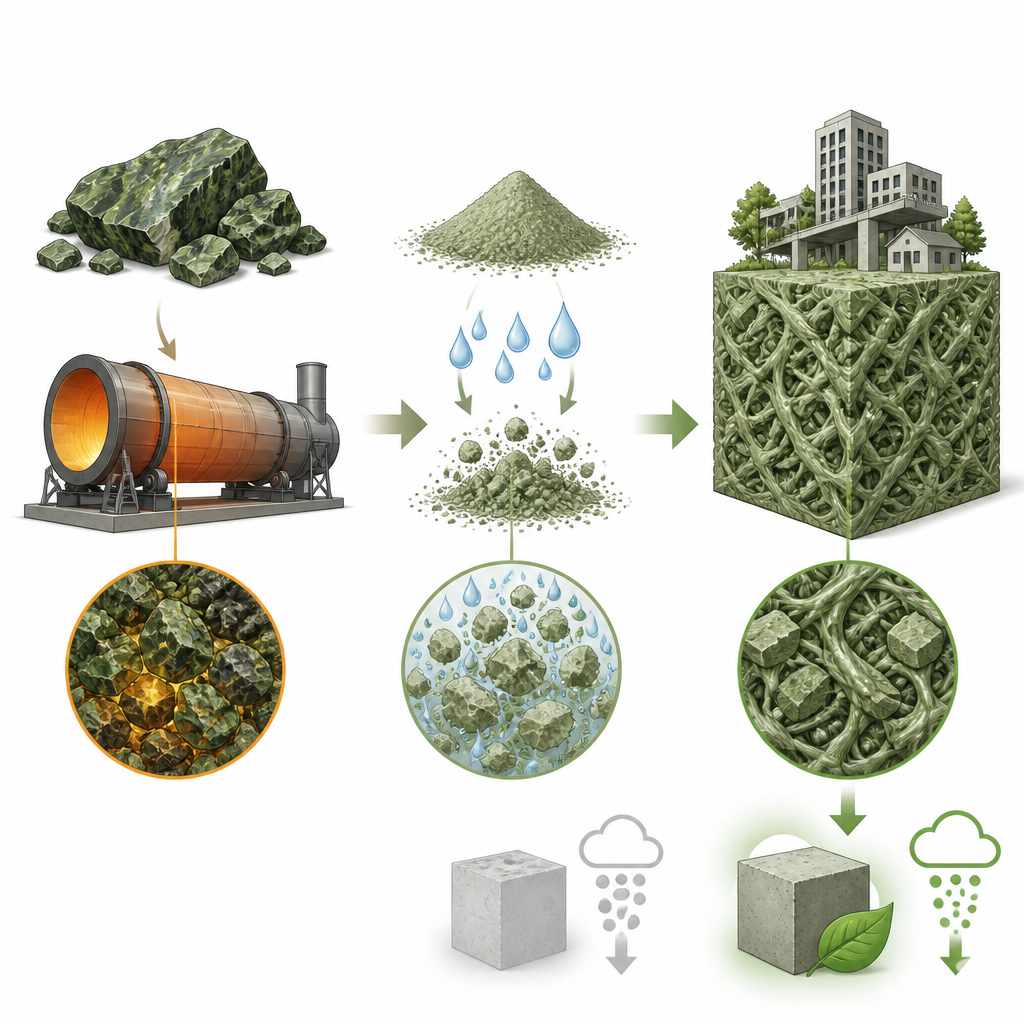
The new binder starts with serpentinite rock from existing quarries. The rock is crushed, heated to about 775 degrees Celsius in a rotary kiln, and then finely ground. This heat treatment partly removes water from the minerals and disrupts their crystal structure, turning them into an X-ray amorphous, highly reactive powder. When this powder is mixed with water, it slowly dissolves and re-forms as very fine magnesium silicate hydrate phases. These new phases knit the material together and give it compressive strength similar to commercial Portland cement, as shown by strength tests over 28 days. Handling on site is broadly similar to standard cement, although the new binder currently needs higher doses of plasticizing additives to achieve good flow at low water content, and tailored admixtures still have to be developed.
Practical performance in real structures
The magnesium silicate binder has some important differences from today’s concrete. The pore water inside hardened material is less alkaline, with a pH around 10 instead of 13. High alkalinity normally helps protect steel reinforcement bars from rust, so this change raises questions for durability. However, other studies on similar binders show that a finer pore structure and low electrical conductivity can offset the lower pH, and the authors suggest using coated steel or alternative fibers where needed. The heat released when the binder hardens is also lower, which could benefit very large concrete elements by reducing cracking. Overall strength and workability make it suitable for many ready-mix and precast uses, though more testing is needed for long-term durability and compatibility with common additives.
Is there enough suitable rock on Earth
To matter for climate, any new binder must be made at vast scale. The team analyzes a global geological database of serpentinite deposits in 36 cement-producing countries. In 28 of them, known resources are large enough to support more than a century of current cement production if fully replaced by the new binder. Some countries could even export material. Where database coverage is poor, such as parts of Africa and South America, the authors complement the data with literature studies, using Egypt and Nigeria as examples. These case studies show that significant serpentinite deposits exist even where maps are incomplete, but they also highlight the need for more detailed local surveys before large investments are made.
How much carbon could this actually save
Because serpentinite contains no built-in carbon dioxide, the new binder avoids the chemical emissions that occur when heating limestone, which today add roughly 600 kilograms of carbon dioxide per ton of conventional cement clinker. It also requires lower kiln temperatures that can be reached with electric heating. Using future energy scenarios for Europe, the authors model how emissions from magnesium silicate binder production fall as power systems switch from fossil fuels to renewable or nuclear sources. If European plants gradually retrofit or replace existing cement kilns so that by 2050 all clinker is magnesium-based and powered by carbon-neutral electricity, cumulative avoided emissions could reach about 2 billion tons of carbon dioxide. Annual emissions from European cement in that scenario fall to just a few million tons per year, a drop of around 97% compared with today.
A possible road to climate-friendly concrete
The study concludes that magnesium silicate binder from serpentinite rock could form the technical basis for near carbon-neutral concrete by mid-century, at least in regions with suitable energy supplies and raw materials. The process fits well with current industrial equipment, avoids dependence on large-scale carbon capture and storage, and taps into widely distributed rock resources. Challenges remain, including detailed durability studies, tailored chemical additives, regulatory approvals, and the sheer pace of plant conversion required. Even so, the work shows that rethinking the minerals behind cement could play a major role in cutting emissions from one of the world’s most important materials.
Citation: Naber, C., Majzlan, J., Moosdorf, N. et al. Magnesium silicate binder shows potential as a carbon-neutral route for cement manufacture. Commun. Sustain. 1, 79 (2026). https://doi.org/10.1038/s44458-026-00085-z
Keywords: low carbon cement, magnesium silicate binder, serpentinite, cement decarbonisation, construction materials