Clear Sky Science · en
Net electricity savings from artificial intelligence depend on deployment efficiency in China’s power system
Why Smarter Power Matters
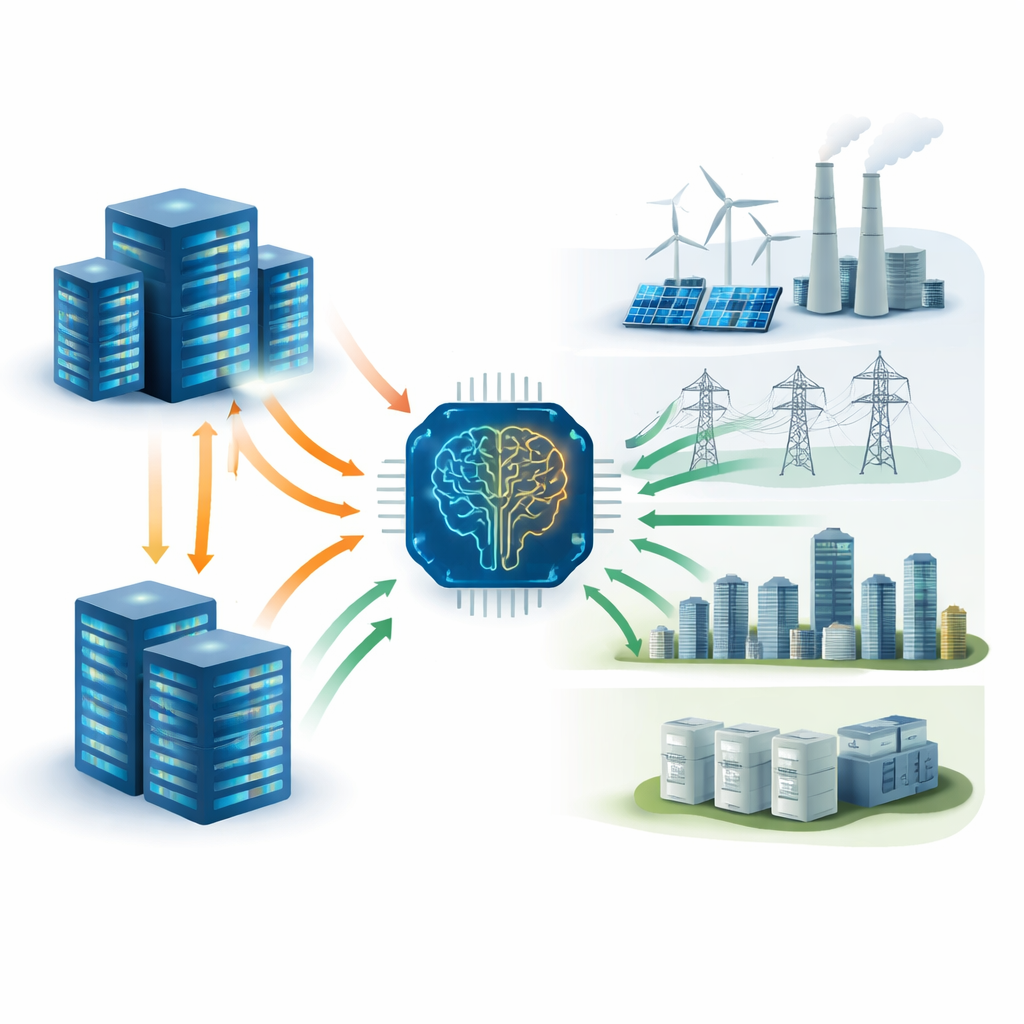
Artificial intelligence (AI) is often portrayed as an invisible brain in the cloud, but behind every clever chatbot or image generator sits a very real stream of electricity. This study asks a question with big consequences for climate and energy planning: can the power savings that AI delivers inside the electricity system outweigh the extra power it consumes in huge data centers? Focusing on China’s rapidly evolving grid, the authors trace how AI could turn from a growing electrical burden into a net saver—if it is deployed efficiently and widely enough.
Two Faces of Artificial Intelligence
The paper begins by outlining a tension. On one side are AI data centers, whose specialized servers can use six to eight times more electricity than traditional machines. As models grow larger and more frequently used, these facilities are becoming a major new source of demand on the grid. On the other side, AI algorithms are being embedded throughout the power system itself—helping forecast wind and solar output, fine‑tune coal plants, manage building heating and cooling, balance industrial loads, and extend battery life. These applications can cut waste and smooth peaks in demand. The core puzzle is whether, taken together, the savings from AI in the grid can cancel or even exceed the electricity that AI computing itself draws.
Measuring the Net Effect Over Time
To tackle this, the researchers build a dynamic assessment model that runs from 2025 to 2060. They estimate AI’s own electricity use from the “bottom up,” starting with projected shipments of AI servers, how long they stay in service, how much power they draw during training and everyday use, and how energy‑efficient data centers become over time. In parallel, they comb through a decade of studies on AI‑enabled power‑saving measures. Using meta‑analysis, they synthesize how much electricity can be saved in seven key practices, such as improving coal plant efficiency, cutting transmission losses, raising building and industrial efficiency, and optimizing battery storage. These savings are then scaled up for China under three different assumptions about how deeply such AI tools spread through the system.
Different Futures for AI and the Grid
The model combines three storylines for AI’s electricity use with three for its saving power, yielding nine possible futures. On the consumption side, a “technology‑driven” path assumes rapid growth in AI computing but strong gains in server chips and cooling systems; a “policy‑constrained” path assumes tight rules that limit expansion and enforce good efficiency; an “inertia” path assumes slower improvement and looser controls. On the saving side, an “efficient” path imagines fast, wide adoption of top‑performing AI tools across power plants, power lines, buildings, factories, and storage; a “typical” path reflects moderate uptake; and an “inefficient” path assumes slower or patchy deployment. Together, these scenarios reveal how both smarter hardware and deeper AI use in operations shape the balance between extra demand and avoided waste.
Where the Biggest Savings Hide
Across the many ways AI can help, the study finds a clear “vital few”: roughly one‑fifth of practices provide more than four‑fifths of total saving potential. Improving building loads, reducing grid line losses, and sharpening renewable energy forecasts stand out as the heaviest hitters. Nationally, under the most optimistic saving assumptions, AI could cut about 15% of China’s projected electricity use by 2060; under typical or inefficient assumptions, that drops to single‑digit percentages. Regional analysis of five provinces shows that areas rich in power generation—like Inner Mongolia with its coal and renewables—benefit most from AI on the supply side, while industrial and service hubs such as Guangdong and Jiangsu reap larger gains from managing demand in buildings and factories.
When AI Becomes a Net Saver
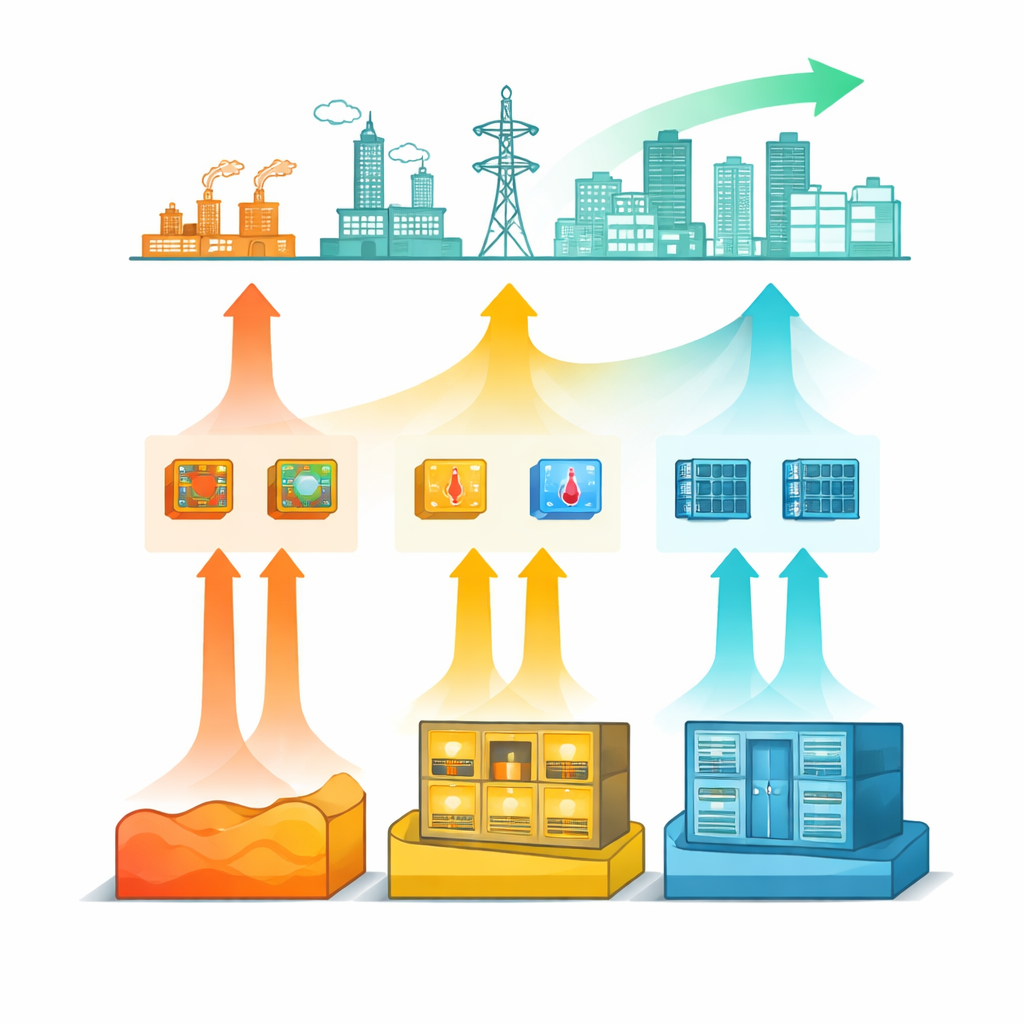
The key metric in the study is “net electricity saving”: the ratio of electricity saved by AI to the electricity AI consumes. A value above 100% means AI is, on balance, reducing strain on the grid. Among all nine futures, only the combination of high deployment of saving applications and strong technology progress in data centers—the Efficient–Technology‑Driven case—delivers this outcome early, reaching about 130% by 2040. In this pathway, rapid rollout of AI across the grid and buildings, combined with highly efficient chips and very low cooling overhead, allows savings to outpace AI’s own demand. Even then, the benefit flattens and slightly declines after 2050 as technologies mature and easy gains are exhausted. In less ambitious futures, net saving is delayed or never achieved within the study period.
What This Means for Everyday Life
For non‑specialists, the takeaway is that AI is not automatically good or bad for the climate. Left to grow inside wasteful data centers with limited use in actual grid operations, it mainly adds to electricity demand. But if paired with aggressive efficiency standards, better hardware, and wide deployment in power plants, power lines, buildings, factories, and storage, AI can more than pay back its own bill in saved kilowatt‑hours. The study suggests that China—and by extension other countries—will need smart policies to push AI in this direction: strict limits on inefficient data centers, incentives for advanced cooling and chips, and strong support for AI tools that curb waste across the power system. Done right, the same technology that threatens to overload the grid could become one of the engines that makes it cleaner and more reliable.
Citation: Zhou, K., Yang, Z. & Hu, R. Net electricity savings from artificial intelligence depend on deployment efficiency in China’s power system. Commun. Sustain. 1, 72 (2026). https://doi.org/10.1038/s44458-026-00080-4
Keywords: artificial intelligence and energy, data center efficiency, power grid optimization, electricity demand forecasting, renewable energy integration