Clear Sky Science · en
Superconducting hybrid energy transmission and storage system and its projected impact on a sustainable energy future
Why this future energy idea matters
As more of our electricity comes from wind and solar power, keeping the lights on becomes trickier. Sun and wind do not always match when and where people need energy, and today’s power lines and storage systems were not built for this new world. This article explores a bold proposal to move and store huge amounts of clean energy using a single high-tech pipeline that carries both electricity and liquid hydrogen, aiming to help countries move toward a fully renewable, low-carbon future.
Today’s clean energy puzzle
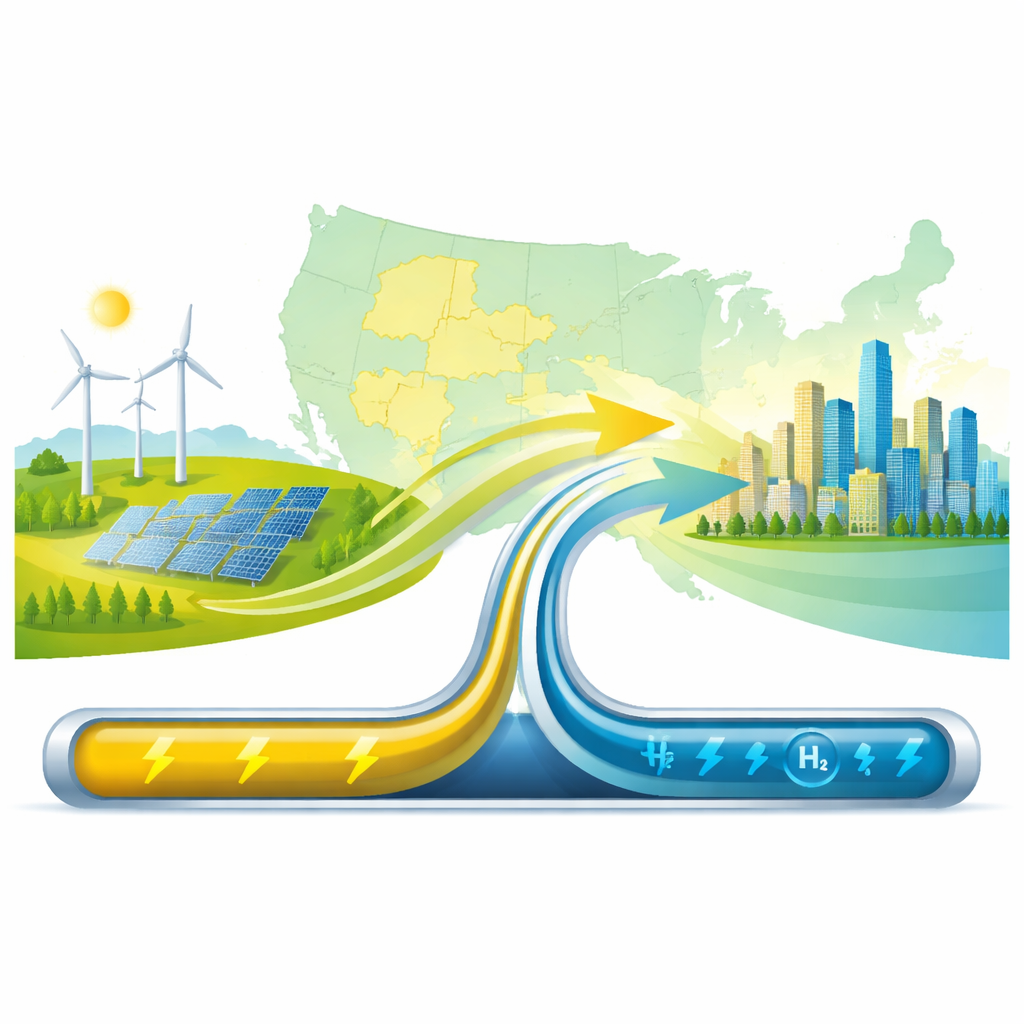
China, like many large countries, has vast regions rich in wind and sun that are far from big cities where most power is used. Real data from all 31 mainland provinces in the first half of 2024 show a clear mismatch: some provinces, such as Neimenggu and Yunnan, generate far more electricity than they consume, while coastal and industrial regions such as Jiangsu, Zhejiang and Guangdong rely heavily on imported power. As China plans to boost wind and solar generation up to sixfold by 2060 and sharply cut fossil fuel use, these gaps are expected to grow. Traditional long-distance power links can help, but they lose energy on the way and face cost, land use and planning hurdles.
A new kind of energy superhighway
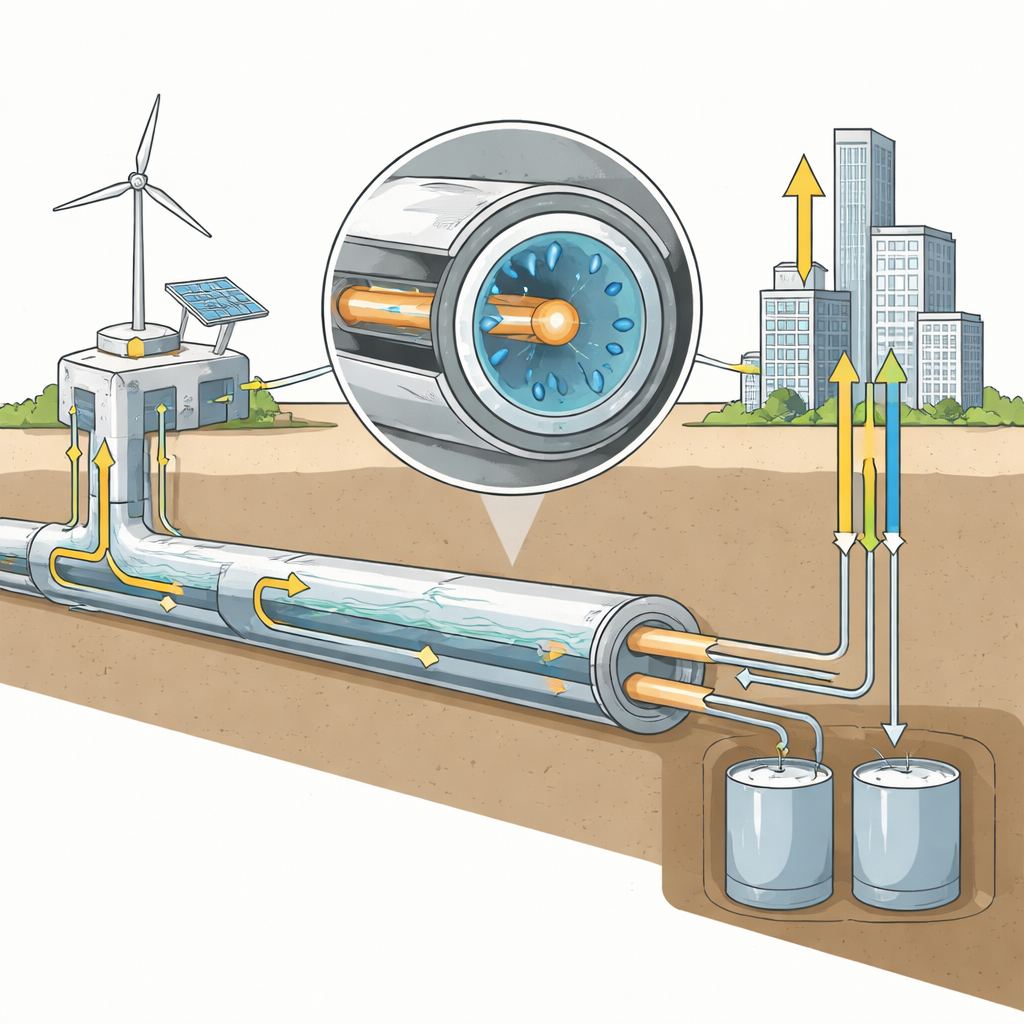
The researchers propose a “hybrid-energy” system built around superconducting cables cooled by liquid hydrogen. Superconductors can carry electricity with almost no resistance, while liquid hydrogen can serve as both an energy fuel and the refrigerant that keeps the cable cold. In this design, surplus wind and solar electricity first supply homes and businesses. Extra power is then used to split water and make hydrogen, which is cooled into liquid form and pumped through the same buried pipeline that hosts the superconducting cable. In effect, the pipeline becomes an energy superhighway that delivers electricity and stored hydrogen together from resource-rich regions to distant demand centers.
A real-world test on an island
To see how this would work in practice, the team modeled a case study on Chongming Island near Shanghai, a coastal region with strong wind and solar resources. They designed a ring of energy “nodes” connected by hybrid-energy pipelines, each 10 kilometers apart and equipped with cooling stations. In the simulated day, wind provides power during early and late hours, solar dominates around midday, and the combined system keeps a steady 42 megawatts flowing to local users. Surplus electricity is converted into more than 13,000 kilograms of liquid hydrogen, which cools the superconducting cables and acts as a large energy store that can be tapped later when the wind drops or the sun sets.
Capacity, losses, and costs
Technical analysis shows that a single superconducting cable in this setup can transmit up to 100 megawatts, roughly twice the capacity of a comparable conventional line, while the liquid hydrogen flow can reach several times the baseline amount by modestly adjusting pipe size and flow speed. At modest power levels and distances around 100 kilometers, traditional high-voltage lines still have lower energy losses and cheaper upfront costs. However, as capacity scales toward hundreds of megawatts, the nearly loss-free cable becomes more attractive: for a 500 megawatt link, the hybrid pipeline’s losses are less than half those of standard cables. When the researchers factor in costs of building and running electrolysers, pipes, tankers and substations, the hybrid system becomes competitive over time for very large, long-lived projects, especially if equipment prices fall as expected.
Narrowing the energy gap between regions
Taking a national view, the authors project China’s power system in 2060 under two scenarios: one with a mostly conventional grid and another where hybrid-energy pipelines are widely deployed. In the conventional case, even with 80 percent of electricity from renewables, many coastal provinces still face big shortfalls and rely on imports, while inland provinces struggle to export their surplus clean power. In the hybrid scenario, the stronger, more flexible transmission and the use of surplus electricity to make hydrogen allow the system to absorb about twice as much renewable power and nearly five times as much hydrogen. This network can ease shortages near major cities, reduce dependence on fossil fuels, and move the country closer to fully meeting electricity demand with renewables.
What this means for a cleaner future
The study concludes that superconducting hybrid-energy pipelines could one day complement or partly replace today’s power lines and fuel transport, offering a way to move large amounts of clean energy efficiently across long distances while also storing it as hydrogen. The approach is not ready for instant rollout: it faces challenges in safety, cryogenic engineering, long-term reliability and upfront cost. Still, if technologies for liquid hydrogen and superconducting cables continue to advance, systems like the one proposed here may become an important tool for balancing uneven wind and solar resources and supporting a future energy system based almost entirely on renewables.
Citation: Chen, X., Chen, Y., Jiang, S. et al. Superconducting hybrid energy transmission and storage system and its projected impact on a sustainable energy future. Commun. Sustain. 1, 77 (2026). https://doi.org/10.1038/s44458-026-00077-z
Keywords: renewable energy, liquid hydrogen, superconducting cables, energy storage, long-distance transmission