Clear Sky Science · en
Geospatial analysis reveals socioeconomic inequities in access to recycling infrastructure in the United States
Why this matters for everyday life
Households across the United States are urged to recycle, yet much of our plastic still ends up in landfills or the environment. This study shows that the problem is not just about personal habits, but about where recycling facilities are built—and who gets fair access to them. The authors use nationwide mapping data to reveal that many lower-income and less-educated communities must travel much farther for their plastic to be sorted and reused, which helps explain why U.S. recycling rates remain low and uneven.
Uneven chances to recycle
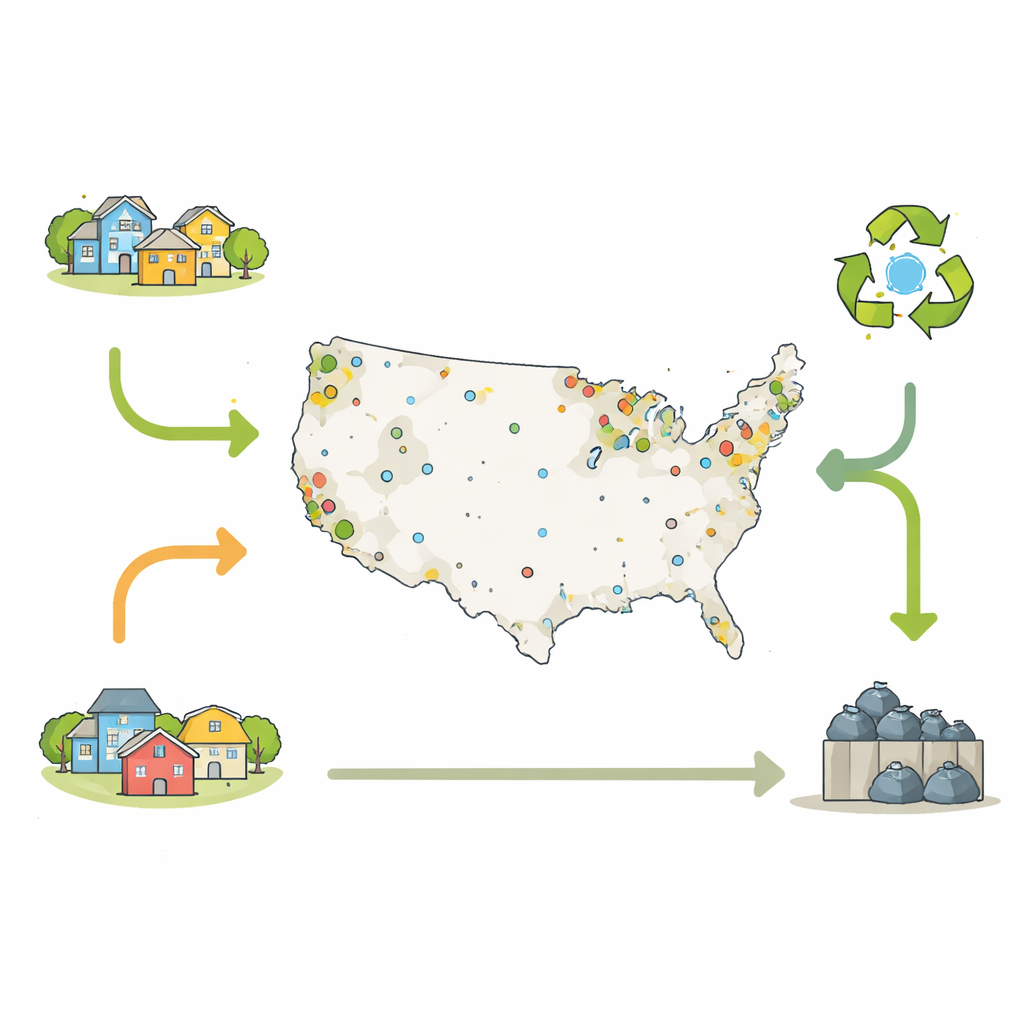
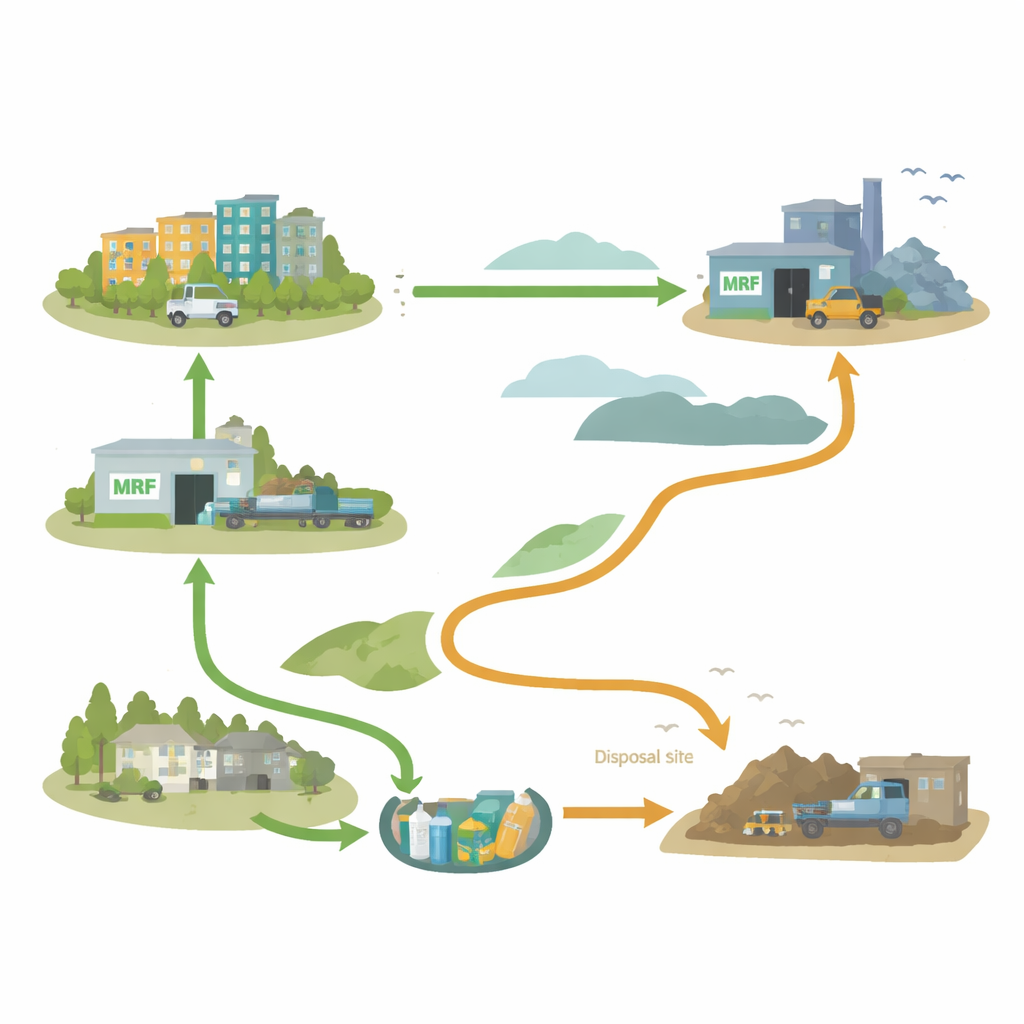
The researchers focus on material recovery facilities, or MRFs, which are the plants that receive mixed recyclables, sort them, and prepare them for further processing. By calculating the distance from roughly 130 million buildings in the contiguous U.S. to the nearest MRF, and combining these data with census information on income and education, they map who actually has convenient access to recycling infrastructure. They find that plastic packaging waste generation is surprisingly similar across income and education levels—people everywhere buy bottled drinks and packaged food—but the ability to recycle that waste is not. Communities near MRFs tend to be 30–55% wealthier and notably more college-educated than those without nearby access.
Where the gaps are biggest
Distance strongly shapes recycling opportunities. On average, a building in the U.S. is about 50 kilometers from the closest MRF, but this hides major regional differences. Some states with many facilities in compact areas, like New Jersey, Connecticut, Massachusetts, and California, keep average distances short and achieve plastic packaging recycling rates around 27–30%, roughly double the national average of 14%. In contrast, large states with sparse infrastructure, including Texas, Montana, Wyoming, and North Dakota, have far fewer facilities, much longer travel distances, and recycling rates that lag far behind. The study also looks farther down the chain, measuring distance from MRFs to plastic reclaimers that turn sorted material into usable feedstock; long hauls here can make recycling uneconomical and further depress performance.
Hidden inequities in who gets served
To understand inequity more clearly, the authors compare areas within the typical access radius of an MRF to "NoMRF" areas outside that range. Across multiple distance cutoffs, the pattern is consistent: neighborhoods with adequate access to MRFs are denser and better off. They show higher household and per-capita incomes, higher wealth scores, more college graduates, and slightly lower income inequality than underserved regions. Meanwhile, high-waste communities that lack MRFs tend to resemble other underserved areas rather than well-served ones, even when they generate more plastic that could be recycled. This suggests facilities are not being placed where they are most needed from a waste perspective, but where economic and social conditions are more favorable for investment and local support.
Policies that can boost results
The study also highlights how public policy can change outcomes. States with container deposit laws, often called "bottle bills," have plastic packaging recycling rates that average about 29%, roughly twice the national level. These programs work alongside infrastructure by rewarding people for returning beverage containers through separate collection systems, which deliver cleaner material into the recycling stream. Statistical tests show that when looking at many factors together—wealth, education, income inequality, and proximity to MRFs—no single factor fully explains recycling rates, underscoring that performance depends on a web of infrastructure, policy choices, and local conditions rather than any one variable alone.
What this means for a fairer future
For everyday residents, the message is that recycling success is shaped as much by the system around them as by their individual effort. The study concludes that plastic waste generation is broadly similar across society, but the opportunities to recycle it are not. Wealthier, better-educated communities enjoy closer access to sorting facilities and, in many cases, supportive state policies, while many high-waste, lower-income regions remain overlooked. The authors argue that closing these infrastructure gaps—by adding facilities in identified “NoMRF” hotspots and pairing them with smart policies—will be essential to making U.S. recycling both more effective and more equitable, while broader efforts to reduce plastic use at the source remain the most powerful long-term solution.
Citation: Mousania, Z., Miles, M., Vedantam, A. et al. Geospatial analysis reveals socioeconomic inequities in access to recycling infrastructure in the United States. Commun. Sustain. 1, 57 (2026). https://doi.org/10.1038/s44458-026-00069-z
Keywords: plastic recycling, environmental justice, waste infrastructure, geospatial analysis, circular economy