Clear Sky Science · en
Cheap-talk and left-wing political orientation boost cooperative sustainability when politically outnumbered
Why Politics Matters for Protecting Shared Resources
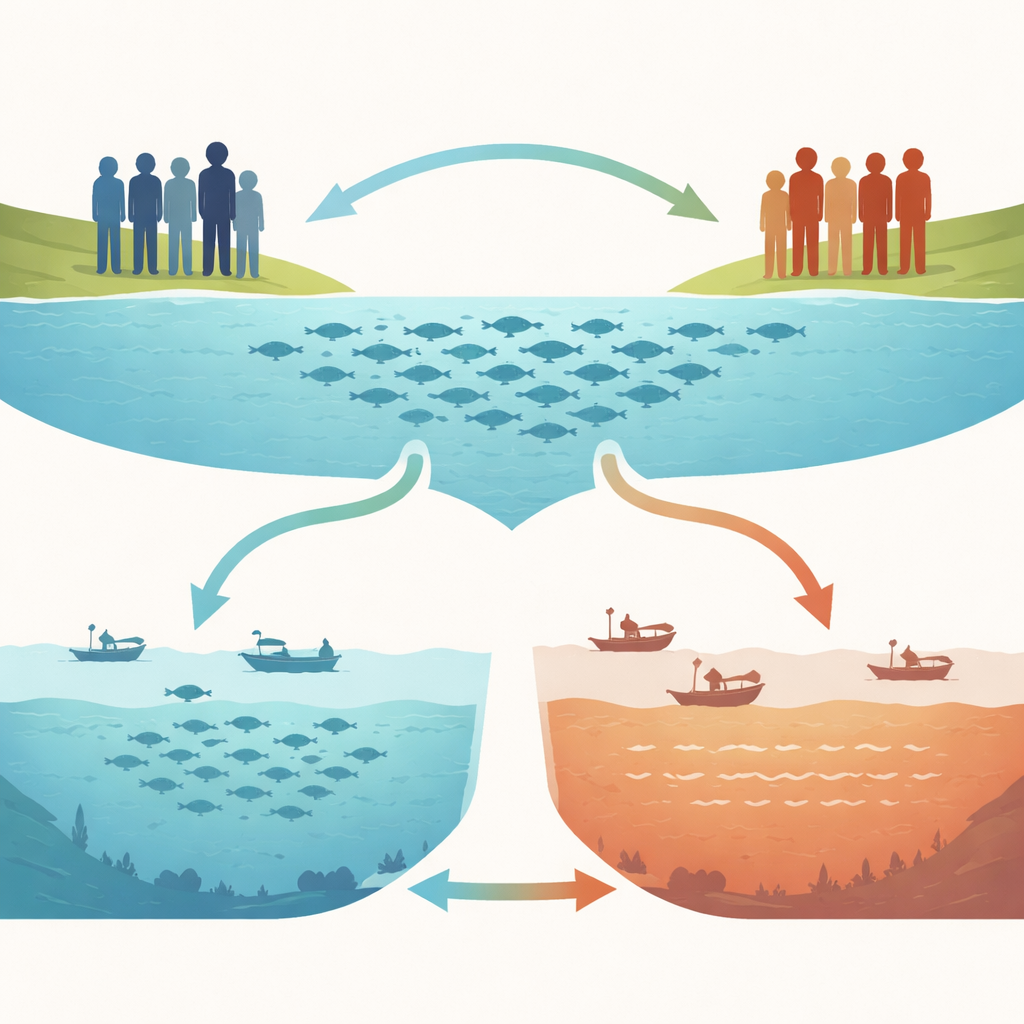
Imagine a small group of people sharing a fishing lake. Everyone can earn money by catching fish, but if they are too greedy, the fish will disappear for everyone. Now add a twist: half the group are Democrats, half are Republicans, and they know it. Will they still work together to keep the lake healthy? This study uses an online fishing game to explore how political identity and simple communication shape people’s willingness to cooperate for environmental sustainability.
Testing Cooperation in a Virtual Fishing World
The researchers recruited 324 Americans who identified as either Democrat or Republican and placed them in online groups of four to play a fishing game called FISH 6.0. Each fish caught was worth real money, but if the group overfished, the shared resource collapsed and the game ended early. Although every group was actually made up of either four Democrats or four Republicans, participants were told that their group was either fully aligned with their own party, evenly mixed between parties, or dominated by the other party. This allowed the team to study how people behave when they feel surrounded by allies, evenly split, or politically outnumbered.
Talking Without Strings Attached
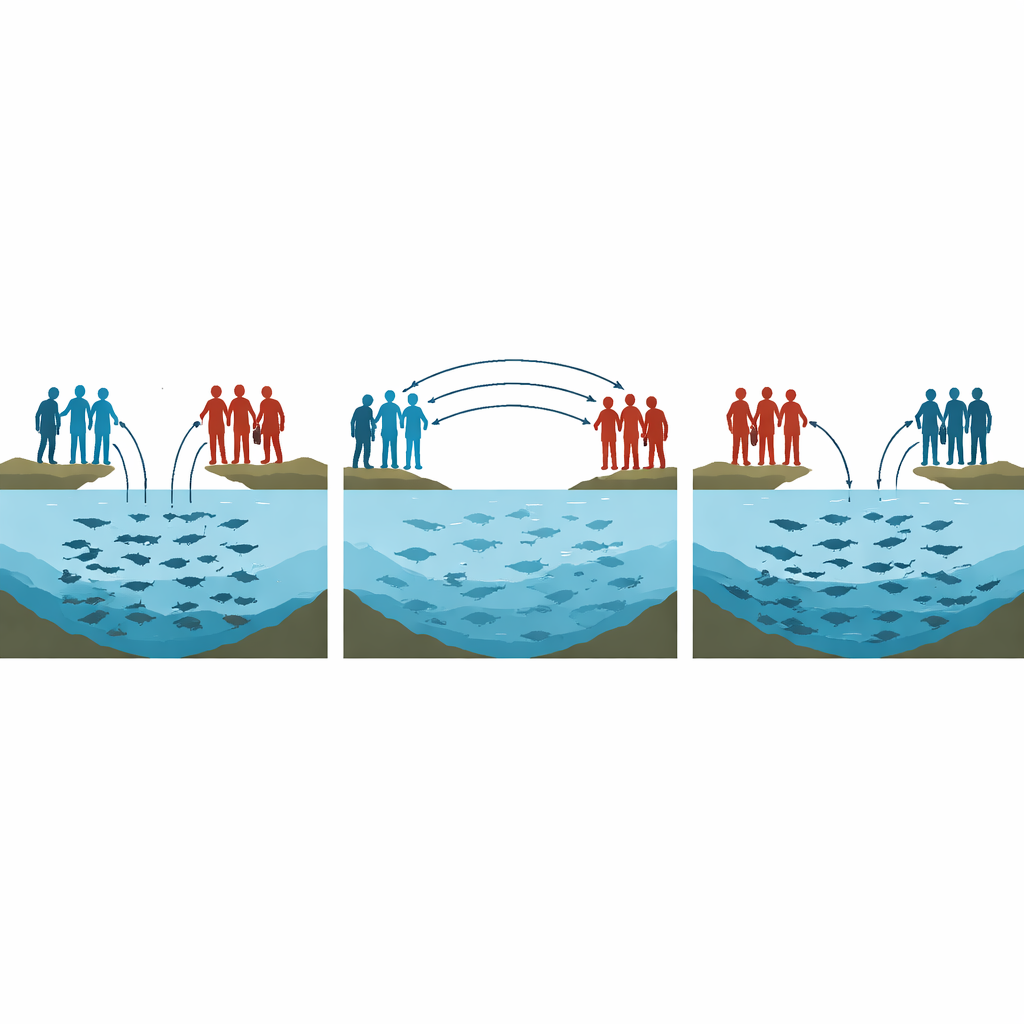
A central feature of the experiment was a simple form of communication called “cheap-talk.” In some groups, players could send cost-free numerical pledges about how many fish they intended to catch in the next round. These promises were not enforced and carried no direct consequences if broken, yet they allowed players to signal intentions and gauge whether others were aiming for short-term profit or long-term sustainability. Other groups had no opportunity to communicate at all, forcing players to rely only on guesses about one another’s behavior.
Who Cooperates When Politics Are Mixed
The study found that Democrats and Republicans behaved similarly when they believed everyone in their group shared their party. In these politically aligned groups, both sides cooperated at comparable levels—especially when they could communicate their intentions. But differences appeared when groups were politically mixed or when participants believed they were the lone member of their party. In those settings, Democrats tended to fish more cautiously and sustain the resource better than Republicans, particularly when they felt politically outnumbered. Republicans, by contrast, often showed almost no cooperation in groups without communication, regardless of group composition.
When Simple Conversation Helps—and When It Does Not
Cheap-talk turned out to be a powerful tool, but only under certain conditions. In groups that were perceived as politically aligned, communication sharply boosted cooperation: players were far more likely to limit their catches and keep the fish population going for multiple seasons. Cheap-talk also helped when participants believed they were in a political minority, allowing them to coordinate with what seemed to be the majority’s strategy and achieve more sustainable outcomes. However, in evenly balanced groups—two Democrats and two Republicans—communication made little difference. Even with the chance to share pledges, these groups often failed to protect the shared resource, suggesting that mutual suspicion or clashing expectations between the two sides can neutralize the benefits of talking.
What This Means for Real-World Sustainability
In everyday life, many environmental challenges—from fisheries to forests to the climate—look a lot like this virtual lake: people with different political views must decide whether to act for quick gain or long-term stability. This study shows that perceived political makeup strongly shapes those choices. When people believe they are among allies, or when there is a clear majority and minority, simple, low-cost communication can help bridge divides and support cooperative behavior. But in perfectly balanced, highly polarized settings, mistrust may run so deep that even open conversation struggles to prevent overuse. For a lay observer, the takeaway is that brief, non-binding exchanges about intentions—on social media, in community meetings, or in local groups—can still nudge people toward shared environmental goals, especially when they see a clear direction within the group. Yet lasting sustainability may also require tackling the deeper partisan suspicions that make cooperation hardest precisely where political lines are most evenly drawn.
Citation: Hansen, R.R.S.F., Koomen, J.A., Buck, B. et al. Cheap-talk and left-wing political orientation boost cooperative sustainability when politically outnumbered. Commun. Sustain. 1, 63 (2026). https://doi.org/10.1038/s44458-026-00062-6
Keywords: political polarization, environmental cooperation, common-pool resources, Democrats and Republicans, communication and trust