Clear Sky Science · en
Rapid removal of mining waste-contributed phosphate from estuarine waters by pre-existing apatite in north Manatee County, Florida
When a Pollution Scare Meets a Hidden Protector
In 2021, residents around Tampa Bay watched nervously as hundreds of millions of litres of wastewater from a phosphate fertilizer site were deliberately released to prevent a structural collapse. People feared this chemical-rich water would trigger long-lasting damage to the bay, fueling toxic algae and choking marine life. This study follows what actually happened to one key ingredient in that wastewater—phosphate—and reveals that a natural mineral already in the bay’s sandy bottom quietly soaked up most of the threat.
A Sudden Flood of Fertilizer Ingredients
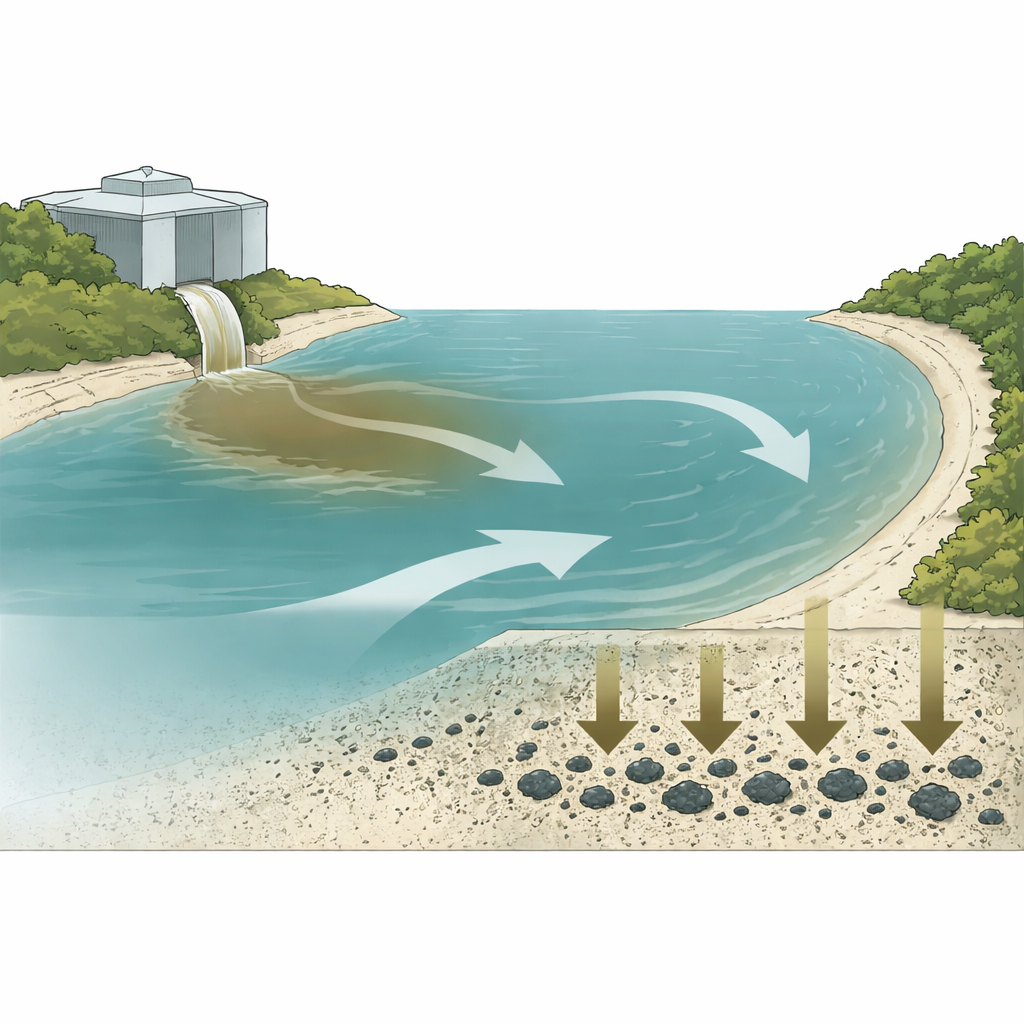
The incident began at the Piney Point phosphogypsum stack, a large waste pile from decades of fertilizer production in Manatee County, Florida. To avoid a catastrophic breach, authorities ordered an emergency discharge of roughly 800 million litres of acidic, nutrient-rich “stack water” into nearby Tampa Bay over ten days. This water carried high levels of nitrogen and phosphate, the same nutrients found in agricultural fertilizers. While nitrogen-driven algal blooms soon made headlines, the long-term fate of the huge pulse of phosphate—known for driving harmful algae and oxygen loss—remained unclear. The authors set out to track where that phosphate went and whether it continued to pose a risk.
Reading the Bay’s Sandy Archive
From mid-2021 to 2024, the researchers repeatedly sampled surface sediments along the eastern shoreline of Tampa Bay, spanning locations north and south of the discharge point and including distant control sites. They measured how much easily removable phosphate could be extracted from these sediments and compared it with distance and predicted flow paths of the released water. The pattern was striking: sites closest to, and down-current from, the discharge showed much higher phosphate levels—often several times those at more distant or up-current sites. Meanwhile, measurements of dissolved phosphate in the bay’s water were below detection. Together, these observations pointed to the sediment, rather than the water column, as the main repository of the released phosphate.
The Quiet Work of a Common Mineral
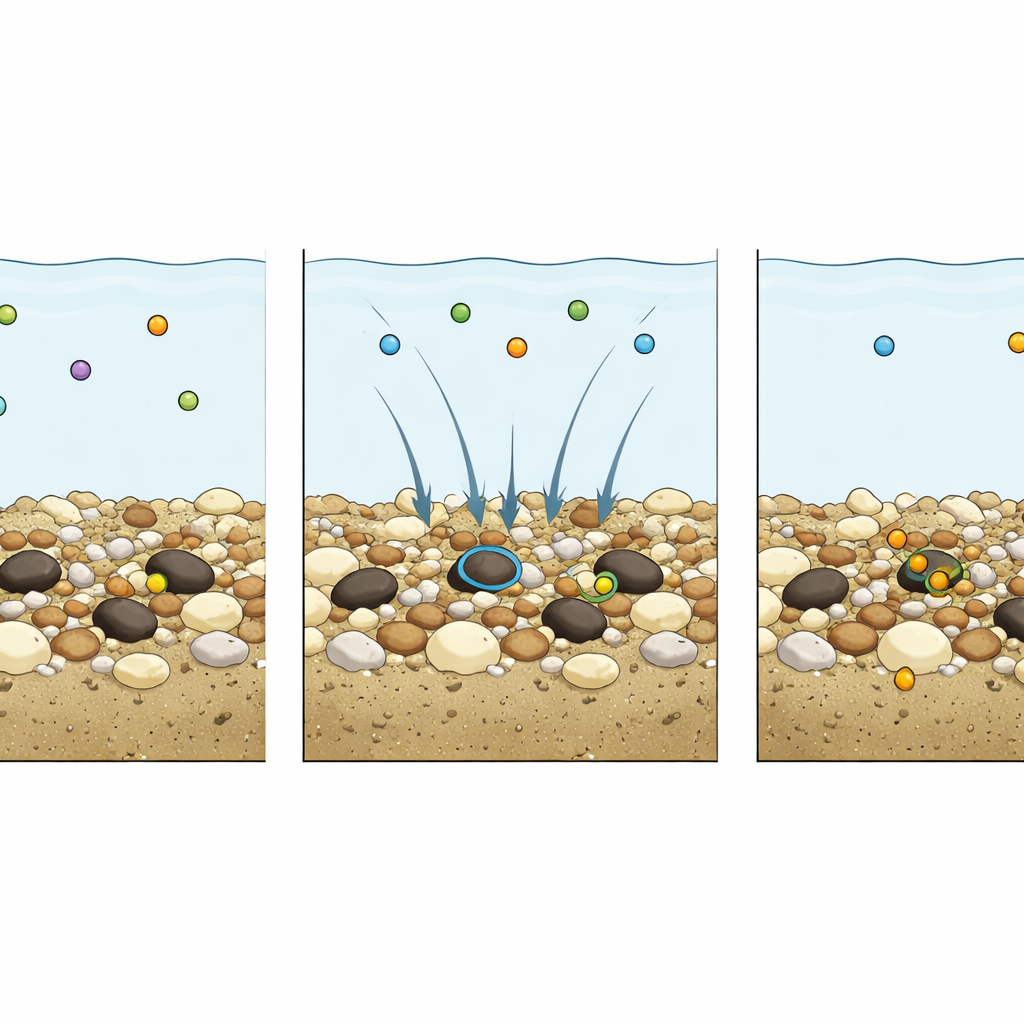
The team then looked more closely at what the sediments were made of. Using imaging and X-ray diffraction, they found that most grains were quartz and calcite, but some sites also contained notable amounts of a phosphate-rich mineral called apatite, derived from Florida’s naturally phosphatic “Bone Valley” deposits. To see how different minerals handle phosphate, the researchers performed lab experiments mixing simulated stack water with artificial seawater and various solid materials: pure apatite, quartz sand, calcite, and natural sediments from the bay. In the absence of any solids, phosphate stayed in solution for weeks, even when conditions favoured mineral formation. When solids were present, however, phosphate levels in the water dropped sharply—fastest and most completely when apatite was available, with much of the removal happening within the first hour.
A Natural Sponge with Long Memory
Field data and experiments together suggest that pre-existing apatite grains in the seabed acted as powerful “sinks” for the stack-derived phosphate. Instead of forming new phosphate minerals directly from the water, the released phosphate likely first stuck to the surfaces of apatite and other grains, then gradually crystallized into more stable calcium phosphate coatings. Sediment cores from nearby studies show phosphate-rich layers aligned with the 2021 event, and even with an earlier 2003 release, indicating that once phosphate is captured in this way, it can stay locked in place for many years. A simple mass-balance estimate shows that the amount of phosphate stored in a thin layer of enriched sediment is comparable to the total phosphate released, meaning the seabed can account for nearly all of the input.
Lessons for Future Spills and Cleanups
For non-specialists worried about the long-term consequences of the Piney Point discharge, the study offers cautious reassurance: because Tampa Bay’s sediments already held apatite, most of the extra phosphate was rapidly removed from the water and kept out of repeated circulation, limiting prolonged ecological damage. At the same time, the findings point to a proactive strategy for managing similar wastewater elsewhere. By deliberately adding finely ground apatite or phosphate-rich mining by-products to contaminated waters, managers might speed up phosphate removal in a controlled way before a crisis forces an emergency release. In other words, a naturally occurring mineral that helped Tampa Bay dodge a worst-case scenario could also become a practical tool for preventing future nutrient disasters.
Citation: Major, J.D., Feng, T. & Pasek, M.A. Rapid removal of mining waste-contributed phosphate from estuarine waters by pre-existing apatite in north Manatee County, Florida. Commun. Sustain. 1, 61 (2026). https://doi.org/10.1038/s44458-026-00060-8
Keywords: phosphate pollution, Tampa Bay, apatite minerals, wastewater spills, estuarine sediments