Clear Sky Science · en
Happiness efficiency rises with better working conditions, social support and access to nature
Why Happiness per Dollar and Hour Matters
Many people in rich countries already use more energy and materials than the planet can safely provide, yet they are not necessarily happier. This study asks a fresh question: instead of chasing ever more income, how can we get more happiness out of the money, health, and education we already have? By looking at how efficiently people in Japan turn their resources into life satisfaction, the authors show that good jobs, supportive relationships, and access to nearby nature can boost well-being without demanding more from the Earth.
From More Growth to Better Lives
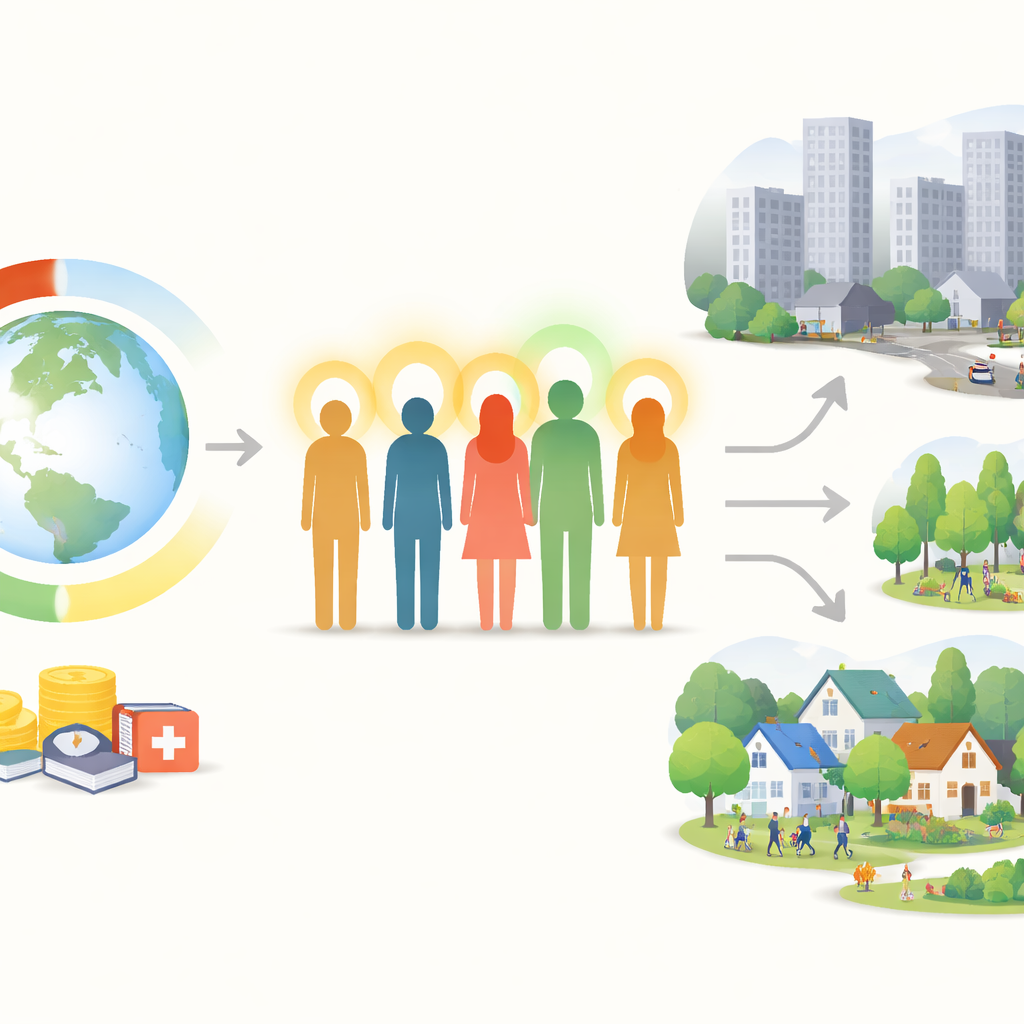
Traditional measures of progress, such as gross domestic product (GDP), track how much an economy produces but say little about whether people actually feel that their lives are going well. Responding to the "Beyond GDP" movement, the authors focus on "happiness efficiency": how effectively individuals convert key resources—income, education, and health—into subjective well-being. Using a large 2023 internet survey of adults across Japan, they first calculate each person’s efficiency score and then ask which life circumstances help some people feel more satisfied than others, despite similar levels of material resources. This approach treats happiness almost like a product and asks who uses their inputs wisely and who ends up wasting them.
Measuring How Well People Use What They Have
To quantify happiness efficiency, the study borrows a tool usually used to judge how well factories turn inputs into outputs. Here, the inputs are a person’s income, years of schooling, and self-rated health, and the output is their reported life satisfaction or their score on the widely used Cantril ladder of well-being. In simple terms, people who report unusually high happiness for their level of resources are considered highly efficient, while those with low happiness given similar conditions are inefficient. The results show wide variation: on average, people achieve less than half of the possible happiness that others in similar situations reach, suggesting significant room to improve well-being without raising incomes or resource use.
Work, Friends, Home, and Nature as Hidden Boosters
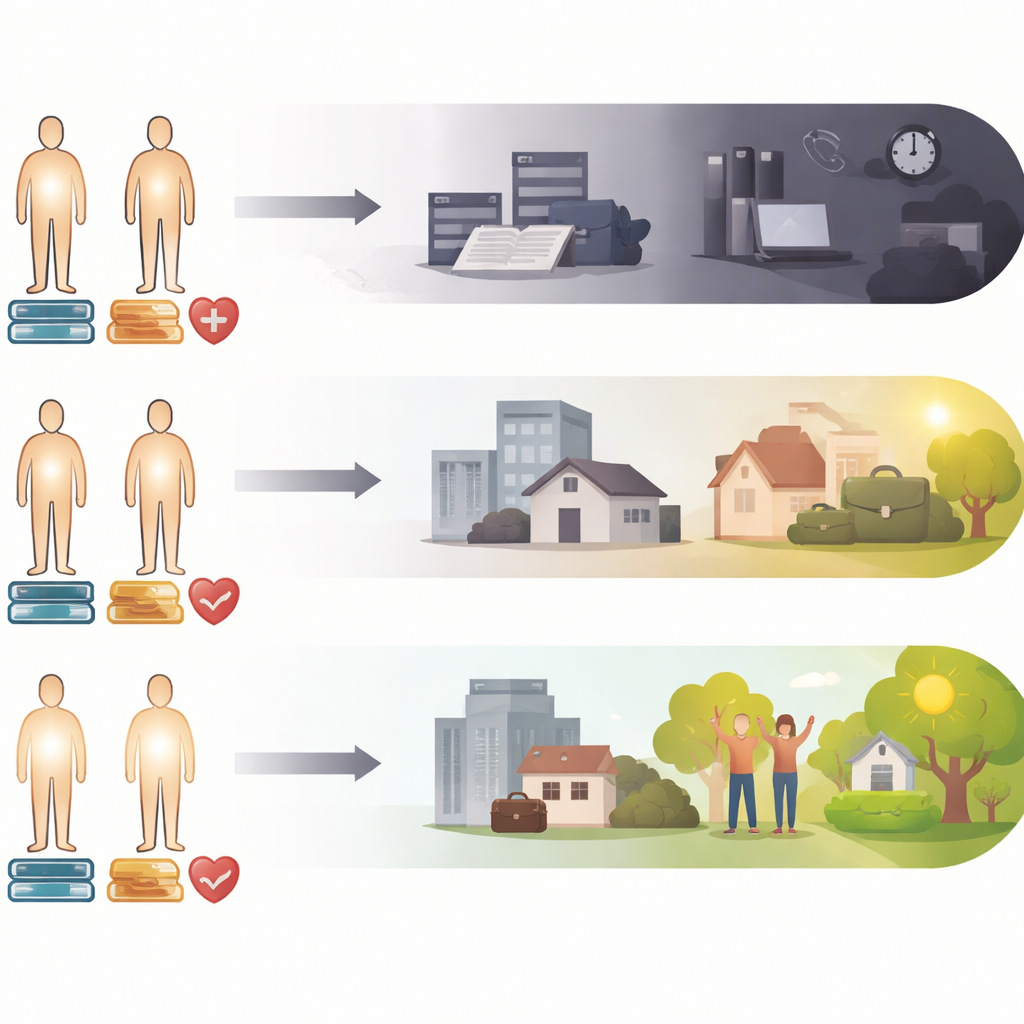
The study then explores what separates high-efficiency individuals from low-efficiency ones. Job situation emerges as a major factor. Regular full-time employees, even after accounting for their income and working hours, tend to be less efficient: something about standard full-time work in Japan appears to dampen happiness. In contrast, full-time homemakers show higher efficiency. A strong sense of work–life balance raises efficiency for everyone, especially women, indicating that having time and energy left over after work is crucial. Social support—having friends or relatives who can help in times of need—also stands out as a powerful booster, as does satisfaction with one’s housing. These findings point to the importance of everyday surroundings and relationships, not just paychecks.
Greener Neighborhoods and Less Focus on Stuff
The natural environment around one’s home also matters. By combining detailed land-cover maps with respondents’ locations, the researchers show that people living in greener areas, with more nearby fields, forests, and other vegetation, tend to use their resources more effectively to feel satisfied with life. Safety and trust in public institutions play smaller but still positive roles. Perhaps most striking is the role of values: people with stronger materialistic attitudes—those who place high importance on owning and buying things—tend to have lower happiness efficiency. Even when income and health are the same, those who care less about possessions and more about experiences, relationships, and nature appear better at turning their circumstances into lasting well-being.
What This Means for People and Policy
For a layperson, the takeaway is encouraging: you do not always need more money to feel better about your life. Instead, improving how you spend your time, where you live, and whom you connect with can raise your "happiness per unit" of income and health. For policymakers, the study suggests that reforms that ease work pressure, strengthen social ties, improve housing and neighborhood quality, and protect urban green spaces can make societies happier without increasing environmental burdens. In a world facing tight planetary limits, focusing on work–life balance, community, safety, and nature offers a way to upgrade quality of life while keeping resource use in check.
Citation: Tsurumi, T., Mizobuchi, H., Kumagai, J. et al. Happiness efficiency rises with better working conditions, social support and access to nature. Commun. Sustain. 1, 53 (2026). https://doi.org/10.1038/s44458-026-00059-1
Keywords: subjective well-being, work–life balance, social support, green spaces, sustainable lifestyles