Clear Sky Science · en
Probing and tuning spatiotemporal pH evolution in aqueous zinc ion batteries
Why Water-Based Batteries Matter
A future powered by solar panels and wind turbines needs huge, safe batteries to smooth out the ups and downs of energy supply. Aqueous zinc-ion batteries, which use water-based liquids and inexpensive zinc metal, look like a promising option for grid-scale storage. But inside these batteries, the acidity of the liquid—described by pH—keeps shifting in space and time, quietly corroding parts and wasting energy. This review explains how those hidden pH changes arise, how they damage the battery, and what scientists are doing to see and control them, with the goal of making water-based batteries last long enough for real-world use. 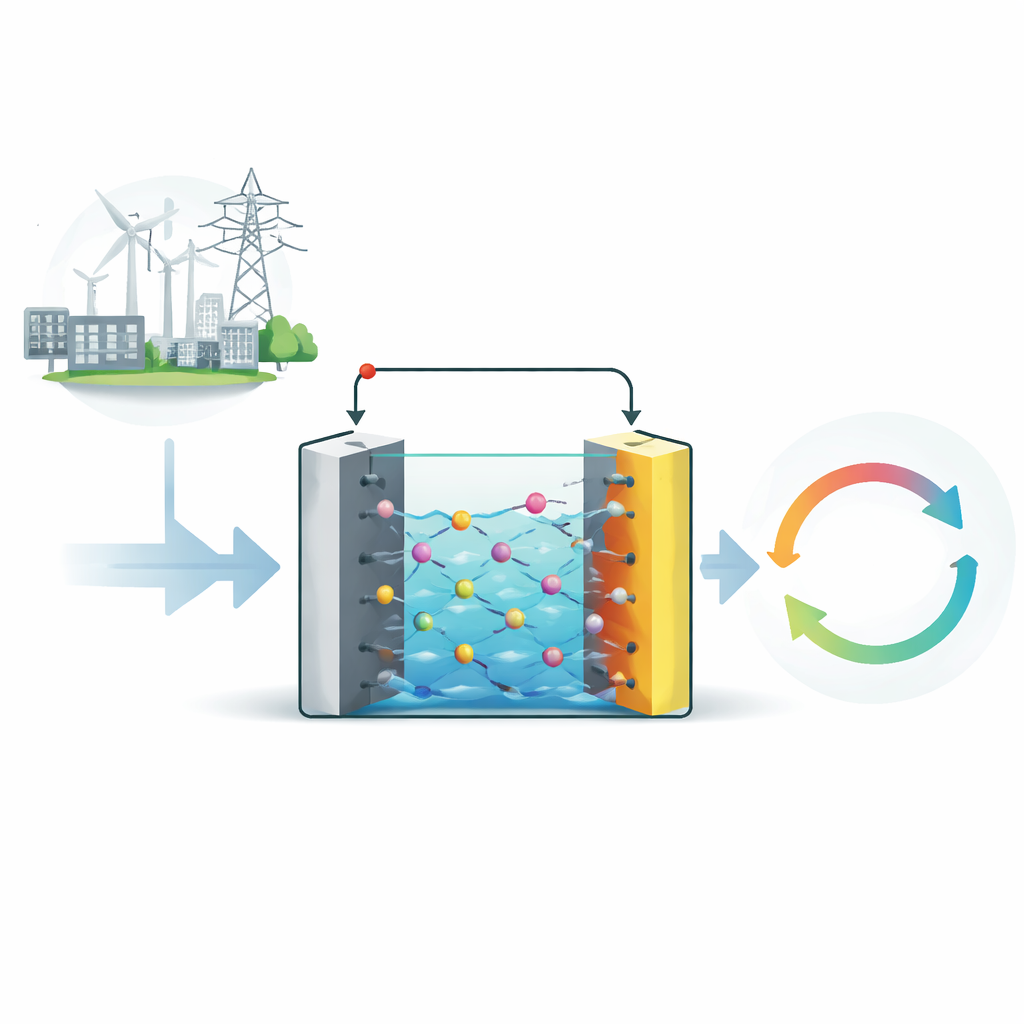
How Water and Zinc Store Energy
At first glance, an aqueous zinc-ion battery seems simple: zinc metal on one side, a manganese oxide or similar material on the other, and a water-based salt solution in between. When the battery charges and discharges, zinc ions shuttle through the liquid while electrons flow through an external wire, storing and releasing energy. Because the liquid is mostly water, the battery is non-flammable, can be built without expensive dry rooms, and uses abundant, low-cost elements. These advantages have driven a surge of research attention as grids look for safer alternatives to conventional lithium-ion batteries for large stationary storage.
The Hidden Swings in Acidity
Beneath that simplicity, the water itself is constantly reacting. At the zinc side, some of the electrical current drives water to split and form hydrogen gas, leaving behind hydroxide species that make the nearby liquid more basic. These local changes in pH promote the growth of unwanted compounds that coat the zinc surface and disrupt smooth metal deposition, eventually leading to rough, tree-like growths and wasted active material. On the manganese side, the situation is just as dynamic. Depending on the applied voltage, protons may enter and leave the solid, manganese ions may dissolve into the liquid, and oxygen gas can form at very high voltages—all of which locally make the liquid either more acidic or more basic. The result is a patchwork of acidity levels near both electrodes that shifts during every charge and discharge cycle, driving corrosion, loss of active material, and declining capacity.
Steering the Battery’s Inner Climate
To tame these swings, researchers are learning to “engineer the weather” inside the battery. One approach adds buffering molecules to the liquid—small organic compounds or simple salts that can grab or release protons, softening sudden changes in pH and discouraging harmful by-products on the zinc surface. Another strategy redesigns how zinc ions are surrounded by water and salt ions so that water becomes less chemically active and less likely to split, for example by using highly concentrated salts or carefully chosen co-solvents. Scientists are also building protective skins on the zinc surface, known as interphases, that form in place during operation. These thin layers let zinc ions pass but block the direct contact between bare metal and the liquid, reducing gas formation, smoothing metal growth, and keeping local pH in a safer range. On top of that, specially chosen alloy coatings and crystal orientations can guide zinc to deposit evenly and resist the side reactions that drive pH extremes.
Watching Acidity Change in Real Time
Because these processes unfold over micrometers and milliseconds, progress depends on better ways to “see” pH inside a working cell. Early experiments simply dipped pH probes into open cells, capturing only the average acidity of the liquid. Newer approaches place tiny electrodes directly against one electrode, or add color-changing dyes to the liquid and watch the color shift during cycling, revealing where regions become more acidic or more basic. The authors highlight a broader toolkit borrowed from other fields: special fluorescent molecules that glow differently at different pH, surface-sensitive optical methods that track how water is arranged at interfaces, and tiny transistor-like sensors whose electrical response reflects local acidity. Combined, these techniques can map pH variations across the battery, down to the thin layers where ions first meet the solid surfaces. 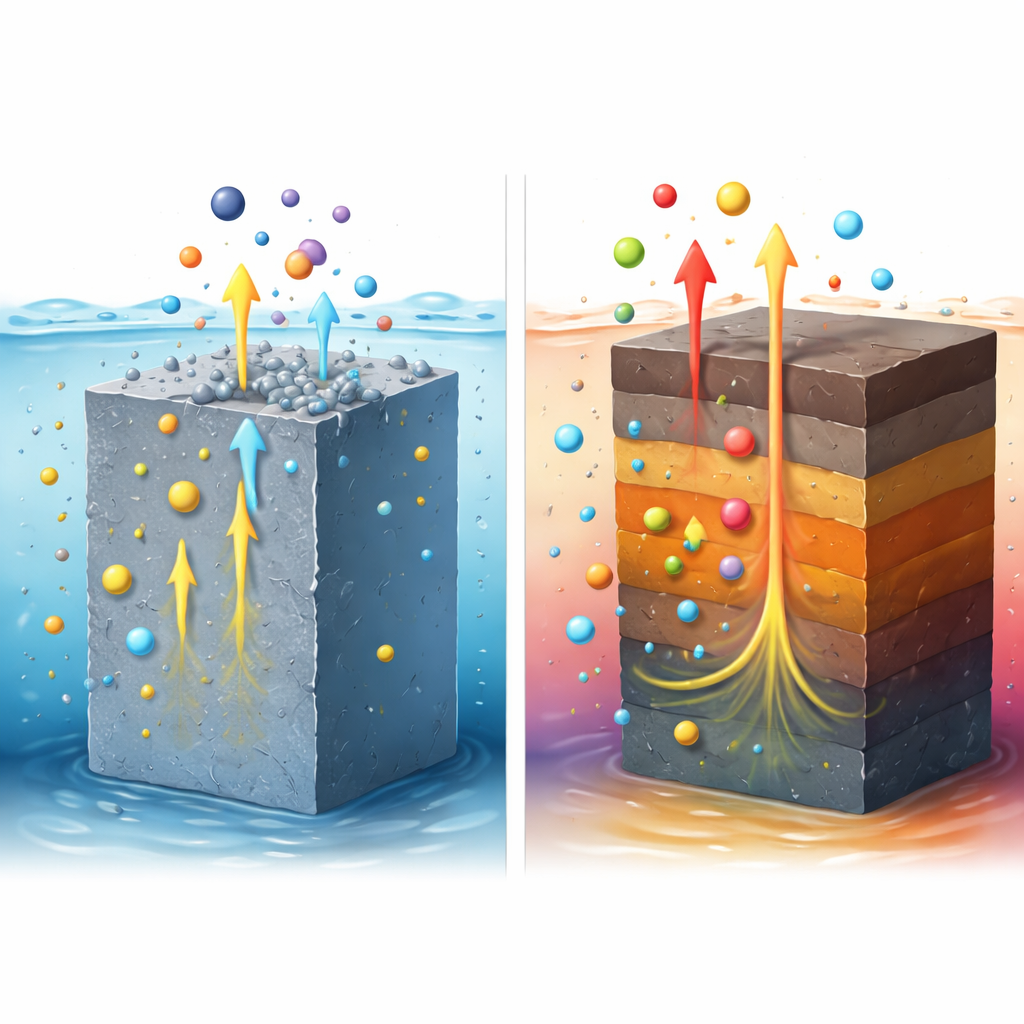
Linking Data, Models, and Smart Design
Looking ahead, the review argues that the most powerful advances will come from combining these pH-measuring tools with high-resolution imaging, X-ray and vibrational spectroscopy, and data-driven models. By feeding experimental maps of acidity into physics-based simulations and machine-learning algorithms, researchers can reconstruct how pH evolves in space and time and connect those patterns to efficiency and lifetime. That insight will guide practical choices: which liquid mixtures best calm the inner chemistry, which electrode coatings keep the interface stable, and what operating voltages avoid the worst side reactions. In simple terms, the article concludes that if we can probe and gently steer the acidity landscape inside aqueous zinc batteries, we can turn pH from a hidden cause of failure into an adjustable knob—helping water-based, zinc-powered batteries become reliable workhorses for the clean energy grid.
Citation: Xue, Z., Jagadeesan, S.N., Zheng, X. et al. Probing and tuning spatiotemporal pH evolution in aqueous zinc ion batteries. npj Energy Mater. 1, 3 (2026). https://doi.org/10.1038/s44456-026-00003-7
Keywords: aqueous zinc-ion batteries, pH dynamics, electrolyte design, battery diagnostics, grid energy storage