Clear Sky Science · en
Machine learning-based mechanics of TPMS architected materials driven by unit-cell geometric features
Shaping Matter from the Inside Out
From lightweight airplane wings to heat-managing electronics, engineers increasingly rely on “architected materials” whose performance comes not from exotic chemistry but from intricate inner geometry. This article explores how a new machine-learning framework can read those internal shapes directly from computer designs and predict how stiff, strong, and thermally conductive the material will be—all without costly trial-and-error simulations. For non-specialists, it offers a glimpse of how future materials may be designed on a laptop by tuning just a few simple shape knobs.
Why Inner Geometry Matters
Architected materials, often called metamaterials, are built from repeating three-dimensional patterns inside a solid, a bit like microscopic scaffolding. Here the focus is on a family of smooth, wavy structures known as triply periodic minimal surfaces (TPMS). These shapes, inspired in part by natural forms such as insect shells and biological membranes, spread material through space with zero mean curvature, which helps avoid stress hotspots and supports efficient heat flow. By simply changing the internal pattern—without altering the base metal—engineers can dial in very different stiffness, strength, and energy absorption, making TPMS attractive for mechanical components, impact protection, and cooling devices.
Describing Complex Shapes with Simple Numbers
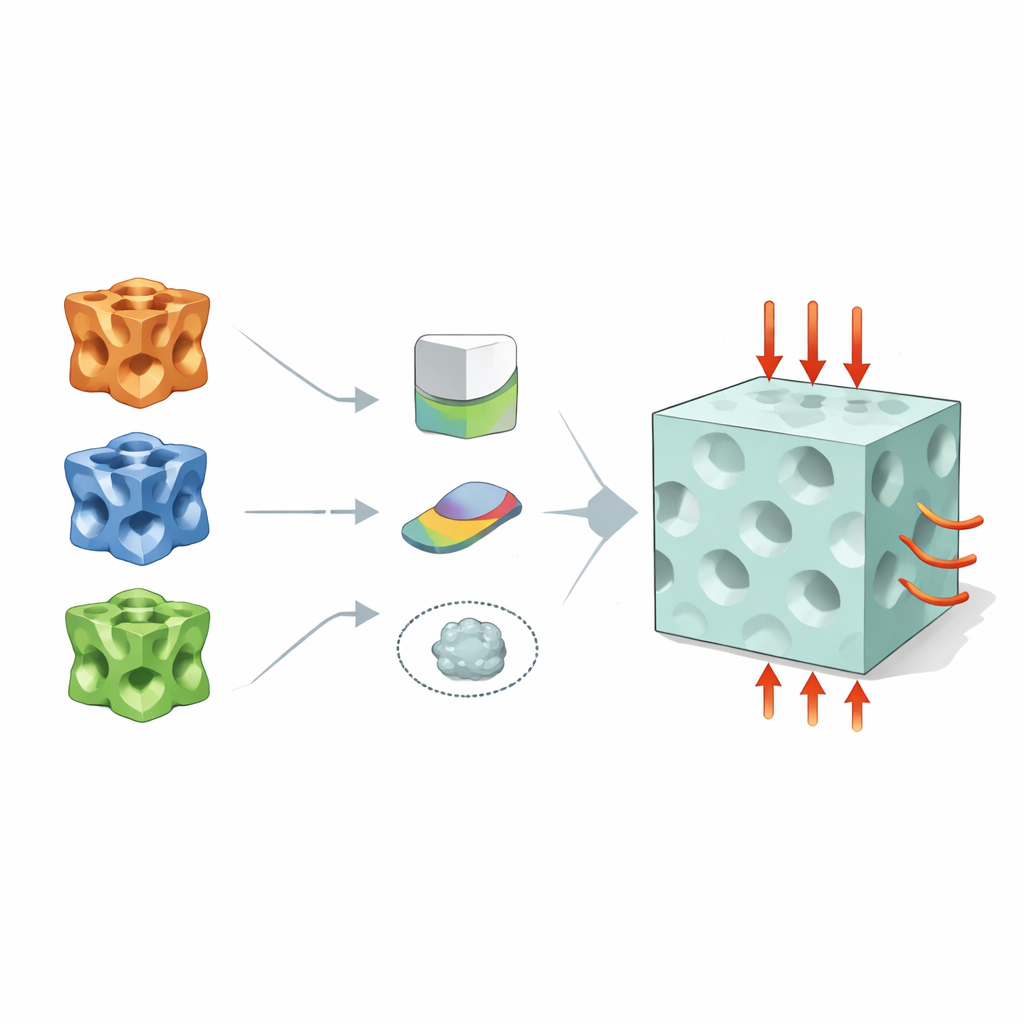
Although TPMS patterns look dauntingly complex, the authors show that their essential mechanical behavior can be captured by a compact set of geometric measurements. They build a database of nine well-known TPMS unit cells, each simulated at several densities, and compute features that any designer can extract from a computer-aided design (CAD) model. These include how much of the unit cube is filled with material (volume fraction), how much inner surface area the pattern provides, how “compact” its surface is compared with a sphere of equal volume, and how mass is distributed through the cell via moments of inertia. They also introduce shape-distance metrics: by comparing the TPMS surface to a reference sphere, they capture how irregular or heterogeneous the geometry is in space.
Linking Shape to Stiffness, Strength, and Heat Flow
Using detailed finite element simulations, the team evaluates each design’s effective Young’s modulus (how it stretches), shear modulus (how it resists sliding), yield strength (when it begins to deform permanently), and thermal conductivity. Different TPMS patterns occupy distinct regions of this performance landscape. For instance, some topologies are relatively soft in simple tension but excel under shear, while others combine high stiffness with strong heat flow. By overlaying these properties on the compactness and surface-area features, the authors reveal that patterns with large internal surfaces and certain mass distributions can be tuned to favor shear resistance, uniaxial stiffness, or improved thermal pathways, depending on design needs.
Teaching Machines to Read Geometry
To turn these observations into a practical predictive tool, the authors train ensemble machine-learning models—Random Forests and XGBoost regressors—on the geometric features as inputs and the four effective properties as outputs. They then apply explainability tools that decompose each prediction into contributions from individual features. Initially, the overall amount of material unsurprisingly dominates the response. But when volume fraction and its closely related moment of inertia are removed from the model, a clear second layer of control emerges: compactness, inner surface area, and the variance of the shape-distance metric rise to the top. These quantities jointly encode how spread out, how finely structured, and how spatially irregular the internal architecture is, and they selectively tune stiffness, shear behavior, plastic onset, and heat conduction.
Three Knobs for Designing Future Materials
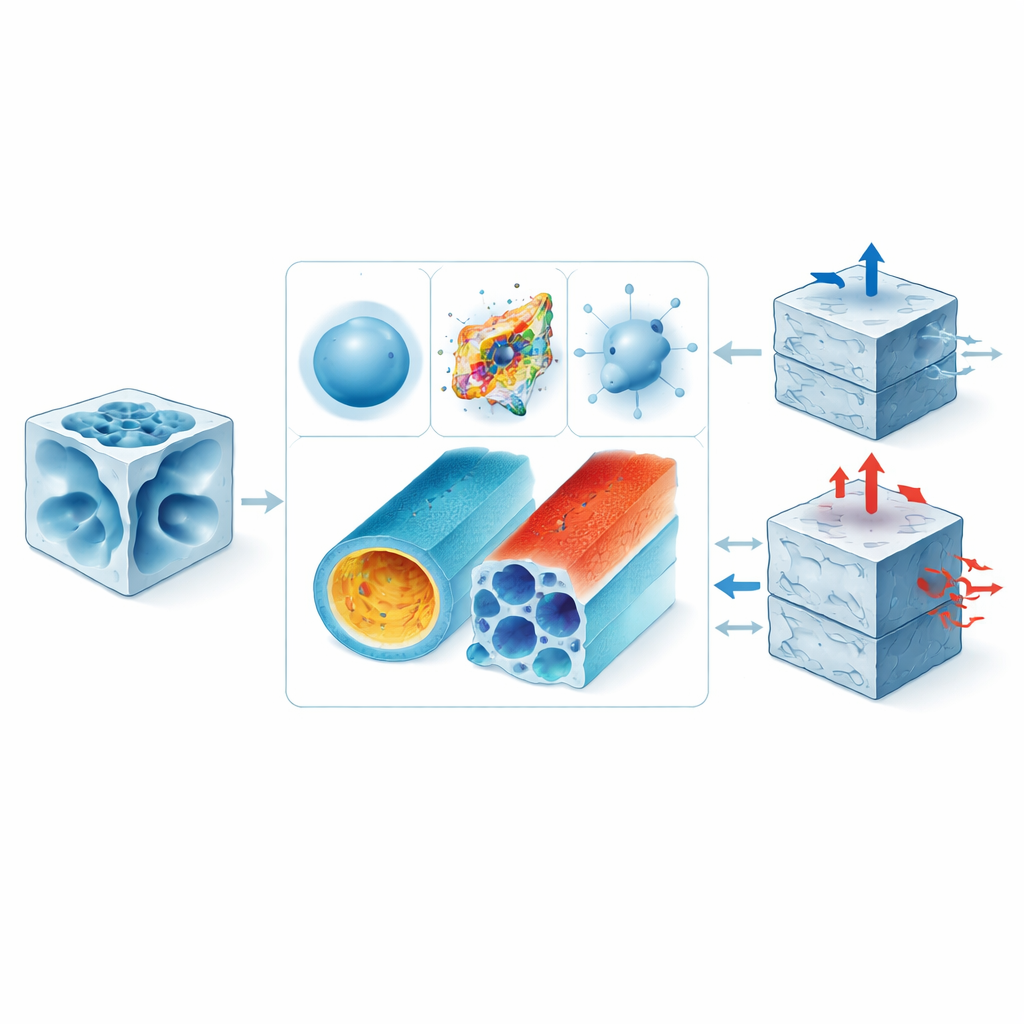
Perhaps the most striking finding is that only three descriptors—compactness, normalized inner surface area, and the variance of the distance to a reference sphere—are enough to predict the mechanical and thermal behavior of these TPMS materials within about five percent accuracy. Even when data are sparse or when the model is asked to extrapolate to unseen designs, performance remains high for most properties. For a designer, this means that instead of wrestling with massive image-based models or opaque neural networks, tuning just three geometric “knobs” in a CAD tool can guide the search for new, multifunctional architectures. In accessible terms, the work shows that the bewildering richness of sculpted internal geometries can be translated into a handful of meaningful measures, opening a scalable and interpretable route to designing the next generation of lightweight, strong, and thermally efficient materials.
Citation: Rodopoulos, D.C., Mermigkis, G., Hadjidoukas, P. et al. Machine learning-based mechanics of TPMS architected materials driven by unit-cell geometric features. npj Metamaterials 2, 16 (2026). https://doi.org/10.1038/s44455-026-00026-9
Keywords: architected materials, metamaterials, triply periodic minimal surfaces, machine learning, materials design