Clear Sky Science · en
Full-space wave manipulations for multifunctional integration based on mechanically reconfigurable and stacked metasurface
Shaping Invisible Waves for Everyday Technology
From Wi‑Fi to airport scanners, our lives quietly depend on invisible ripples of energy called electromagnetic waves. This research introduces a single, reconfigurable “skin” made of tiny patterned pieces that can bend, split, guide, and focus these waves almost at will. By cleverly stacking and rotating these pieces, the authors create a platform that can switch between roles: boosting wireless links, tracking vital signs without contact, and helping identify hidden objects. It is a step toward future smart surfaces that make our surroundings more aware, connected, and secure.
A Flat Machine for Steering Light and Radio
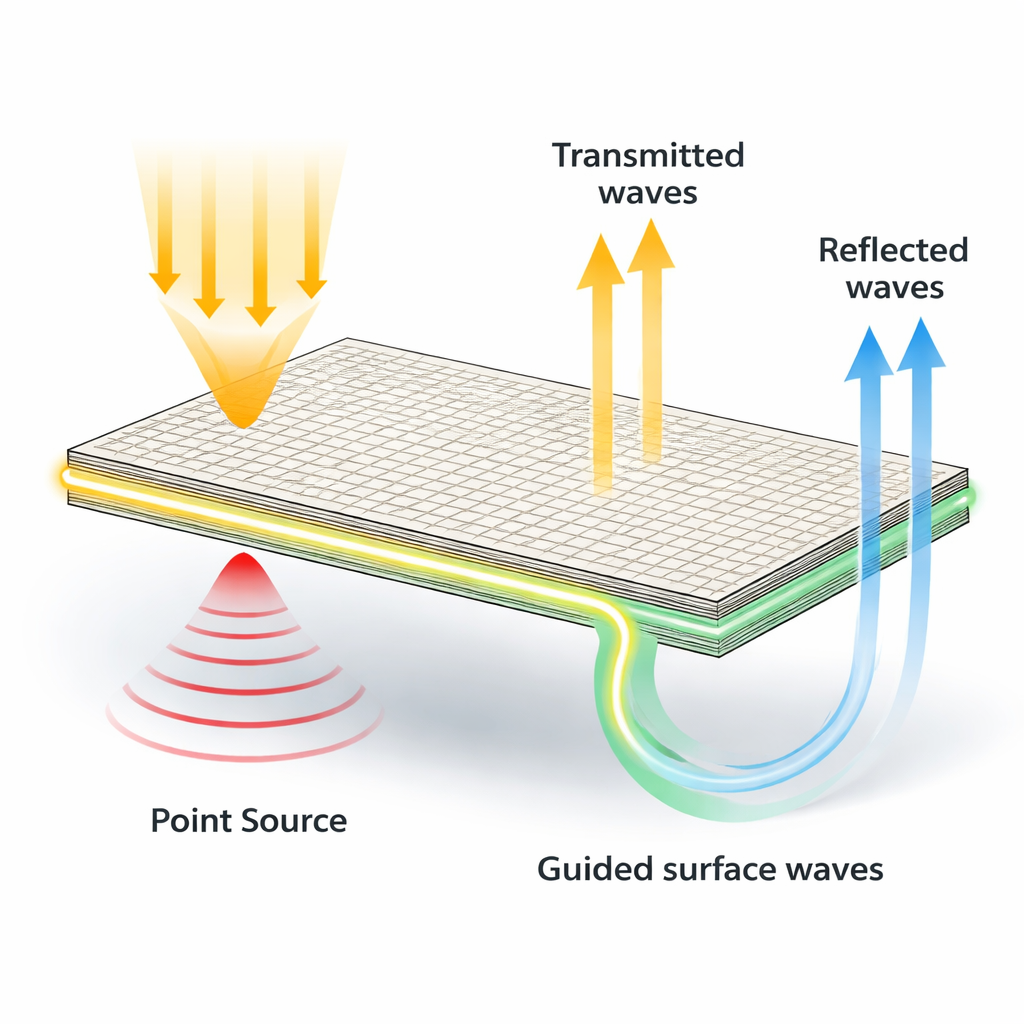
At the heart of the work is a thin engineered surface, a metasurface, built from many repeating “meta‑atoms.” Unlike ordinary materials, whose behavior is fixed by their atoms, these man‑made units are shaped to force waves to twist and turn in specific ways. The team stacks these units in layers and makes them mechanically detachable and rotatable, like modular tiles. By changing each tile’s in‑plane rotation, they do not alter the hardware, but they do alter how the whole sheet responds to incoming waves—whether it sends them through, bounces them back, or traps them along its surface.
One Surface, Three Directions of Control
The device controls waves in three distinct regions of space at once. First, it shapes waves that pass through it (transmission), steering them into narrow beams, focusing them to a point, or even forming hologram‑like patterns. Second, it performs the same tricks with waves that reflect from its front side, with transmission and reflection staying tightly synchronized. Third, it guides waves that skim along the surface itself, turning sharp corners and dodging defects without losing strength. This “full‑space” control—forward, backward, and along the surface—from a single patterned sheet is what sets this design apart from earlier, more limited systems.
Borrowing Ideas from Exotic Materials
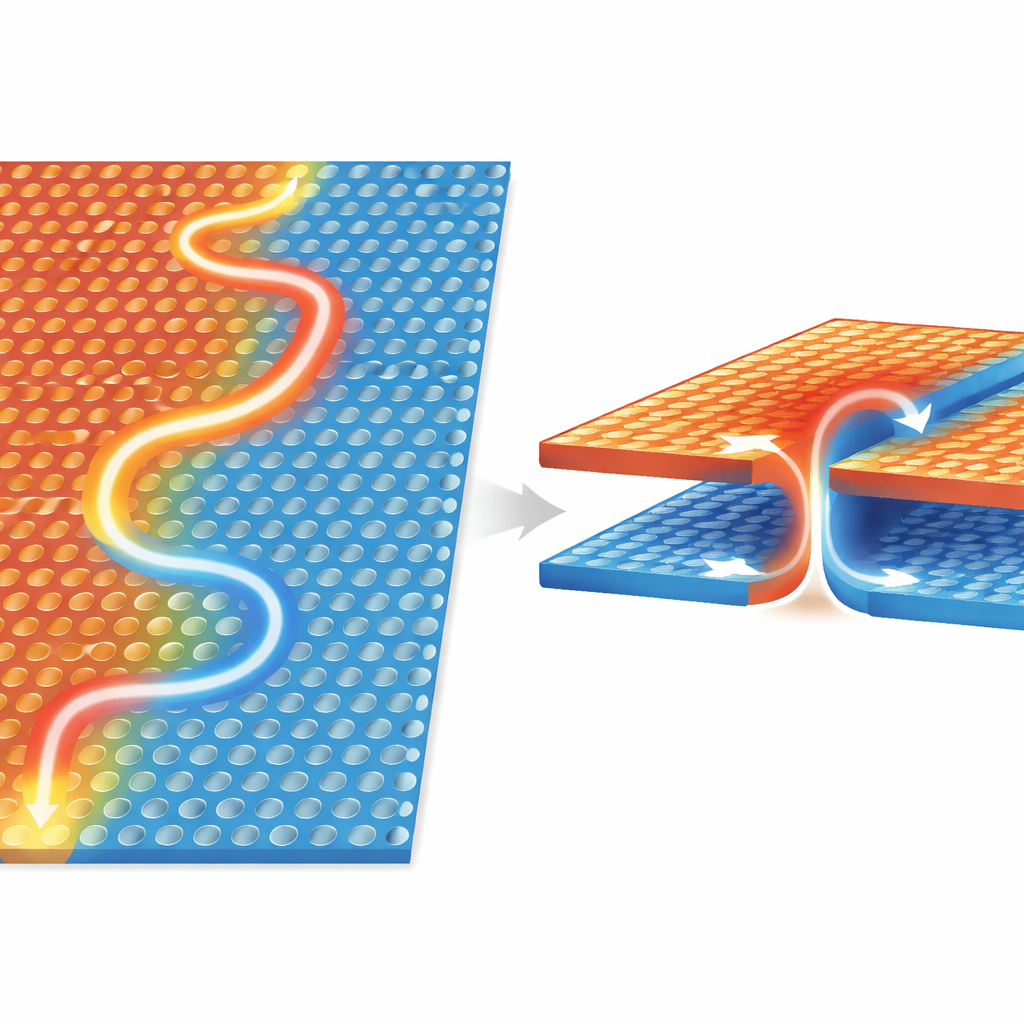
To make the surface‑bound waves so robust, the researchers borrow concepts from topological materials, a family of systems known for channels that keep carrying energy even when the structure is bent or partially damaged. By slightly breaking the symmetry of each meta‑atom, they open special frequency ranges where waves are forced to travel along the boundary between two different regions of the surface. In a more advanced stacked version, the same idea is extended to two layers separated by a small gap, so that energy can be made to start in the upper layer, mix in a central zone, and emerge in the lower layer. This controlled “handoff” between layers acts like a protected waveguide that is resistant to imperfections.
From Lab Demonstration to Real‑World Uses
To show that this is more than a clever physics trick, the team builds three proof‑of‑concept systems. In a wireless link, the metasurface beams data‑carrying signals toward chosen receivers in both transmission and reflection, while guided waves along its surface carry the same information around tight bends with very few errors, even when some tiles are removed. For non‑contact health monitoring, the surface focuses waves onto a person’s chest and back, making small motions from breathing and heartbeat easier to pick up; measured rates closely match readings from commercial wearables. In a security test, the surface scans everyday objects and liquids, and simple neural networks trained on the resulting patterns learn to recognize materials and contents with about 98% accuracy.
What This Means for Future Smart Surfaces
To a lay observer, the main message is that a single, flexible “wave panel” can now act as many devices in one—antenna, sensor, and scanner—simply by changing how its tiny building blocks are rotated or stacked, rather than rebuilding hardware from scratch. Although today it can switch only one major function at a time, the concept of mechanically reconfigurable, topologically protected metasurfaces points toward walls, ceilings, and devices that can dynamically reshape invisible waves to boost communication, watch over health, and strengthen security in a more integrated and energy‑efficient way.
Citation: Chen, L., Cai, Z.X., Yu, X. et al. Full-space wave manipulations for multifunctional integration based on mechanically reconfigurable and stacked metasurface. npj Metamaterials 2, 17 (2026). https://doi.org/10.1038/s44455-026-00025-w
Keywords: metasurface, electromagnetic waves, topological photonics, wireless sensing, security imaging