Clear Sky Science · en
Subsurface ice in doubly shadowed craters as revealed by Chandrayaan-2 dual frequency synthetic aperture radar
Why Hidden Lunar Ice Matters
Water on the Moon is not just a scientific curiosity; it is a potential lifeline for future astronauts. Ice buried in lunar soil could be turned into drinking water, breathable oxygen, and even rocket fuel. This study explores some of the coldest, darkest places on the Moon’s south pole—tiny "doubly shadowed" craters—to find out whether they hide long‑lasting stores of ice just below the surface. 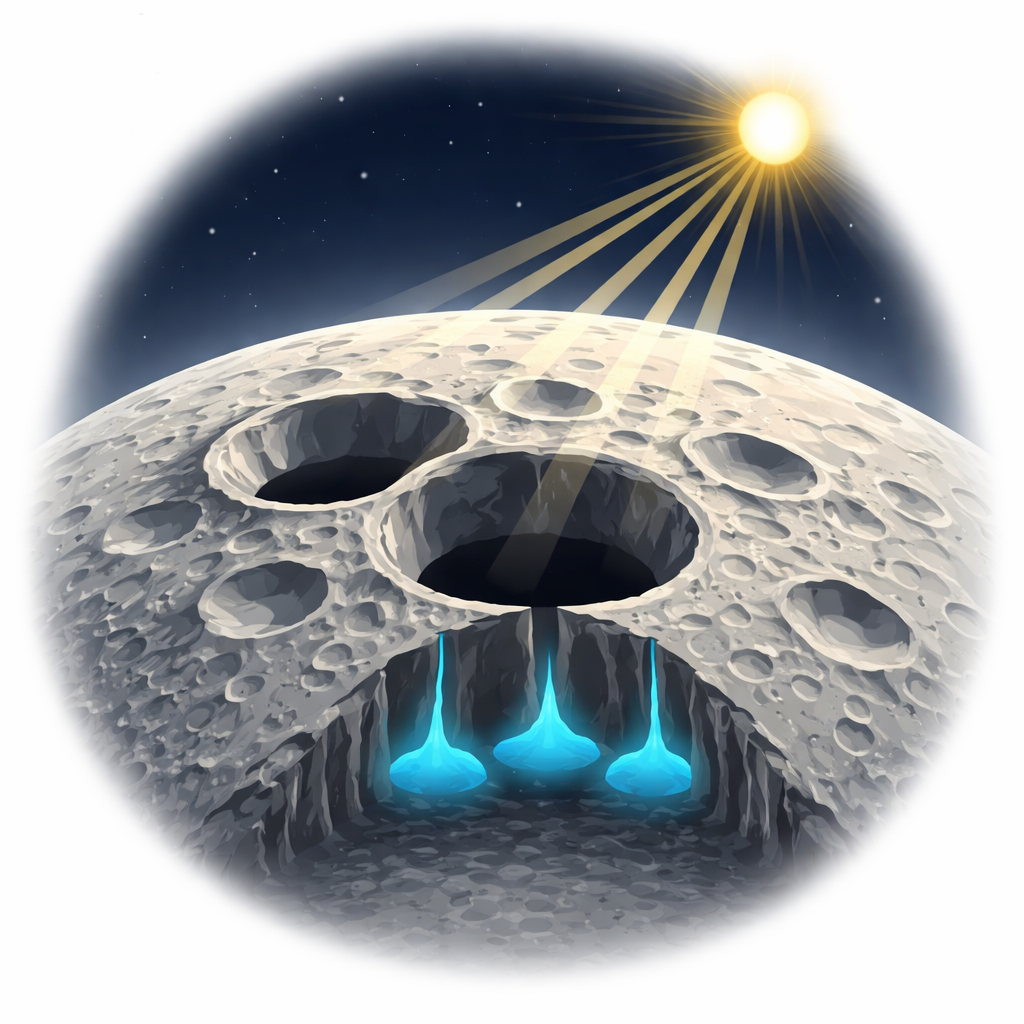
The Coldest Corners of the Moon
The Moon barely tilts on its axis, so in the polar regions sunlight skims the horizon instead of rising high in the sky. Deep crater floors near the poles never see the Sun at all, becoming permanently shadowed regions that are colder than liquid nitrogen. Within a few of these dark craters sit even smaller craters whose raised rims block not only direct sunlight but also faint scattered light and warmth from nearby bright terrain. These special "doubly shadowed" pockets may reach temperatures as low as about 25 kelvin, cold enough for water ice to survive for billions of years if it ever arrived there.
Using Radar to See Below the Darkness
Because these craters are pitch black, ordinary cameras struggle to reveal what lies on their floors. Instead, the Chandrayaan‑2 spacecraft uses a dual‑frequency radar instrument that sends out radio waves and records the echoes. By measuring how the polarization—or orientation—of the waves changes when they bounce back, scientists can infer whether the signal comes from a rough rocky surface or from material that scatters the waves within its volume, as ice does. Two key quantities are used: the circular polarization ratio (how much of the returning signal matches the original twist of the waves) and the degree of polarization (how organized the returned signal remains). Ice buried in soil tends to produce a high ratio but a very disordered, low degree of polarization because the waves ricochet around inside the icy layer. 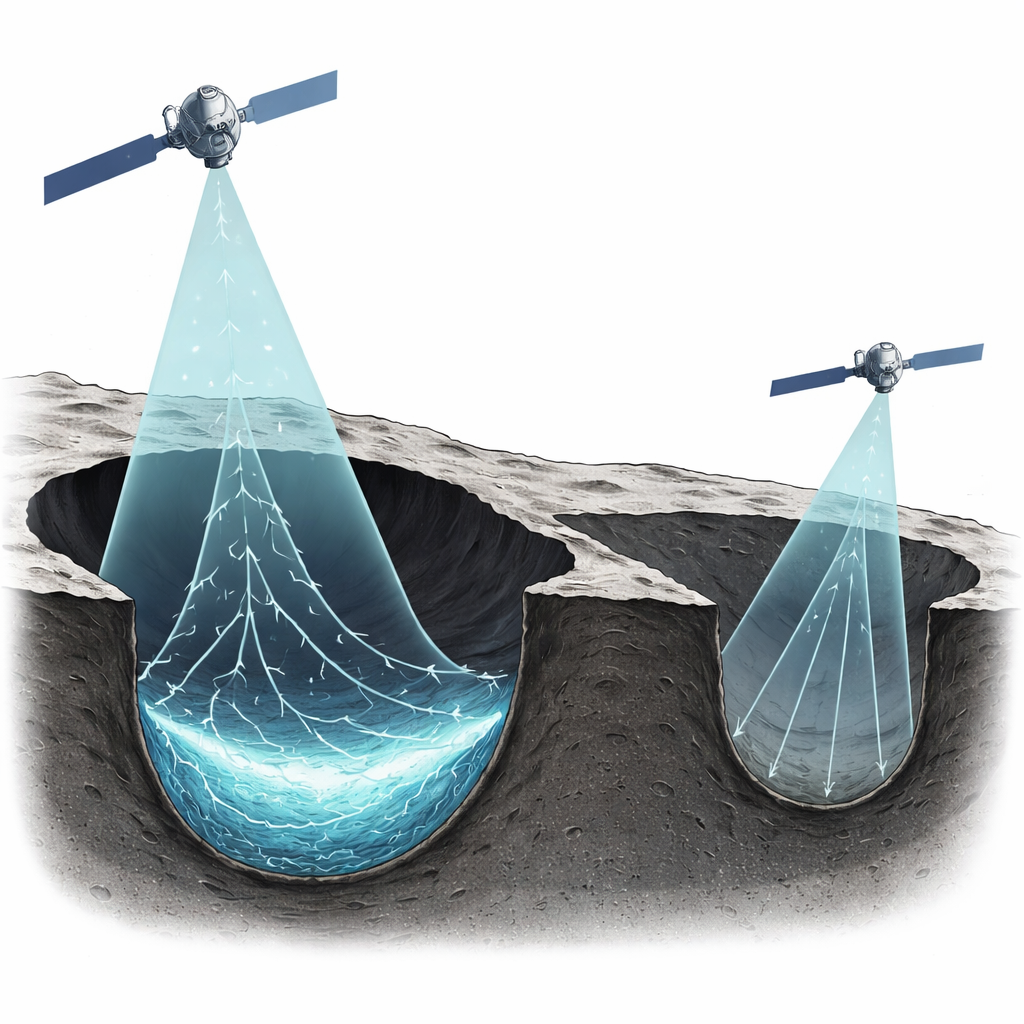
Hunting for Ice in Nine Shadowed Craters
The team examined nine doubly shadowed craters inside three larger south polar craters named Faustini, Haworth, and Shoemaker. They combined radar data with detailed elevation maps and sharp images from the ShadowCam instrument, which can see faintly lit terrain inside shadows. Many of the craters show boulders along their rims and walls, but their dark floors tend to be relatively smooth, reducing one common source of confusing radar signals. The craters span sizes from under a kilometer to almost three kilometers wide, with varying wall steepness and rim shapes, including one particularly striking "lobate" rim in a small crater called F2 inside Faustini.
A New Radar Fingerprint for Buried Ice
Four of the nine craters—F2, F3, H3, and S1—stand out with both elevated circular polarization ratios above one and extremely low degrees of polarization between 0.1 and 0.13. Earlier work had suggested that ice‑rich material should show a degree of polarization below about 0.35; this study finds that in these ultra‑cold craters the values are even lower, refining the radar fingerprint for buried ice to "ratio greater than one plus degree of polarization below 0.13." Surrounding crater walls, ejecta, and an older nearby crater called Tooley display either low ratios, higher polarization, or both, consistent with rough rock rather than ice. The results suggest that where the refined radar signature appears, the echo is dominated by volume scattering from ice mixed into the upper few meters of the regolith.
Clues from an Unusual Crater Rim
Crater F2 offers a particularly compelling case. It has the strongest and most extensive radar signature of all nine craters and a distinctive raised, lobate rim that wraps around its edge. Elevation measurements show that F2 formed hundreds of meters below the surrounding floor of Faustini, deep within the permanently shadowed zone. The authors argue that the impact that created F2 likely punched into an ice‑bearing layer, splashing out icy, slushy material that froze into the oddly shaped rim we see today. Other craters with weaker radar signs of ice lack such dramatic rims, possibly because their impacts did not reach the ice layer or because their ice was delivered later and simply accumulated quietly in the cold ground.
What This Means for Future Moon Explorers
Overall, the study concludes that subsurface ice at the lunar south pole is patchy rather than uniform, even within these ultra‑cold traps. Only four of nine doubly shadowed craters show strong or partial signs of buried ice in the shallow subsurface, and F2 appears to be the richest target. At the same time, the work provides a sharper radar test for spotting genuine ice deposits and separating them from merely rough terrain. For future missions seeking to tap the Moon’s frozen resources, these doubly shadowed craters—and especially F2 in Faustini—look like promising places to drill, sample, and perhaps one day extract water to support a sustained human presence beyond Earth.
Citation: Sinha, R.K., Bharti, R.R., Acharyya, K. et al. Subsurface ice in doubly shadowed craters as revealed by Chandrayaan-2 dual frequency synthetic aperture radar. npj Space Explor. 2, 22 (2026). https://doi.org/10.1038/s44453-026-00038-9
Keywords: lunar ice, Moon south pole, permanently shadowed craters, radar mapping, space resources