Clear Sky Science · en
The new generation lunar gravitational wave detectors: sky map resolution and joint analysis
Listening to Ripples in Space from the Moon
Gravitational waves – tiny ripples in space-time from violent cosmic events – have already opened a new way to observe the universe. But today’s detectors on Earth and in space can only hear some of these signals. This paper explores how building a new kind of observatory on the Moon could fill a crucial gap in our “cosmic hearing,” allowing astronomers to pinpoint where otherwise hidden events are happening across the sky.
A Quiet Place Between Earth and Space
Different gravitational-wave detectors are tuned to different tones, or frequency bands, much like radio receivers tuned to different stations. Ground-based instruments such as LIGO listen at higher frequencies, while planned space missions like LISA and TianQin will focus on much lower ones. Between these ranges lies a poorly explored band from about one-tenth to ten cycles per second. This “deci-hertz” window is expected to carry signals from intermediate-mass black hole mergers, compact pairs of white dwarfs, and even echoes of exotic processes in the early universe. However, neither current ground facilities nor standard space missions can study this band with high sensitivity or precision. The authors argue that the Moon is an unusually favorable place to close this gap: it offers natural high vacuum, far less seismic shaking than Earth, and no atmosphere or human activity to interfere with delicate measurements.
Designing a Lunar Triangle to Catch Waves
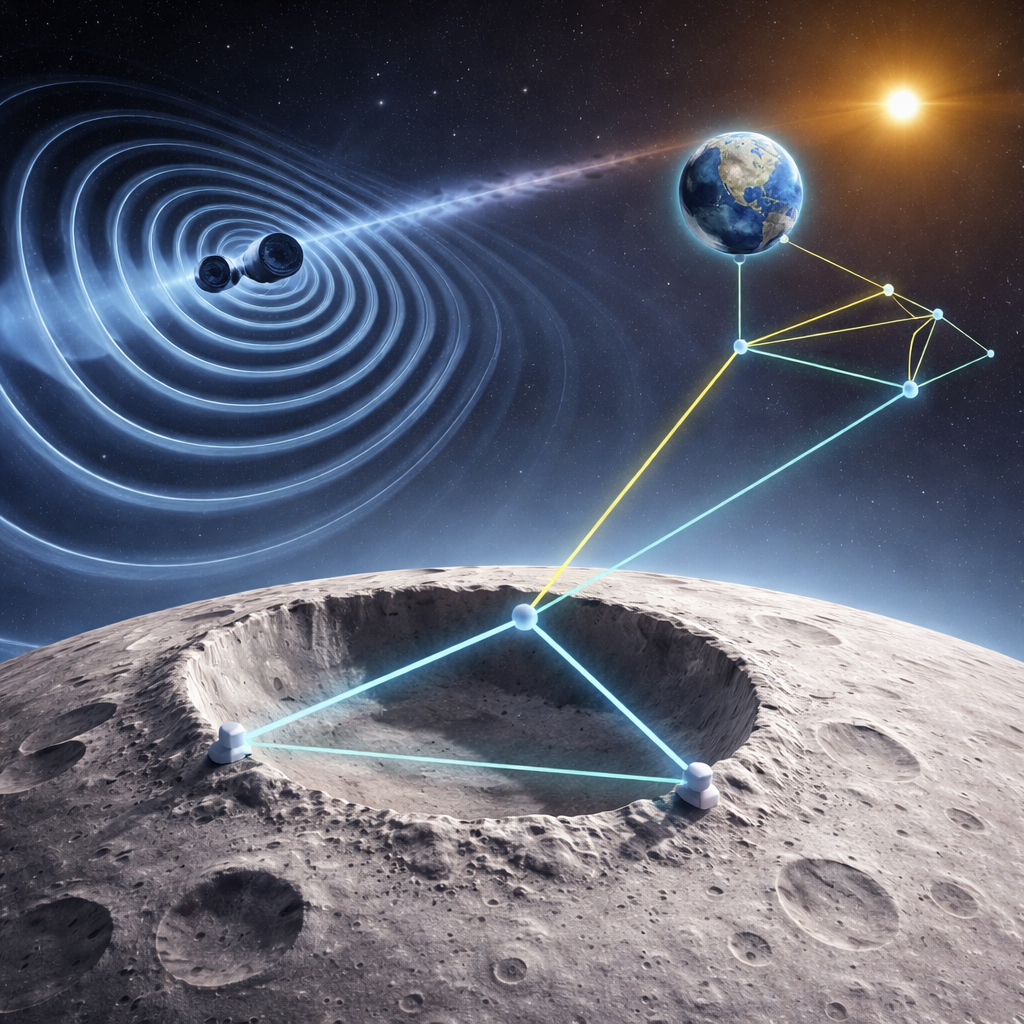
The proposed Crater Interferometry Gravitational-wave Observatory, or CIGO, would place three laser-linked stations on the rim of a polar lunar crater, forming a triangle roughly 100 kilometers on a side. Unlike space missions that fly freely in formation, these stations would be rigidly anchored to the lunar surface, simplifying some aspects of the design. As gravitational waves pass through, they slightly stretch and squeeze the distances between stations, and ultra-precise lasers would record those changes. Using a standard forecasting technique called the Fisher information matrix, the authors simulate how well CIGO could determine the positions of thousands of idealized, nearly constant-frequency sources scattered over the sky. They directly compare its performance with LISA and TianQin at several representative frequencies in the deci-hertz band.
Sharpening the Sky Map
The central question is “sky localization”: how accurately can each detector, or a network of them, draw a patch on the sky containing the true source? The study shows that at lower frequencies around 0.1 hertz, CIGO and TianQin perform similarly well, and both outdo LISA in pinpointing source positions. As the frequency increases toward ten hertz, CIGO’s accuracy improves dramatically and surpasses both space missions by more than two orders of magnitude. In a combined network, all three detectors complement one another at the low-frequency end: their different orbits and orientations fill in each other’s weak spots, leading to substantially better sky coverage. But above a few hertz, the network’s overall performance is essentially set by CIGO alone, with LISA and TianQin adding little extra information for localization.
Real-World Noise and a Smarter Geometry
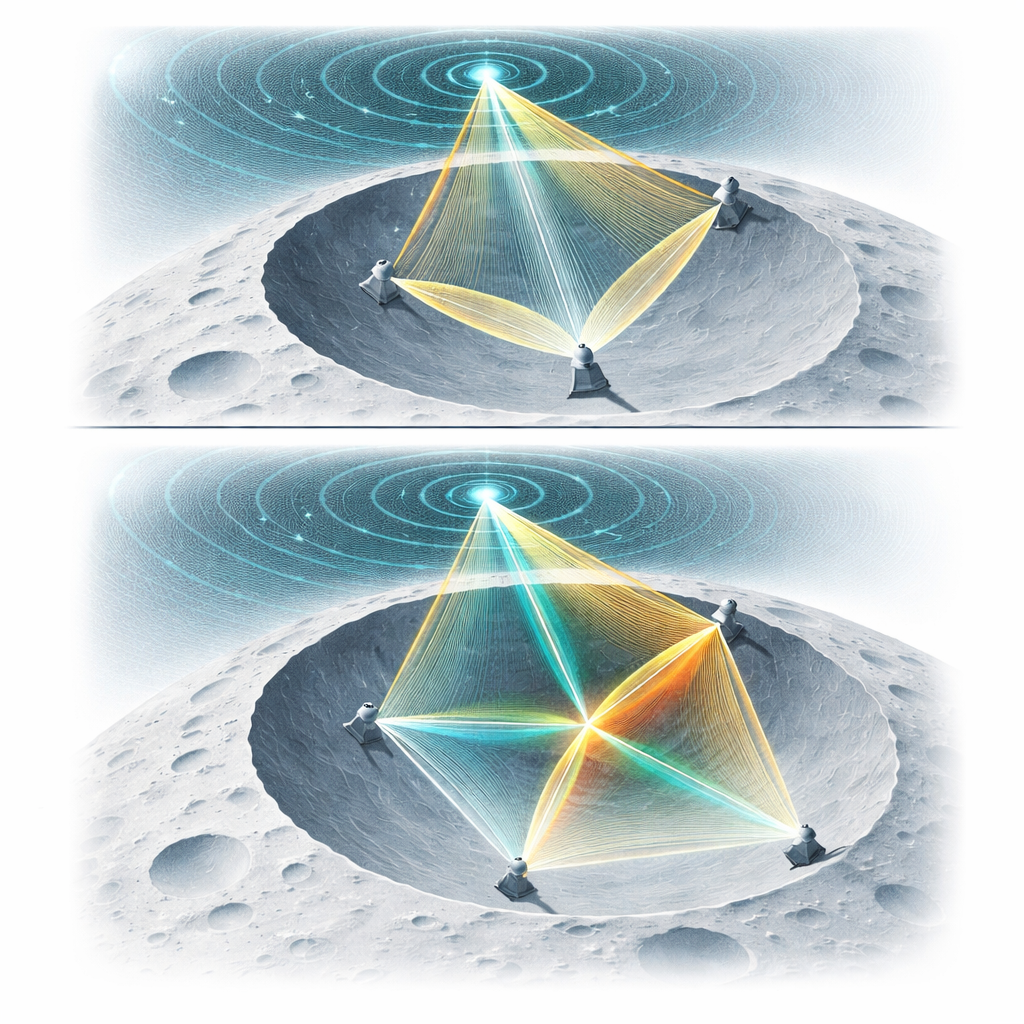
No detector operates in perfect silence, so the authors also estimate how the lunar environment would limit CIGO. Even though the Moon is much quieter than Earth, slow seismic motions and related effects still raise the noise level below about 3 hertz. Under conservative assumptions, this extra noise would noticeably degrade CIGO’s ability to localize low-frequency sources, signaling the need for advanced vibration isolation and thermal control technologies. To further boost performance, the team explores an upgraded layout called TCIGO. In this design, a fourth station is placed at the bottom of the crater, so that the four stations form a regular tetrahedron. Each triangular face of the tetrahedron acts as a separate interferometer, effectively turning the system into a small network at a single site. Simulations show that this configuration not only removes sky directions where the original triangle performs poorly, but also improves overall localization by roughly a factor of five across the target band.
A New Link in the Gravitational-Wave Chain
In everyday terms, the study finds that a lunar observatory like CIGO would give astronomers a much sharper “cosmic GPS” for events that sing in the mid-frequency range. In its more advanced tetrahedral form, TCIGO could match or surpass the pointing power of planned space detectors and ground observatories in their overlapping bands, while filling the long-missing gap between them. That means better chances of quickly identifying host galaxies, pairing gravitational waves with light or neutrino signals, and testing fundamental physics in new regimes. If realized, a lunar gravitational-wave observatory would become a key missing link in a continuous global and space-based network, allowing us to trace cosmic cataclysms across the entire sky and across a far wider range of frequencies than is possible today.
Citation: Zhang, X., Yu, C., Li, H. et al. The new generation lunar gravitational wave detectors: sky map resolution and joint analysis. npj Space Explor. 2, 21 (2026). https://doi.org/10.1038/s44453-026-00037-w
Keywords: gravitational waves, lunar observatory, CIGO, sky localization, deci-hertz astronomy