Clear Sky Science · en
Deep learning framework for crater detection and identification on the Moon and Mars
Why Craters Matter for Space Exploration
When we look at the Moon or Mars through a telescope, their pockmarked faces tell a story of billions of years of cosmic impacts. Each crater records a collision that shaped a world’s surface and history. But there are far too many craters for humans to catalog by hand. This paper explores how modern artificial intelligence can automatically find and sort those craters in satellite images, helping scientists understand planetary history and even plan safer landings for future missions.
Reading the Scars on Planetary Surfaces
Impact craters are more than just round holes in the ground. Their size, shape, and degree of wear reveal how often rocks have slammed into a planet, how its crust has evolved, and which regions may be geologically young or ancient. Traditionally, scientists have identified craters by manually scanning images, a slow and tiring task prone to human disagreement. Earlier computer methods tried to help by looking for edges or circular patterns, but they struggled whenever lighting, terrain, or crater size changed. With modern deep learning, computers can instead learn directly from examples, spotting subtle patterns that would be difficult to capture with hand-crafted rules.
Teaching Computers to Spot Craters
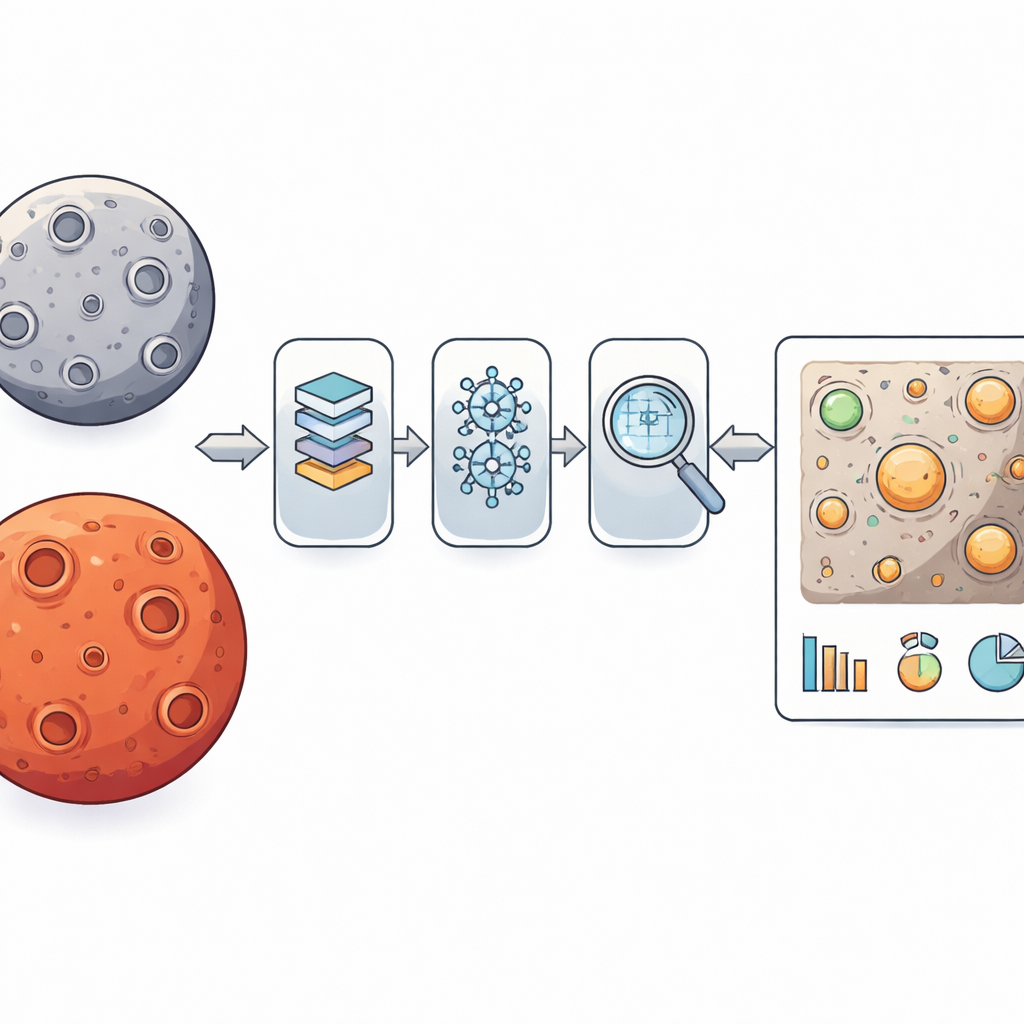
The authors present a two-step computer system that searches for craters on the Moon and Mars. First, a fast model scans large satellite images and proposes where craters are likely to be. Second, more specialized models zoom in on those regions to decide whether a crater is small, medium, or large. To train these systems, the team combined high-resolution images from NASA missions with community-provided lunar images, and then carefully labeled hundreds of craters by hand. They also split craters into three groups based on their diameter and created datasets in different formats so each model type could learn effectively.
How the Different AI Models Compare
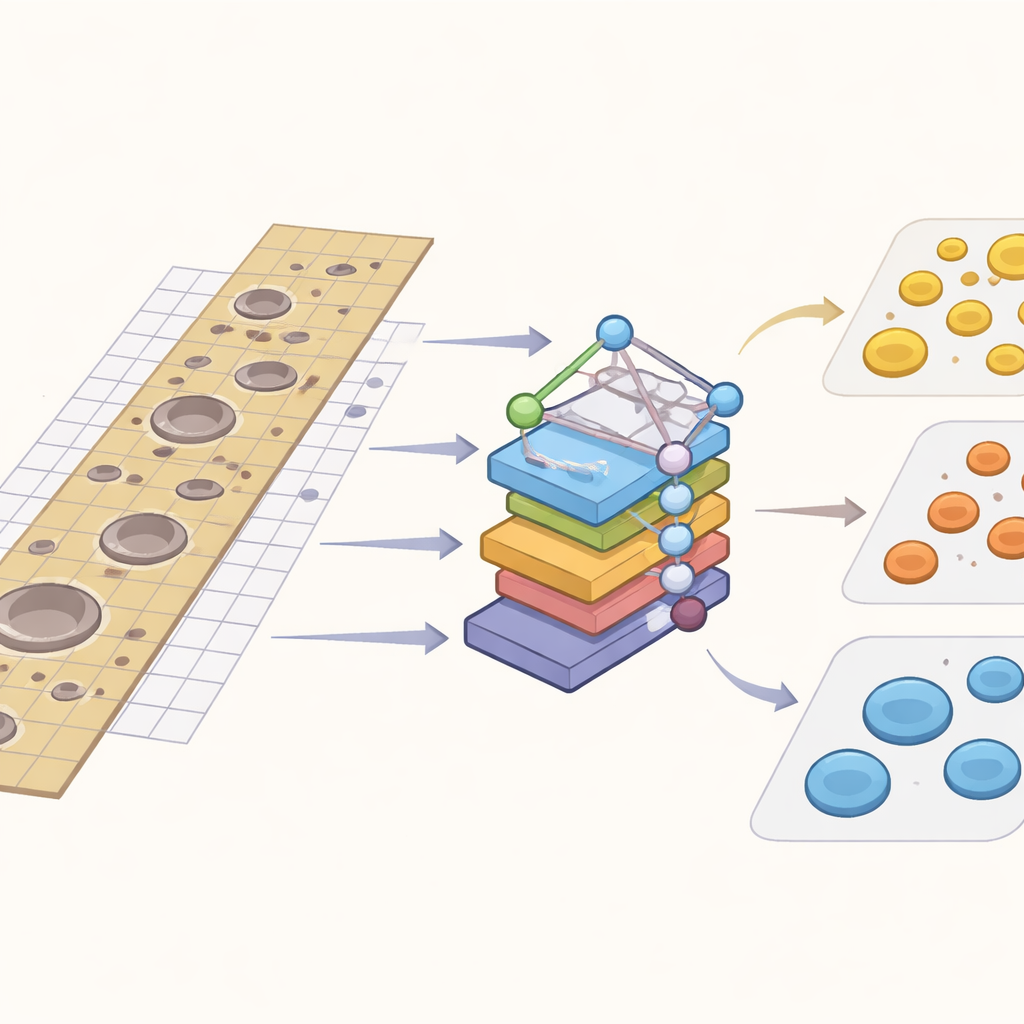
The study focuses on three popular deep learning models that each play to different strengths. A classic convolutional neural network (CNN) looked at small cutout images centered on individual craters. A model family known as YOLO scanned full images and drew boxes around craters in a single pass, making it attractive for real-time or large-scale use. A deeper model called ResNet-50, borrowed from general image recognition, was used to test whether more layers can capture finer details. The researchers also tried two ways of feeding images to YOLO: directly using full, very large images, and chopping them into overlapping tiles so that tiny craters would not be missed.
What Worked Best on the Moon and Mars
Each model excelled at different parts of the problem. The CNN was remarkably good at recognizing small craters, especially when they were plentiful in the training data, but it struggled with larger and rarer ones, revealing how much class imbalance matters. YOLO provided the most balanced performance across small, medium, and large craters, handling the challenge of multiple crater sizes reasonably well on both the Moon and Mars. ResNet-50 showed strong precision for large craters—when it flagged one, it was often correct—but still missed many examples, especially in under-represented size groups. Overall, the combination of a fast detector plus targeted classifiers proved more effective than any single model alone.
Why This Matters for Future Missions
For a non-specialist, the key message is that artificial intelligence can now reliably scan enormous planetary image archives and produce maps of crater sizes and locations, something that would be impossible to do manually at the same scale. This automated framework turns raw images of lunar and Martian landscapes into structured reports that summarize how many craters of each size occur in a region. Such maps help researchers piece together the impact history of these worlds and identify promising or hazardous areas for landers and rovers. While the current study used relatively small regions and still grapples with data imbalance, it lays the groundwork for smarter, more comprehensive surveys that will support the next generation of robotic and human exploration.
Citation: Ma, Y., Guo, J., Yu, Z. et al. Deep learning framework for crater detection and identification on the Moon and Mars. npj Space Explor. 2, 19 (2026). https://doi.org/10.1038/s44453-026-00036-x
Keywords: lunar craters, Mars surface, deep learning, impact cratering, planetary mapping