Clear Sky Science · en
Decoding the mechanical property “genome” of Chang’e-5 lunar regolith
Why Moon Dust Matters for Life Beyond Earth
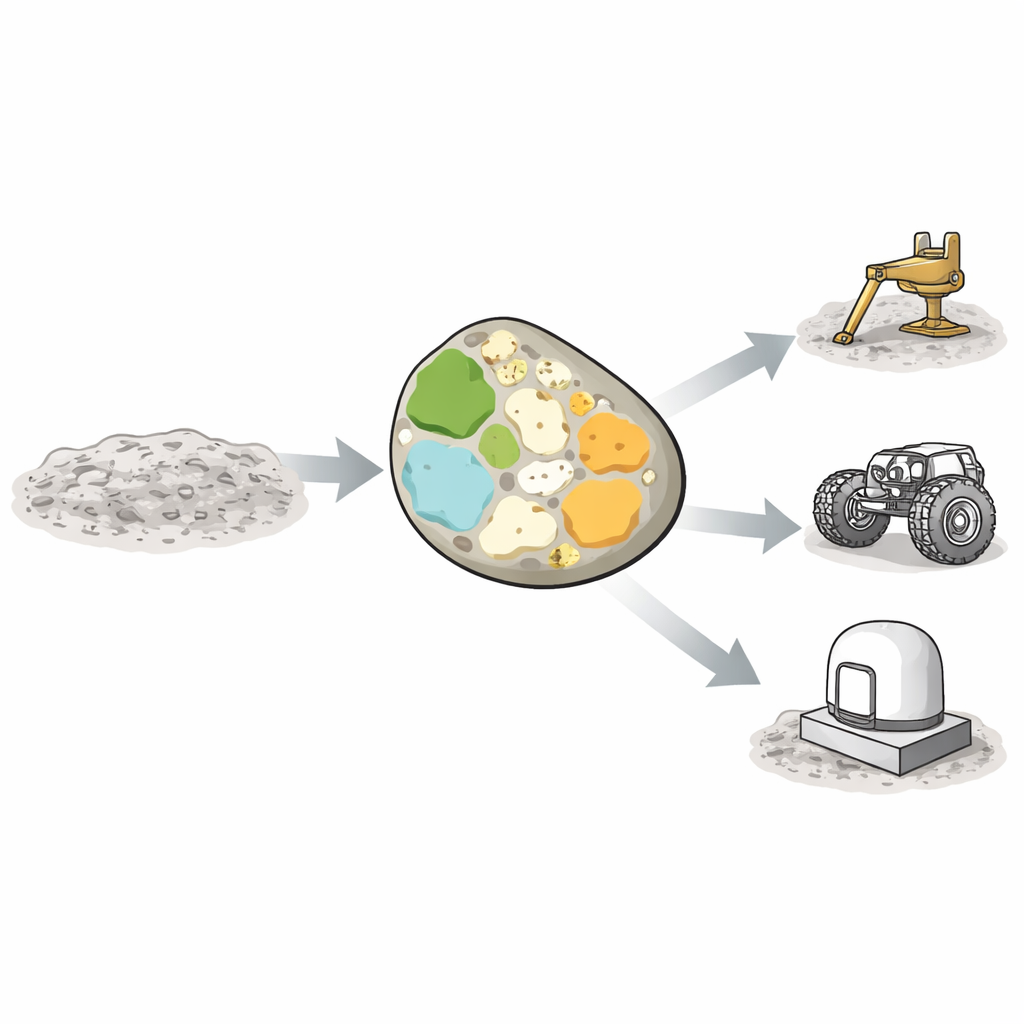
The soft-looking “dust” that covers the Moon is anything but gentle. This lunar soil, called regolith, will support landers, rovers, habitats, and mining equipment as humans push toward long-term stays on the Moon. Yet until now, engineers have mostly treated this material as a simple bulk substance, without really knowing how each tiny grain behaves. This study zooms in on a single particle of lunar soil brought back by China’s Chang’e‑5 mission, decoding its internal structure and strength in unprecedented detail—and revealing patterns that can help design safer missions and smarter ways to use lunar resources.
Looking Inside a Single Grain of Moon Soil
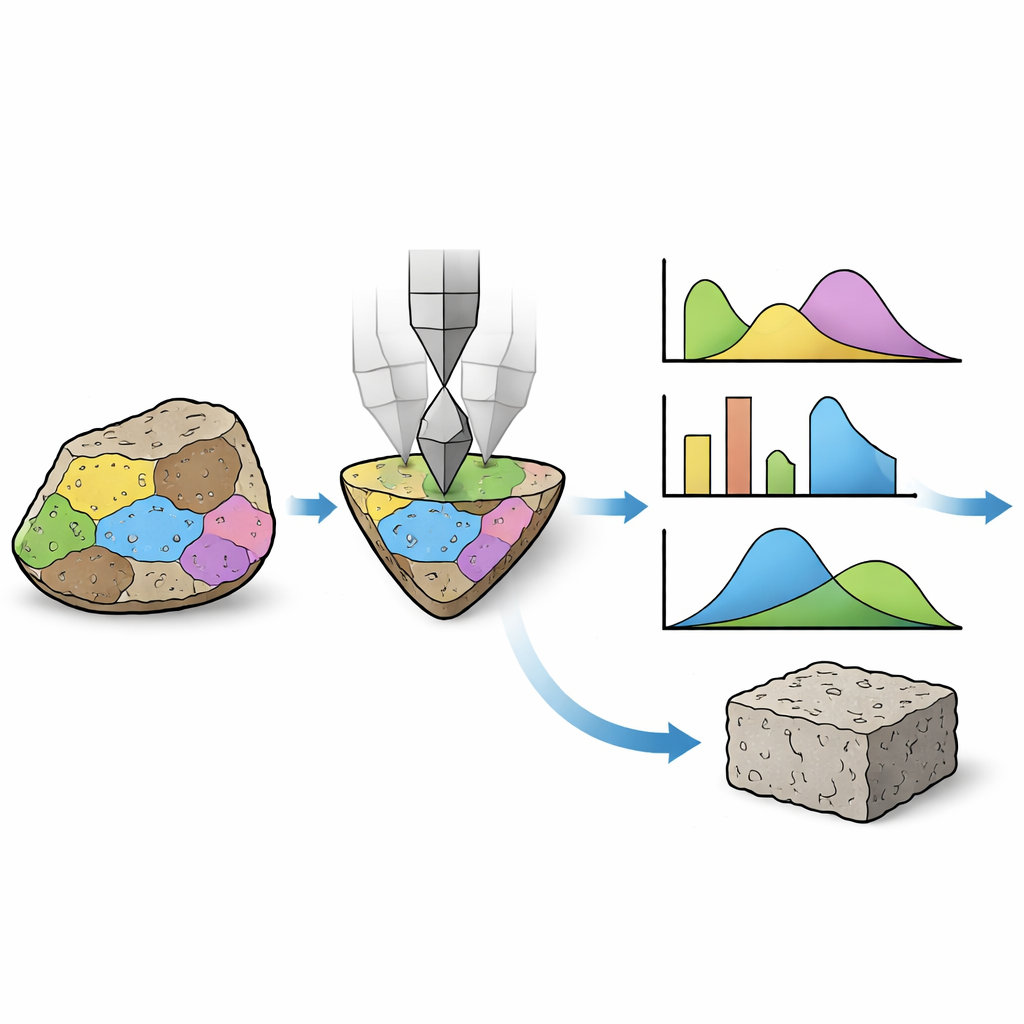
Rather than crushing or averaging many particles, the researchers carefully chose one intact grain from the Chang’e‑5 samples and treated it as a miniature world. Using high‑resolution X‑ray imaging, they built a three‑dimensional map of its interior. The grain turned out to be a jumbled mix of several minerals—mostly pyroxene, with smaller amounts of plagioclase, olivine, and a trace of glass—shot through with pores and cracks of many sizes. This internal landscape is far from uniform: some regions are dense and compact, others riddled with voids. Such fine‑scale variation means that different parts of the same grain can respond very differently when stressed by landers’ feet, rover wheels, or drilling tools.
Measuring the Hidden Strength of Moon Rock
To link structure to strength, the team used a technique called nanoindentation. A tiny diamond tip pressed into specific mineral patches on the polished cross‑section of the grain, while instruments recorded how deeply it sank under a controlled load and how the material bounced back when the load was removed. By repeating this across regions rich in pyroxene, plagioclase, and olivine, they built up a “mechanical fingerprint” for each mineral. They found that hardness and stiffness span a wide range—from relatively soft plagioclase to very resistant olivine—and even the same mineral type can behave differently depending on local composition, nearby pores, and proximity to another, harder phase.
Universal Rules Hidden in Moon Dust
Despite this complexity, the data revealed surprisingly simple trends. For pyroxene and plagioclase, hardness scales in a straight‑line fashion with a measure of stiffness (the reduced Young’s modulus), while fracture toughness—the resistance to crack growth—increases with overall stiffness across the minerals studied. These “scaling laws” echo patterns seen in Earth rocks and engineered composites, suggesting that basic physical rules govern how brittle grains deform and break, whether on Earth or the Moon. The work also shows that moon minerals are often harder but less stiff than their terrestrial cousins, likely because space weathering—micrometeorite impacts, temperature swings, and solar wind—creates toughened rims and internal microcracks at the same time.
From Grain‑Scale Physics to Lunar Engineering
By combining mineral maps with local strength measurements, the authors estimate an upper limit for how stiff the solid framework of lunar soil can be, before pores and gaps are taken into account. This information feeds directly into computer models that treat regolith as a collection of interacting grains, allowing engineers to predict how the surface will compact under a lander, how deeply wheels will sink, or how much force a drill must exert. Differences in hardness and toughness between minerals also point to where components will wear fastest and how much energy drilling into certain layers will consume—critical inputs for planning long‑duration missions and building structures from lunar soil itself.
What This Means for Future Moon Bases
This study shows that the Moon’s dusty blanket is governed by understandable, even universal, rules that connect what each grain is made of to how it bends, cracks, and carries load. By decoding this mechanical “genome” at the particle level, the work provides a physical bridge from nanometer‑scale features to the behavior of landers, rovers, and future habitats resting on regolith. For non‑specialists, the key message is simple: the more precisely we know how individual moon‑dust grains respond to stress, the more confidently we can design hardware, predict risks, and turn local soil into a reliable building material for a sustained human presence beyond Earth.
Citation: Liu, Y., He, Y., Yu, S. et al. Decoding the mechanical property “genome” of Chang’e-5 lunar regolith. npj Space Explor. 2, 20 (2026). https://doi.org/10.1038/s44453-026-00035-y
Keywords: lunar regolith, Chang’e-5, moon exploration, nanoindentation, space resources