Clear Sky Science · en
Thermal weathering and fragmentation insights on aristarchus crater
Rocks That Crack in the Moonlight
The Moon may look unchanging to the naked eye, but up close its surface is alive with slow, relentless change. This study zooms in on Aristarchus Crater, one of the brightest and most dramatic craters on the lunar near side, to ask a simple question with big implications: how do rocks fall apart on an airless world? By combining sharp orbital images with physics-based calculations, the authors show that daily temperature swings on the Moon can slowly pry apart boulders, crack the crater floor, and reshape the landscape over millions of years.
A Young Crater in a Busy Lunar Neighborhood
Aristarchus Crater sits on a high, blocky plateau surrounded by ancient lava plains. It is relatively young, about 40 kilometers wide, and unusually bright, so its cliffs, central peak, and floor are still crisp rather than worn down. Earlier work focused on its chemistry and volcanic history. Here, the authors instead treat it as a natural laboratory for how solid rock responds to a harsh space environment. Using high-resolution images from NASA’s Lunar Reconnaissance Orbiter, they mapped boulders, isolated mounds, fracture networks on the floor, and the structure of the crater walls and central peak. These features record both the violent impact that created the crater and the quieter processes that have been sculpting it ever since.
Reading the Landscape in Boulders and Cracks
The image survey reveals clear patterns. Steep crater walls and the towering central peak are littered with large, angular boulders, some with trails that show they have rolled downslope. On the relatively flat floor, the rocks are smaller and more scattered, and low mounds dot the surface, some with rough blocky tops and others smoother, perhaps coated by fine volcanic ash. Across wide areas of the floor, long, curving cracks form networks that resemble dried mud from far above. These are interpreted as cooling fractures that formed as pools of melted rock or lava solidified and then shrank in the cold of space. Their shapes and preferred directions hint at how the crater floor cooled and how deeper stresses in the plateau have guided cracking over time.
Heat, Cold, and the Slow Breaking of Stone
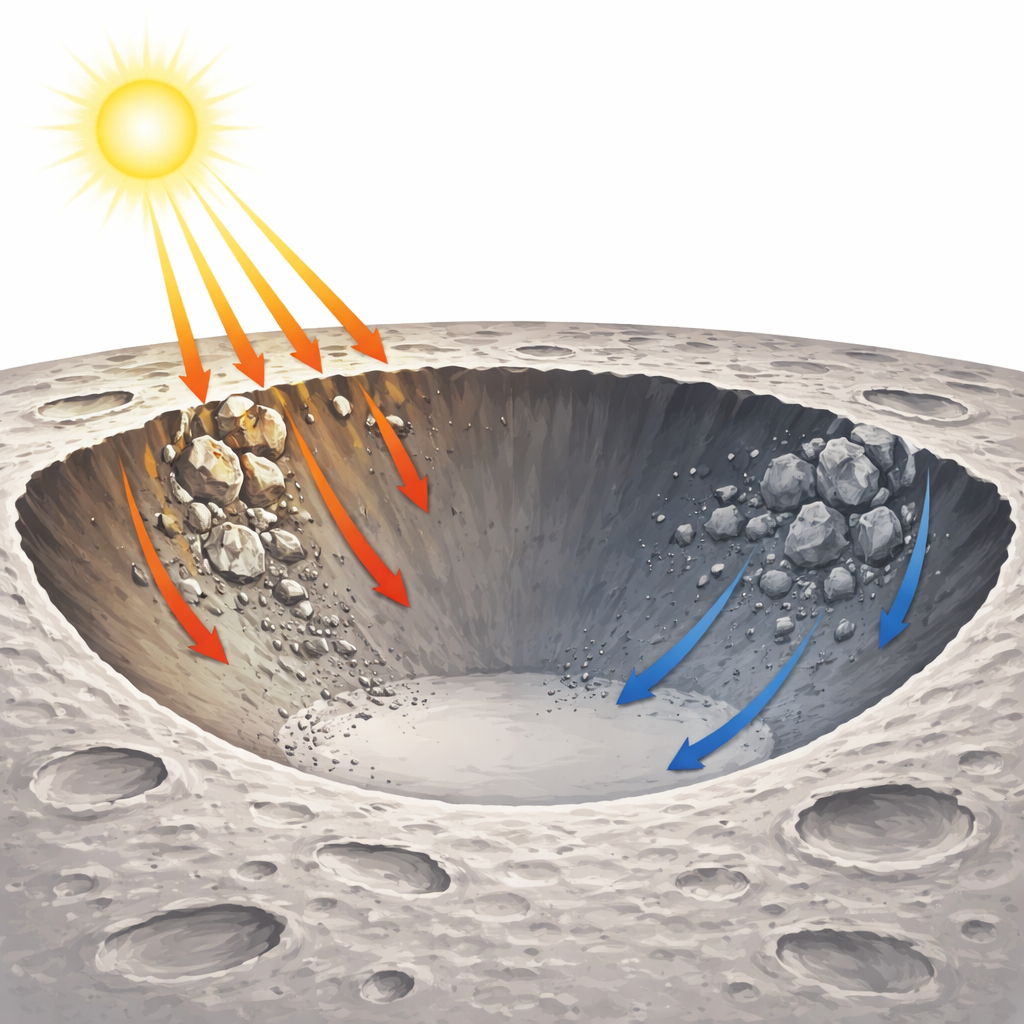
The heart of the study is the idea that extreme temperature swings are slowly tearing these rocks apart. Near the latitude of Aristarchus, lunar surface temperatures can rise to nearly 380 kelvin in daylight and fall to around 120 kelvin at night, a daily change of about 260 degrees. With no air to soften this cycle, surface layers of rock rapidly heat and cool while the interior lags behind, creating strong internal stresses. Using known physical properties of common lunar rocks, the authors calculate how much strain and stress these cycles generate in blocks of different sizes and on slopes ranging from flat floor to steep wall. Their results show that the stresses often match or exceed the strength needed to grow existing cracks in basalt and anorthosite, the main rock types in the area.
Peeling Layers Off Lunar Boulders
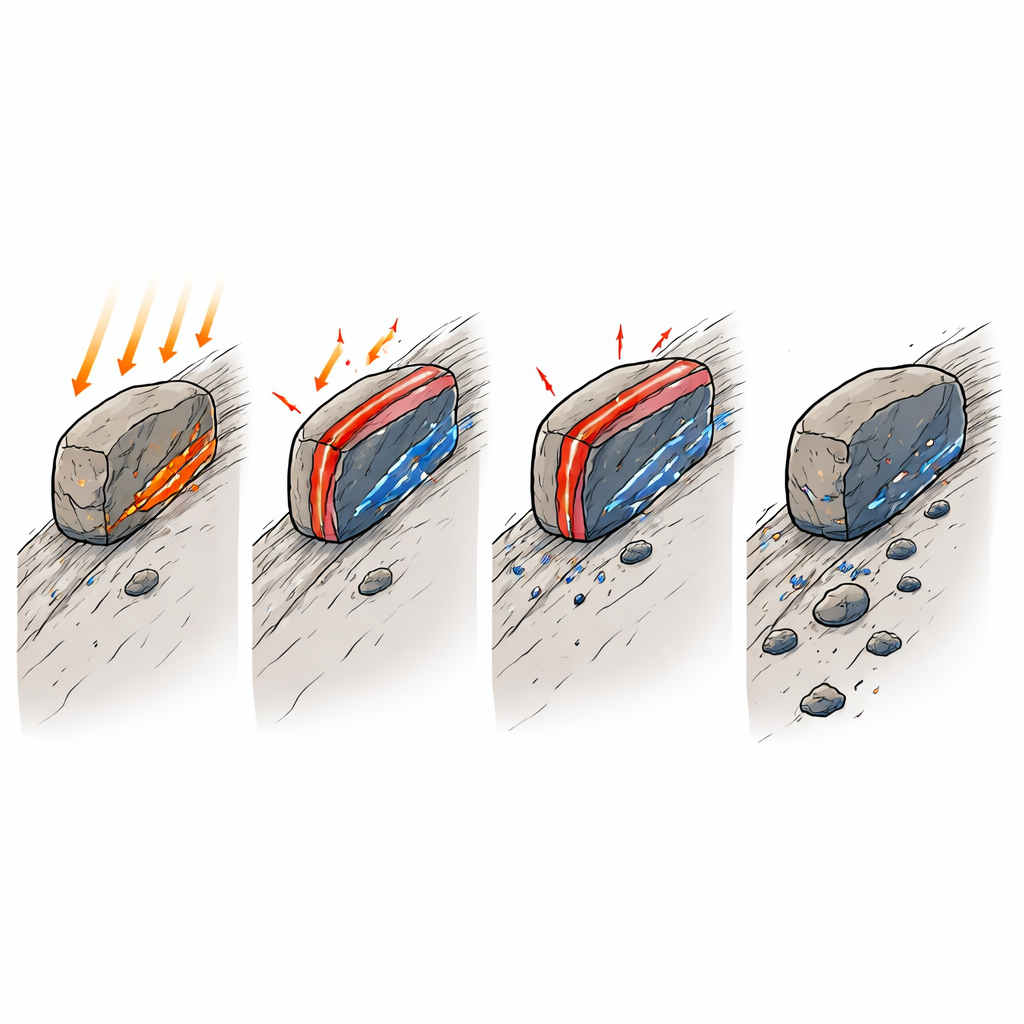
To explain what this means for individual rocks, the team adapts a model originally developed to study rock falls in Earth’s mountains. In this picture, a curved slab of rock or a boulder on a slope bows slightly as its outer surface heats faster than its interior. Repeated day–night cycles cause tiny surface-parallel cracks to lengthen. When the stress at the tip of a crack surpasses the rock’s resistance, thin shells of rock “exfoliate” or flake off, much like layers peeling from an onion. The model shows that on both the crater floor and the steep walls, the calculated stress intensity commonly beats the threshold for fracture. This agrees with images that show boulders with rounded cores and broken outer layers, and with the fact that large, intact blocks cluster mainly on the highest, steepest ground while smaller fragments accumulate downslope.
Why This Matters for Exploring the Moon
Putting the observations and modeling together, the authors argue that thermal fatigue—damage from relentless heating and cooling—is a major force reshaping Aristarchus Crater today. It works alongside impact hammering, landslides, and volcanic activity to break big blocks into smaller ones, widen cracks on the floor, and feed slow rockfalls off the crater walls. Because the same temperature swings affect the entire Moon, similar processes are likely active in other young craters as well. Understanding this quiet, steady weathering helps scientists read the Moon’s geologic history more accurately and anticipate how its surface will evolve—critical knowledge for planning long-lived landers, habitats, and instruments on our nearest neighbor in space.
Citation: Dalal, P., Sahoo, S., Kundu, B. et al. Thermal weathering and fragmentation insights on aristarchus crater. npj Space Explor. 2, 16 (2026). https://doi.org/10.1038/s44453-026-00029-w
Keywords: lunar craters, thermal weathering, Aristarchus, boulder fragmentation, airless body geology