Clear Sky Science · en
Demonstrating pressure-driven heating and cooling using a MOF-coated heat exchanger
Turning Pressure into Heating and Cooling
Keeping buildings comfortable without warming the planet is a growing challenge. Many common heat pumps still depend on high pressures and refrigerants that can harm the climate. This study explores a different route: using harmless carbon dioxide (CO₂) and a sponge-like material to create heating and cooling simply by changing pressure, not by boiling and condensing a fluid. The work shows in the lab that this idea is not just theory—it can quickly warm or chill flowing water by several degrees, with relatively modest pressures.
A New Way to Move Heat
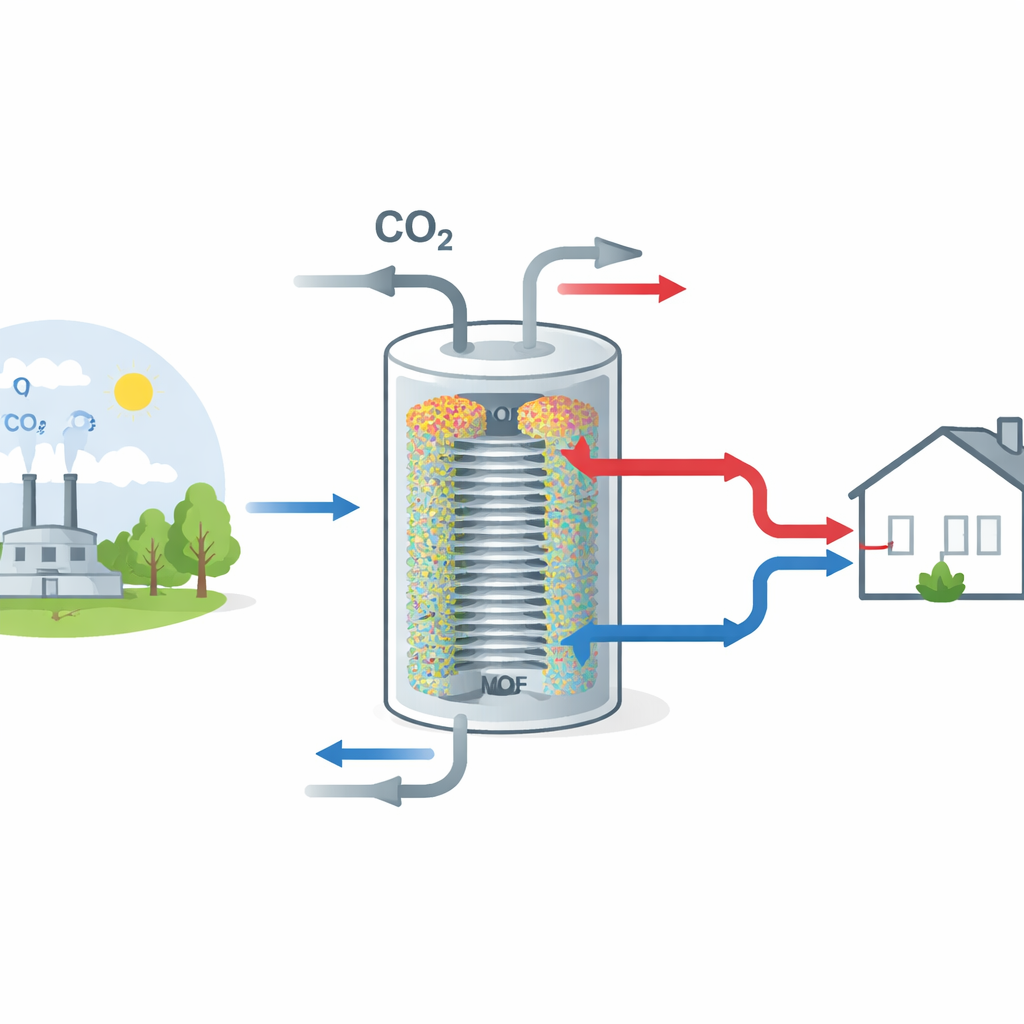
Conventional CO₂ heat pumps usually run at very high pressures and supercritical conditions, which makes equipment thicker, heavier, and more complex. The researchers instead test a concept called a hybrid compression–adsorption system. At its heart is a special heat exchanger: a metal tube with fins, coated with a porous material known as a metal–organic framework, or MOF. This MOF (called MIL-101(Cr)) acts like a nanoscale sponge that can soak up large amounts of CO₂ on its internal surfaces. When CO₂ sticks to the MOF under higher pressure, it releases heat; when the pressure is lowered and CO₂ lets go, it absorbs heat. If water is flowing inside the tube while this is happening, that water can be heated or cooled without ever mixing with the gas.
How the Test System Works
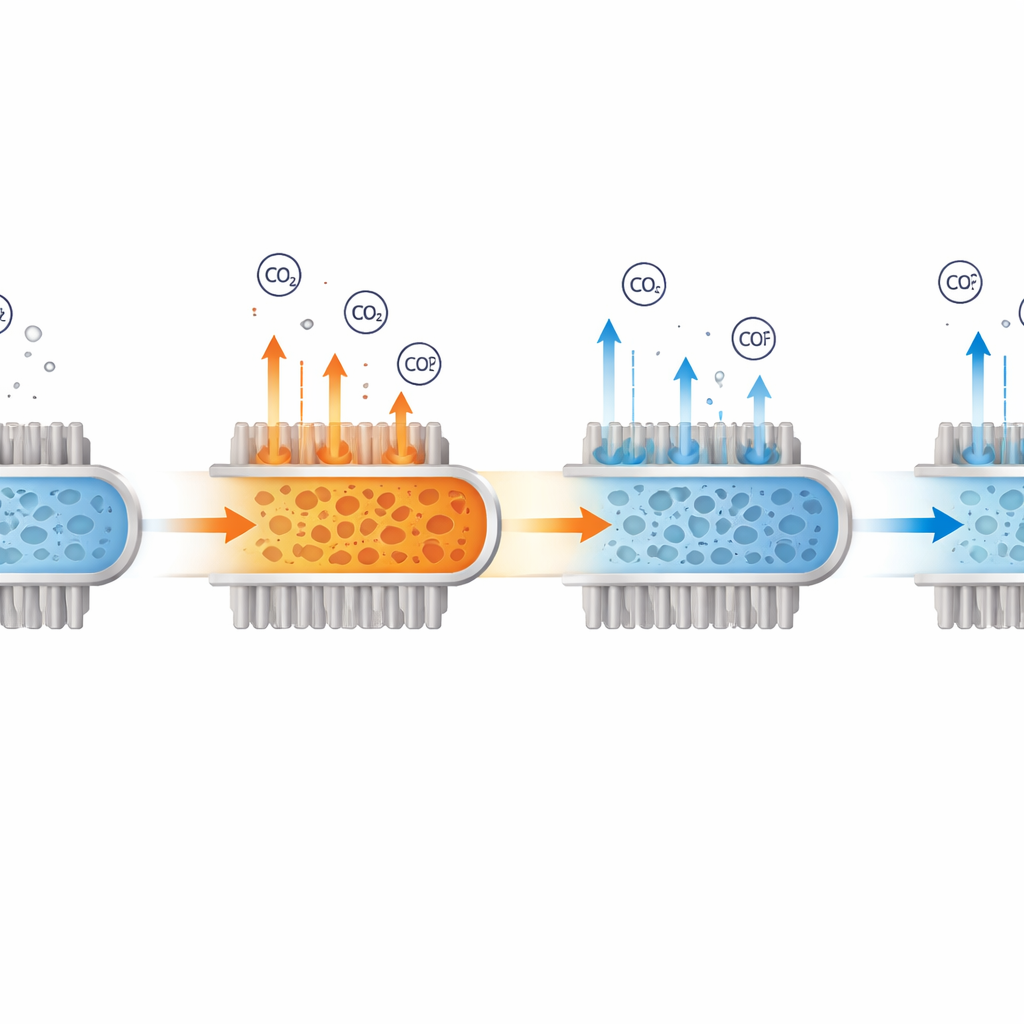
The team built a batch-style setup: the MOF-coated heat exchanger sits inside a sealed pressure vessel, connected to a compressor and a separate gas tank. By rapidly raising the CO₂ pressure from 0.8 to 3.0 megapascals, they force CO₂ into the MOF, which warms up and then heats the water flowing through the tube. Dropping the pressure back down makes CO₂ leave the MOF, cooling it and chilling the water instead. Under typical test conditions—room-temperature water entering at a modest flow rate—the system changed the outlet water temperature by about plus or minus 9 kelvin (roughly plus or minus 9 °C), and nearly all of the CO₂ uptake or release occurred within two minutes. Each cycle moved about 20 kilojoules of heat, with around 81% of that energy successfully passed into the water.
What Controls the Performance
To understand how to get the most from this approach, the researchers varied several operating conditions. The size of the pressure swing turned out to be the main driver of total heating and cooling: larger swings and lower overall pressures led to more CO₂ moving in and out of the MOF, and therefore stronger thermal effects. Changing how fast the pressure rose or fell mainly altered how sharp the temperature peak was, not the total energy moved per cycle. Likewise, the inlet water temperature had only a small influence, confirming that the key source of heat is the CO₂ sticking to and leaving the MOF, rather than simple warming or cooling of the gas itself. In contrast, the water flow rate had a strong effect on power: faster flow did not make the water much hotter or colder at its peak, but it shortened the time needed for a cycle and increased the average heating and cooling power.
Peering Inside the Heat Exchanger
Because the MOF layer and the water are both changing temperature over time, standard steady-state heat exchanger formulas are not enough to predict behavior. The authors therefore built a detailed computer model that simulates mass, momentum, and energy transport in the MOF bed, metal tube, and water. They calibrated the model using known properties of CO₂ in MIL-101(Cr) and compared its predictions with their measurements. The match was good: the simulations reproduced how the MOF and water temperatures evolved along the tube and how different water flow rates changed the heating power. This gives confidence that the model can be used to design and optimize future devices without having to build and test every variant.
Why This Matters for Future Heat Pumps
Together, the experiments and simulations show that pressure-driven CO₂ adsorption can reliably deliver useful heating and cooling at pressures below CO₂’s critical point, avoiding some of the safety and design challenges of today’s high-pressure CO₂ systems. The prototype works in batch mode rather than continuously, but it proves the underlying physics and identifies practical limits, especially the need to improve heat transfer on the water side of the device. With better exchanger designs, multiple beds working in sequence, and integration with thermal storage, this concept could lead to new classes of heat pumps that use climate-friendly CO₂ and advanced porous materials to heat and cool homes and buildings more safely and efficiently.
Citation: Hu, MH., Boccamazzo, F., Shamim, J.A. et al. Demonstrating pressure-driven heating and cooling using a MOF-coated heat exchanger. npj Therm. Sci. Eng. 1, 7 (2026). https://doi.org/10.1038/s44435-026-00006-5
Keywords: carbon dioxide heat pump, adsorption cooling, metal-organic framework, low-pressure refrigeration, sustainable HVAC