Clear Sky Science · en
Heat and air pollution shape divergent mortality patterns across rural and urban United States
Why Heat and Dirty Air Matter for Everyday Life
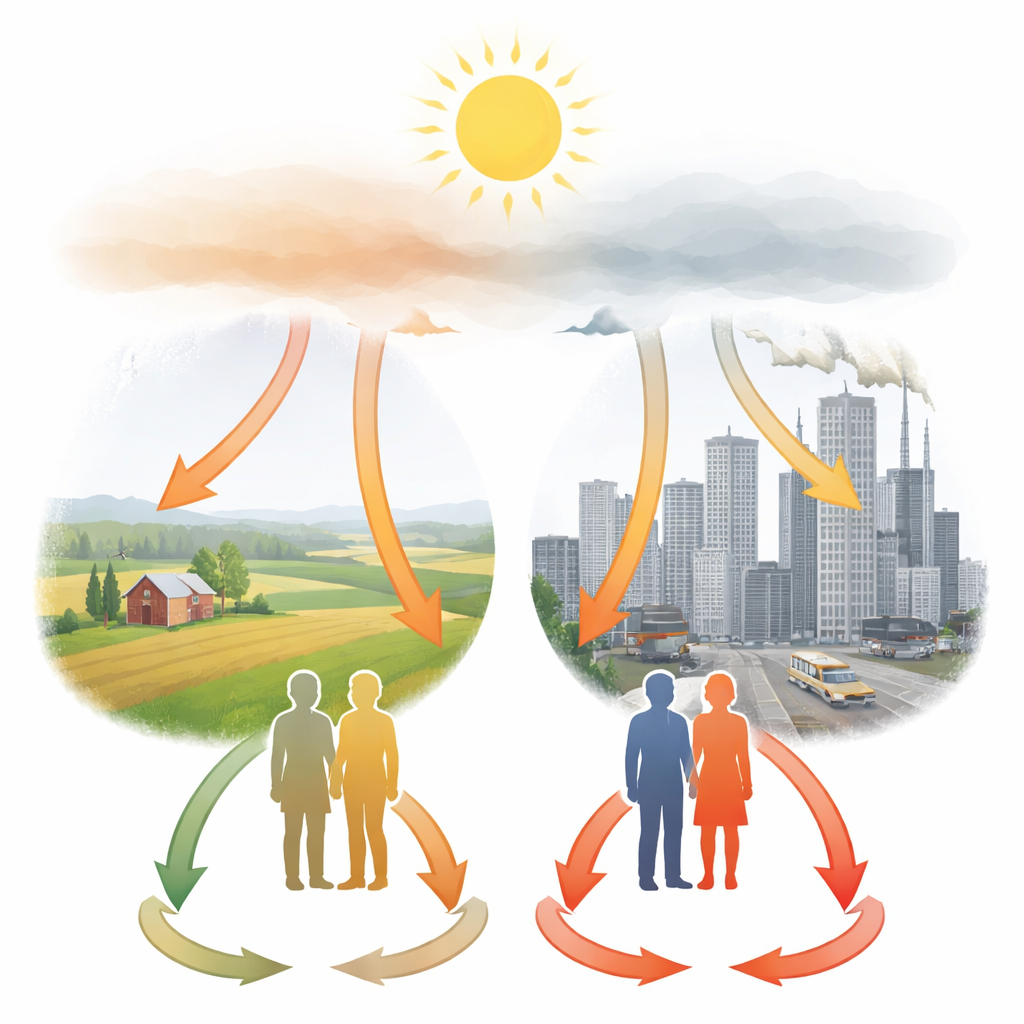
As summers grow hotter and hazy skies become more common, many people wonder what this means for their health and their families. This study looks across the entire United States to ask a simple but urgent question: how do heat and air pollution together change the risk of dying from heart and lung diseases in different places and at different ages? By comparing rural counties with cities from 2009 to 2019, and by focusing on infants, children, working-age adults, and older adults, the authors uncover surprising patterns that challenge the usual story that rural America always fares worse.
Looking Beyond Germs and Doctors
For decades, health experts have stressed that where you live, your income, education, and access to care shape your chances of living a long life. This “social determinants” approach has explained a large share of differences in health and life expectancy. Yet the physical environment—especially temperature and air quality—has often sat in the background of these discussions. The authors bring these missing pieces to the forefront. They combine detailed county-level records on deaths from cardiovascular (heart and blood vessel) and chronic respiratory (long-term lung) diseases with high‑resolution maps of heat and fine particle pollution, along with census-based measures of income, schooling, insurance coverage, and poverty. This allows them to tease apart how weather and dirty air add to, or sometimes counteract, the usual social risks.
How the Study Was Done
The team analyzed more than a decade of data for over 3,000 U.S. counties, focusing on four age groups: infants (up to age one), children and adolescents, working‑age adults, and older adults. They tracked how annual average temperature and levels of tiny airborne particles (PM2.5) were linked with county death rates from heart and lung diseases, while holding constant differences in income, education, health insurance, poverty, and population size. Crucially, they examined how heat and pollution interact with each other and how these combined effects differ between rural and urban counties. This design reveals not only whether hotter or more polluted places have higher death rates, but also whether the risks rise faster in some communities than in others.
When Rural Areas Suffer and When They Are Shielded
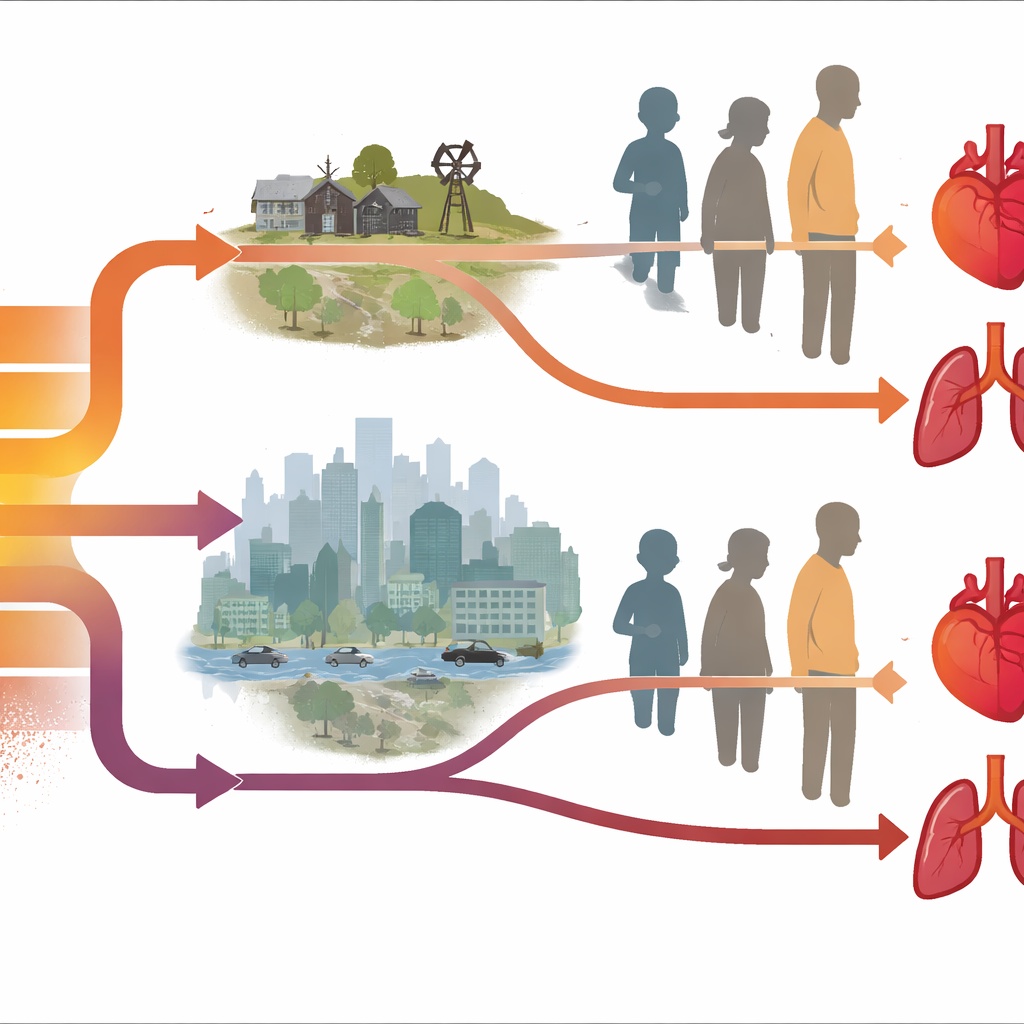
The results show that hotter conditions are generally tied to higher death rates, especially when fine particle levels rise, confirming that climate change and air pollution together pose a serious threat. For heart disease, the study finds a clear rural disadvantage among infants. In rural counties, infant deaths from cardiovascular causes climb sharply as temperatures and particle levels increase, much more than in cities. The authors suggest that longer travel times to specialized care and slower emergency responses may leave rural infants especially exposed when heat and bad air strike. Working‑age adults, by contrast, show a different pattern: in rural areas their heart‑related death rates eventually decline at very high temperatures and particle levels, hinting that people may change their behavior—such as cutting back outdoor work or activity—when conditions become obviously dangerous. In cities, working‑age adults see their heart‑related risks continue to rise as temperatures climb, perhaps because of the urban heat island effect and jobs that keep people exposed despite the danger.
Unexpected City Burdens on the Lungs
For long‑term lung diseases, the story flips in surprising ways. Across all ages, higher temperatures tend to raise respiratory deaths, but the way particle pollution interacts with heat differs sharply between rural and urban counties. In many rural areas, as particle levels increase, lung‑related death rates actually level off or decline compared with cities. This “rural paradox” is especially strong for children, working‑age adults, and older people. The authors argue that rural residents may benefit from lower baseline pollution, more green space, and different kinds of jobs that limit time spent in traffic or heavy industry. Urban residents, by contrast, face a clear “urban penalty”: dense traffic, industry, and heat‑trapping buildings can trap both heat and pollutants, leading to steadily higher lung‑related death rates as temperatures and particle levels rise, particularly for working‑age adults who may be stuck in high‑exposure occupations.
What This Means for Policy and Daily Life
Overall, the study concludes that heat and air pollution do not harm all communities in the same way. Rural America still carries a heavy burden for infant deaths from heart disease, partly because of weaker health infrastructure, but rural areas can be relatively protective for lung diseases in older children and adults. Cities, on the other hand, pay a steep price in respiratory deaths, particularly among people in their prime working years, due to concentrated pollution and extreme heat. These findings suggest that protecting health in a warming world will require tailored solutions: better emergency and specialty care for rural infants, stronger workplace protections, cleaner air, and cooler urban design for city dwellers. For readers, the message is clear: climate and clean air policies are not abstract—they directly shape the odds that people of different ages, in different places, will live long, healthy lives.
Citation: Zhou, S., Liao, C., Wei, Z. et al. Heat and air pollution shape divergent mortality patterns across rural and urban United States. npj Environ. Soc. Sci. 1, 4 (2026). https://doi.org/10.1038/s44432-025-00005-x
Keywords: heat and health, air pollution, rural urban disparities, cardiovascular mortality, respiratory disease