Clear Sky Science · en
Engineering interfacial adhesion of thin polymer films via nanoscale heterogeneity
Why tiny particles matter for sticky materials
Adhesives are everywhere, from bandages and flexible electronics to protective coatings and soft robots. Yet making something that sticks just enough, peels off cleanly, and can be tuned for different partners is surprisingly hard. This study shows how sprinkling tiny solid particles inside a soft rubber-like material gives engineers a new dial for controlling how strongly two surfaces stick together, and even whether they prefer to stick to “like” or “unlike” partners.
Soft films and hidden specks
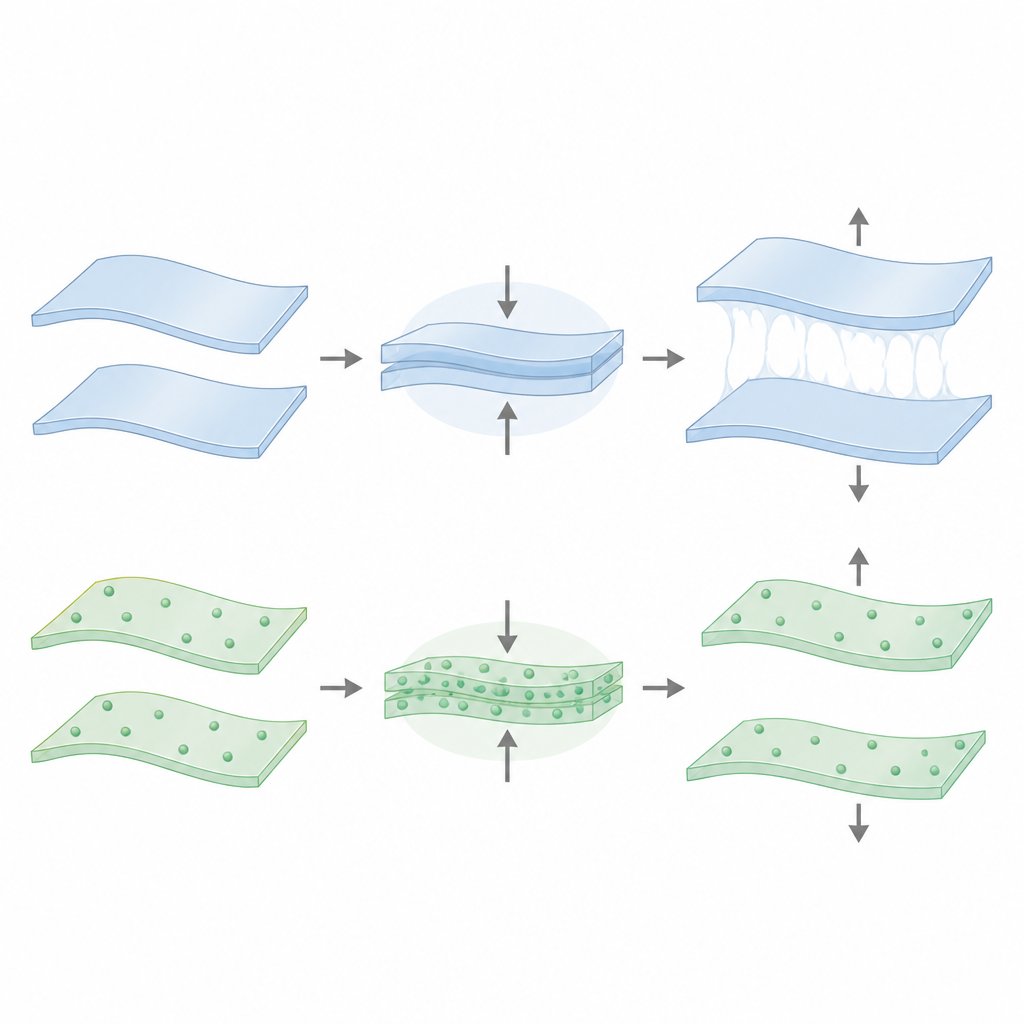
The researchers worked with a popular soft material called PDMS, a silicone rubber used in everything from medical devices to microfluidic chips. They created thin films of pure PDMS and films where they mixed in very small silica particles, each thousands of times smaller than a grain of sand. These particles were treated so that they blended well with the rubber. By changing how many particles they added, they could make films with different levels of internal “speckling” while keeping the overall surfaces smooth to the naked eye.
Watching a crack creep between stuck layers
To measure how well two films stick to each other, the team used a simple but powerful test. Two films were pressed together, and a very thin glass strip acted like a wedge that opened a small gap at one edge. When the pressing force was released, a crack began to grow between the two layers, slowly peeling them apart. Under a microscope, the scientists tracked how far and how fast this crack moved over time. From this motion, they could calculate how much energy was stored in the stretched films and how much energy was needed to keep the crack moving or to stop it.
Same vs different: selective sticking
The twist in this work is that the researchers compared pairs of films that were either the same or different on the inside. In “identical” pairs, both films had the same amount of nanoparticles. In “non-identical” pairs, one film was pure PDMS and the other contained particles. When both sides were equally speckled, adding more nanoparticles made the films stick more strongly. The crack had to travel farther and slow down more before stopping, meaning more energy was needed to pull the layers apart. But when only one side contained particles, the opposite happened. The interface became less compatible, the crack moved more easily, and the overall sticking strength dropped compared with pure PDMS on both sides.
How hidden structure reshapes energy and stress
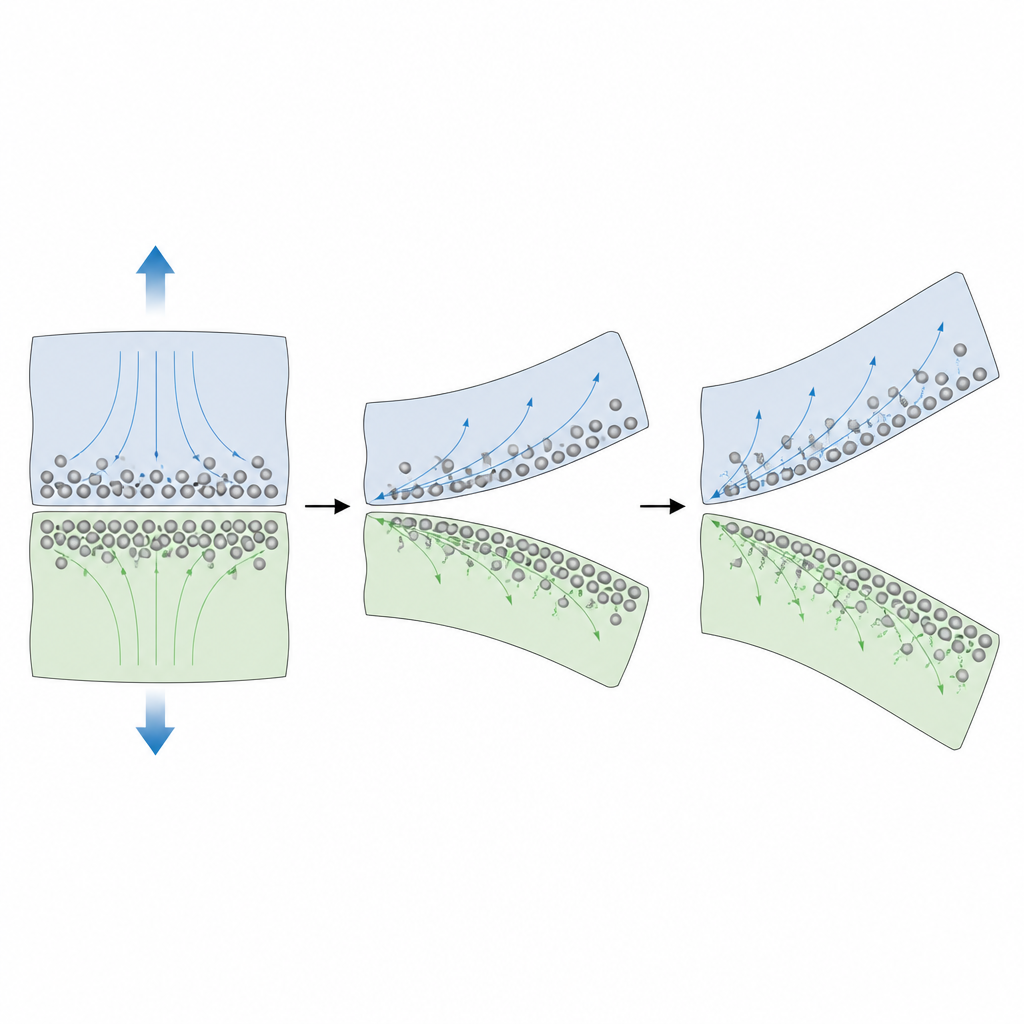
By stretching the films separately, the team showed that adding nanoparticles makes the rubber stiffer. Inside the material, the particles squeeze the polymer chains, leaving them less free to move and helping them carry load more effectively. Near a growing crack, this creates regions where stiffness and surface energy vary over very small distances. These variations change how stress is focused at the crack tip and how energy is released as the crack advances. When both sides have the same internal structure, these effects work together to resist crack growth. When only one side is speckled, the imbalance in stiffness and internal structure drives the system toward easier separation.
What this means for future smart adhesives
In simple terms, this study shows that tiny particles hidden inside a soft material can act like a secret control knob for stickiness. By choosing how many particles to add, and whether they appear on one side or both, engineers can design joints that grab strongly to matching surfaces but let go more easily from mismatched ones. Such control over “who sticks to whom” could help create smarter coatings, reusable tapes, detachable soft devices, and layered materials that are tough where needed yet easy to disassemble when desired.
Citation: Majhi, C., Gupta, S., Singh, M.K. et al. Engineering interfacial adhesion of thin polymer films via nanoscale heterogeneity. npj Soft Matter 2, 13 (2026). https://doi.org/10.1038/s44431-026-00024-x
Keywords: polymer adhesion, nanoparticles, PDMS, interfacial mechanics, soft materials