Clear Sky Science · en
Beyond spatiotemporal modeling: a review of applications of machine learning for traffic-related air pollution toward non-exhaust emissions
Why traffic dust still matters
Many cities are cleaning up car exhaust, yet traffic remains a major source of harmful air pollution. This review article explains how modern computer methods, known as machine learning, are being used to better track and understand traffic-related air pollution, especially the tiny particles that come from worn brakes, tires, and road dust rather than from the tailpipe. These insights can help city planners and health experts design smarter policies to protect people who live, work, and play near busy roads.
From exhaust fumes to invisible road wear
Traffic-related air pollution includes both gases and particles. For years, most attention has gone to exhaust from burning fuel, such as nitrogen oxides and fine particles that damage the lungs and heart. Rules and cleaner engines have steadily reduced these tailpipe emissions. But particles from brake wear, tire wear, road surface grinding, and resuspended dust now make up a growing share of what we breathe near roadways. These non-exhaust sources are harder to measure and control, yet they carry metals and other substances linked to asthma, heart disease, and possibly conditions such as childhood autism and Parkinson’s disease.
Teaching computers to map dirty air
Because it is impossible to place air monitors on every street corner, researchers use machine learning to fill in the gaps. By feeding models with information about traffic levels, land use, weather, and readings from fixed and mobile sensors, they can create detailed maps of pollutants such as fine particles, metals, and traffic gases across a city. Tree-based methods and deep learning often capture complex patterns in these data, while newer graph methods treat monitoring sites and roads as a connected network. These techniques help reveal when and where people are most exposed, but they also struggle with patchy data, inconsistent inputs, and the challenge of making models trained in one city work well in another. 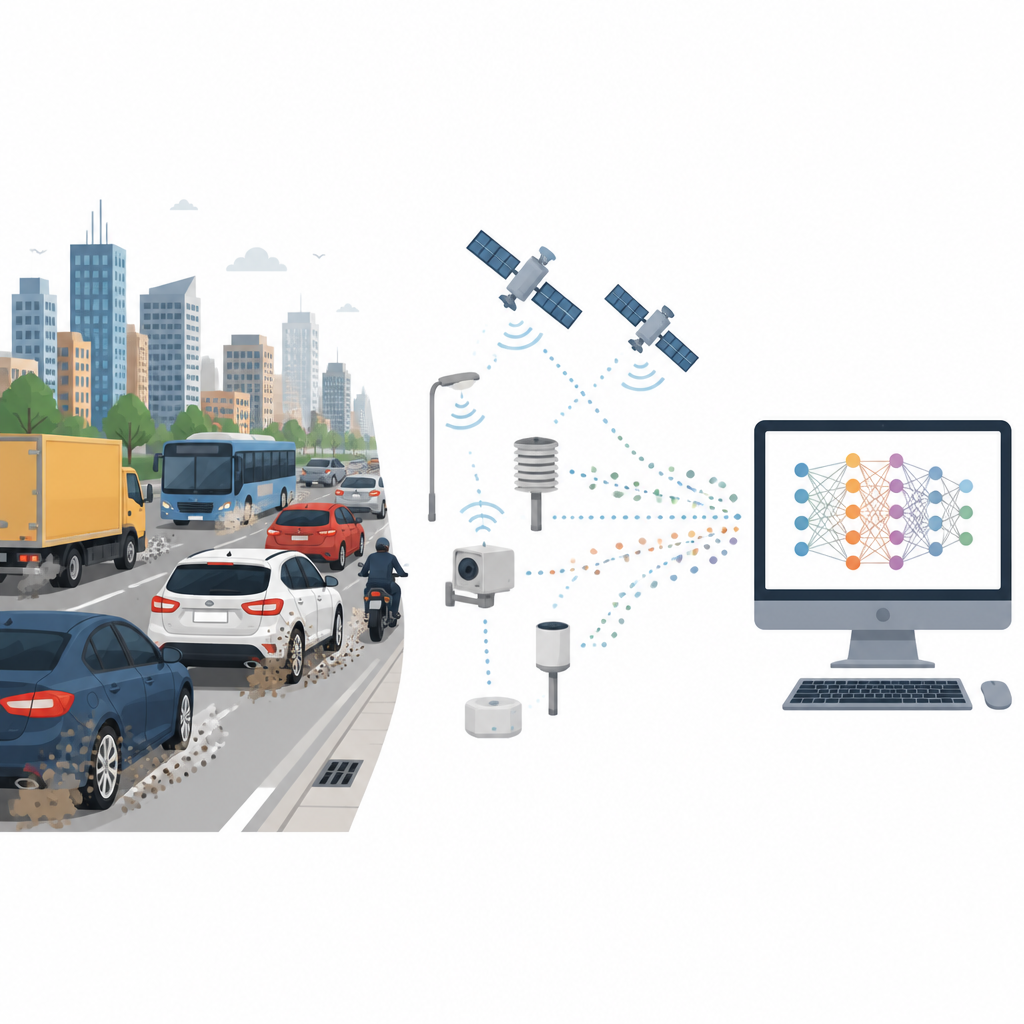
Finding what matters most on the road
Beyond mapping, machine learning can highlight which factors most strongly influence pollution levels. By examining how model predictions change when inputs such as driver behavior, vehicle type, braking intensity, or weather shift, researchers can infer which patterns deserve closer attention. Studies suggest, for example, that hard braking, older vehicles, and certain brake pad materials raise fine particle emissions. However, these importance rankings do not prove cause and effect and can be distorted by hidden links among variables. The authors stress that such results must be checked against physical understanding and tested across different cities before guiding policy.
Zooming in on brake and tire particles
Some of the most innovative work uses machine learning to sort and classify individual particles from road dust and air samples. Powerful microscopes and chemical sensors produce huge image and composition datasets for thousands of particles. Algorithms then learn to distinguish tire wear, brake wear, road minerals, and other particle types that would be tedious and error prone to classify by hand. Lab studies of brake and tire systems use similar models to link design choices, such as pad metal content or braking patterns, to how much particulate matter is released. These methods are beginning to separate non-exhaust pollution from other sources, opening the door to more targeted tests of toxicity and cleaner materials. 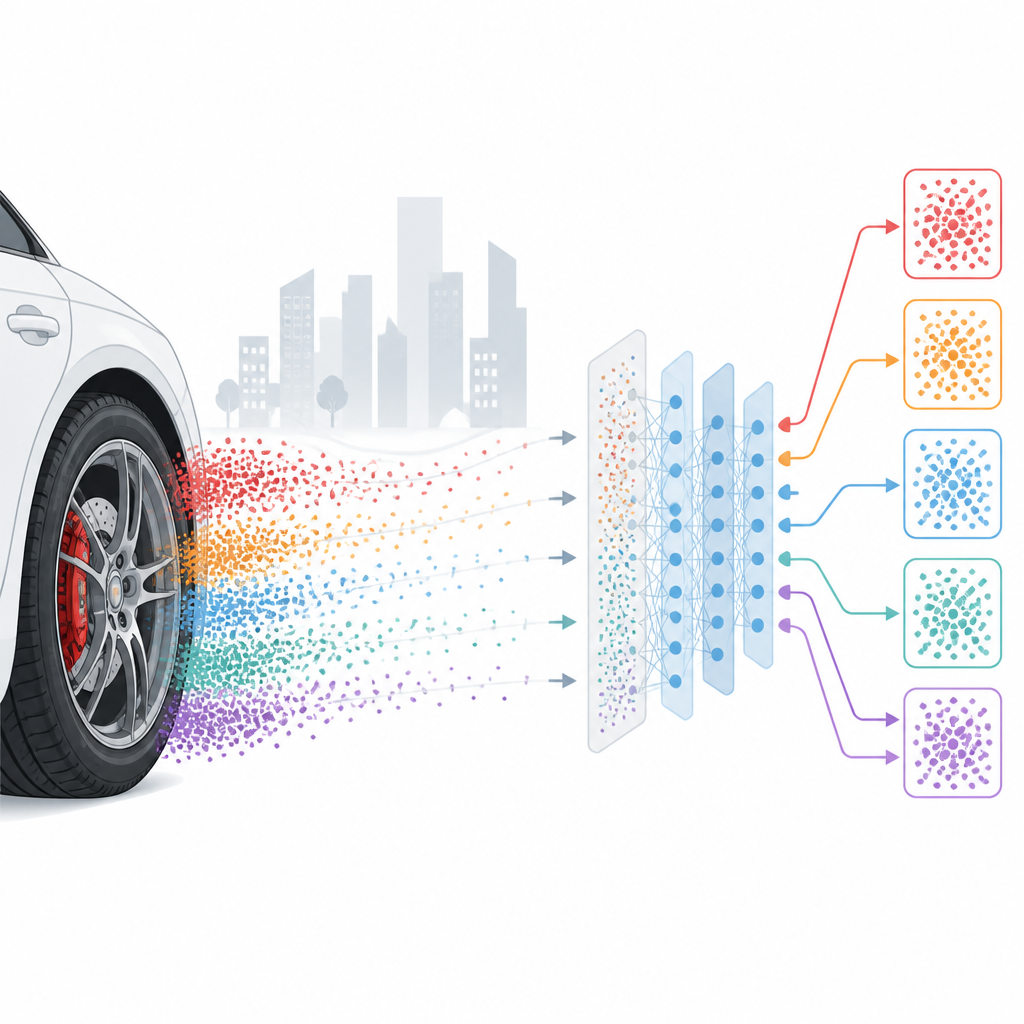
Tracing where pollution comes from
Knowing how much pollution comes from which source is crucial for smart regulation. Traditional statistical tools estimate how much of the measured particles can be traced to traffic, industry, or other contributors. Machine learning now offers fresh ways to group samples with similar chemical fingerprints and to classify likely sources using properties such as magnetic behavior. Early work suggests these tools can match or complement older methods while handling more complex data, though they still rely on careful expert interpretation to avoid mislabeling sources.
What this means for city air and health
Overall, the review concludes that machine learning has become a powerful partner for studying traffic-related air pollution, especially the rising problem of non-exhaust emissions. It helps build finer maps of exposure, reveal patterns in driving and vehicle design that raise or lower emissions, and untangle the mix of particles swirling along our roads. At the same time, limited data, unclear model choices, and weak transfer from one place to another remain major hurdles. The authors argue that progress will depend on better sensors, shared datasets, and methods that blend human expertise with transparent algorithms. Together, these steps can support policies that cut harmful particles from traffic and help protect public health in increasingly motorized cities.
Citation: Ho, N., Dhayade, S., Zhang, Y. et al. Beyond spatiotemporal modeling: a review of applications of machine learning for traffic-related air pollution toward non-exhaust emissions. npj Clean Air 2, 33 (2026). https://doi.org/10.1038/s44407-026-00078-1
Keywords: traffic air pollution, non-exhaust emissions, machine learning, brake and tire wear, urban air quality