Clear Sky Science · en
Sunlight can turn smoldering pine wood smoke into a glass
Why wildfire smoke can behave like glass
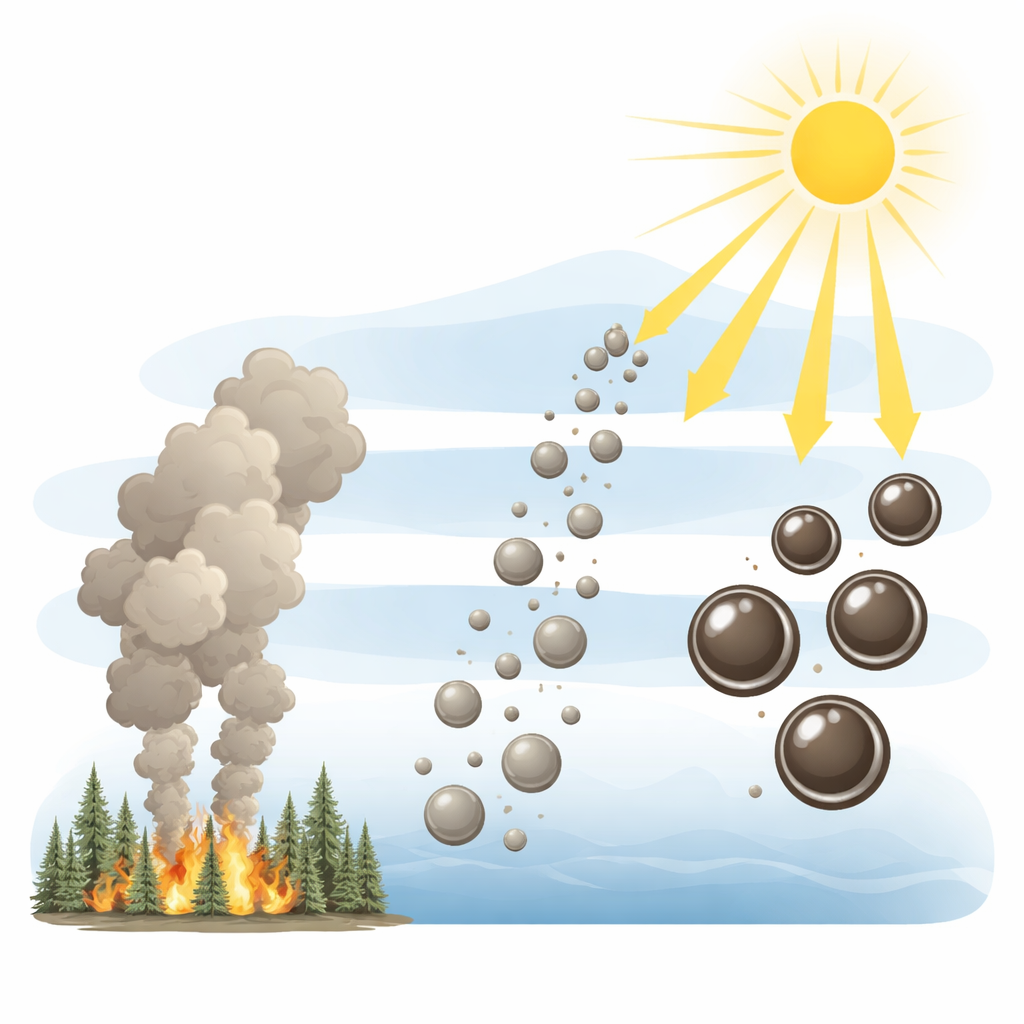
Wildfires don’t just darken the sky for a few days and then blow away. Tiny droplets in the smoke can drift high into the atmosphere, where they affect air quality, cloud formation, and even the ozone layer that shields us from harmful radiation. This study explores an unexpected twist: under the steady gaze of sunlight, some of these smoke particles from smoldering pine wood can partially harden into a glass-like material, changing how they interact with the surrounding air and chemicals.
From forest fires to airborne particles
When forests burn, they release vast numbers of microscopic particles known as biomass burning organic aerosols. These particles already make up a large share of the world’s organic haze and can be lofted by powerful fire-driven storms all the way into the stratosphere, where they can linger for months. While they float, the particles are bathed in ultraviolet light from the sun. Scientists know that the physical state of these particles—whether they are liquid, semi-solid, or glassy—can strongly influence how they affect climate, clouds, and ozone. Yet, until now, no one had directly measured how simple exposure to UV light changes the consistency and internal structure of real wildfire smoke particles.
Watching particles change shape and flow
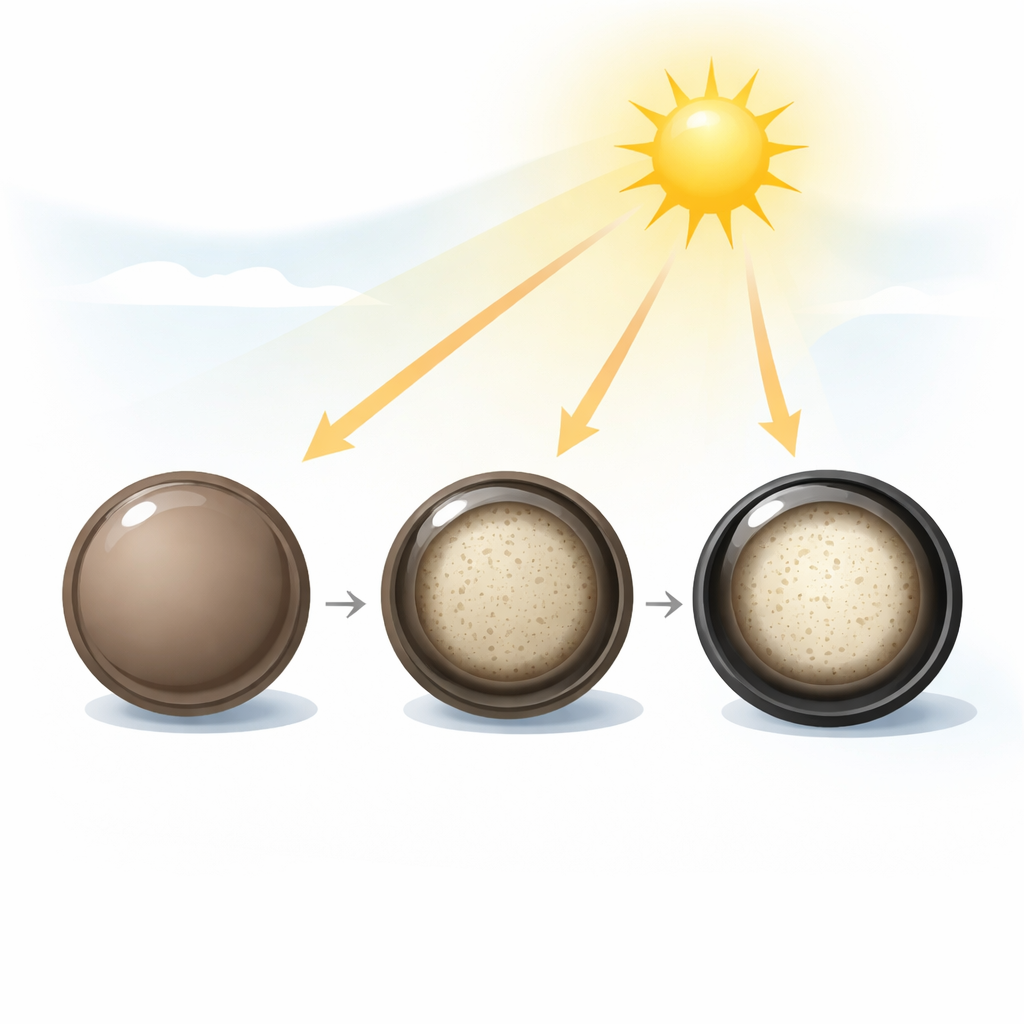
The researchers generated smoke by slowly burning pine wood in the lab and collected the particles on special glass slides. Using a powerful fluorescence microscope, they examined the particles before and after shining 300-nanometer UV light on them for periods that mimic up to about nine sunny days in the lower atmosphere. Unexposed particles showed two main regions: an inner, more water-attracting core and an outer, more water-repelling layer. After several days of simulated sunlight, however, a new bright outer shell appeared, wrapping each particle in a distinct layer a few micrometers thick.
Smoke droplets that stop flowing
To test how easily these particles could flow, the team used a “poke and watch” method. They gently jabbed individual particles with a tiny needle and recorded how quickly the resulting indentation closed. Fresh particles behaved like thick but flowing liquids: the poked hole disappeared in less than a second, indicating a relatively low resistance to flow. Sun-aged particles were dramatically different. After a few days of UV exposure, the holes closed much more slowly, meaning the material had become several thousand to tens of thousands of times more viscous. After nearly nine days of equivalent sunlight, poking caused the outer layer to crack into shards that did not heal, even when watched for hours. Calculations showed that this cracked shell was at least a hundred million times more viscous than water—effectively a glass. Remarkably, these rigid fragments stayed sharp-edged up to about 60 percent relative humidity, showing that the glassy coating persists even in fairly moist air.
Chemistry that builds heavier, stickier molecules
Why does sunlight create this glassy shell? High-resolution mass spectrometry revealed that UV exposure shifts the particle chemistry toward larger, more oxygen-rich molecules. The average molecular weight increased, and so did the ratio of oxygen to carbon atoms. Previous research has shown that heavier, more highly oxygenated organic molecules tend to make materials more viscous. The authors suggest that sunlight triggers reactions in common carbonyl groups and through so-called photosensitized pathways, creating reactive species that join smaller fragments into larger structures and add oxygen. Because 300-nanometer light does not penetrate very deeply into big lab particles, only the outer few micrometers hardened into glass. But real atmospheric smoke particles are much smaller, so sunlight could transform the bulk of each particle rather than just the surface.
What this means for climate and the ozone layer
Combining their measurements with global climate model data on temperature and humidity, the authors estimate that UV-aged wildfire smoke is likely to be glassy throughout much of the free troposphere and stratosphere, often within just over a week of exposure. In many regions, this makes particles up to eight orders of magnitude more viscous than if no UV aging occurred. Such rigidity slows the movement of gases and reactive molecules inside the particles, potentially delaying the fading of brown carbon that absorbs sunlight, altering how pollutants are transported, and hindering key chemical reactions that control ozone in the upper atmosphere. In simple terms, the study shows that sunlight can turn parts of wildfire smoke into microscopic glass beads, subtly but powerfully reshaping their role in Earth’s climate and protective ozone shield.
Citation: Golay, Z.M., Vandergrift, G.W., Kamal, S. et al. Sunlight can turn smoldering pine wood smoke into a glass. npj Clean Air 2, 29 (2026). https://doi.org/10.1038/s44407-026-00070-9
Keywords: wildfire smoke, atmospheric aerosols, sunlight aging, glassy particles, ozone and climate