Clear Sky Science · en
Trends and source contributions of particle number size distribution over 2020-2024 in coastal city of Southeast China
Why Tiny Air Particles Matter Here and Now
Invisible specks floating in the air may seem far removed from daily life, yet they quietly shape our health, our local weather, and even global climate. This study focuses on these tiny particles in Xiamen, a warm, humid coastal city in Southeast China. By tracking how the number and size of airborne particles changed from 2020 to 2024, the researchers reveal how city life, changing weather, and natural chemical reactions in the air combine to influence what we breathe—offering clues that are relevant to many coastal cities worldwide.
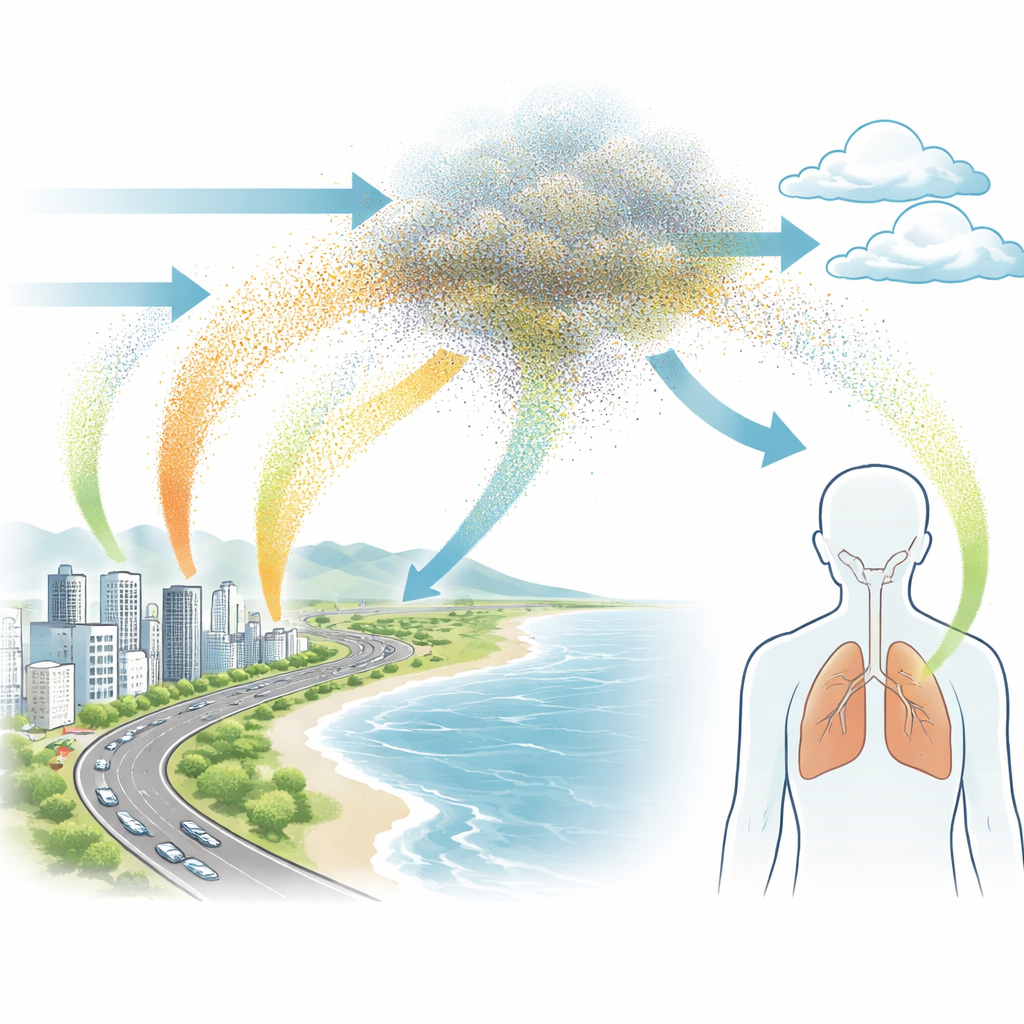
A Coastal City’s Hidden Air Profile
The team continuously measured airborne particles between 7 and 300 nanometers—sizes far smaller than the width of a human hair—above an urban neighborhood near Xiamen’s shoreline. They also recorded common air pollutants, sunlight levels, temperature, humidity, and wind. Compared with China’s big inland megacities, Xiamen’s overall particle pollution was relatively low and stayed below national limits for fine particle mass. Yet the number of tiny particles in the air was still much higher than at pristine coastal locations, showing that local human activity strongly shapes the city’s atmosphere despite its cleaner reputation.
Rising, Falling, and Rising Again
To separate short-term swings from deeper patterns, the researchers used a time-series filter that teases apart daily, seasonal, and long-term changes. They found that the number of particles generally declined from 2020 to 2022, then rebounded in 2023 and stabilized afterward. This pattern lined up with strict emission controls and reduced human activity in the early part of the period, followed by a gradual return to normal life once pandemic-related restrictions eased. Over the whole period, particles in the intermediate size range associated with traffic and other combustion sources became more important, while the very smallest particles ended up slightly lower than at the beginning, suggesting that some types of emissions were better controlled than others.
Birth of New Particles in the Sky
A key focus of the study is “new particle formation” events—moments when gases in the air suddenly combine to create swarms of ultrafine particles that can later grow larger. These events turned out to be surprisingly common in Xiamen, occurring on more than one out of every three days and peaking in summer and autumn. On these days, a burst of extremely small particles appeared and then expanded in size over several hours. The researchers tracked how fast these newborn particles grew and estimated how much a key ingredient, sulfuric acid, contributed. They found that growth slowed from 2020 to 2021, then sped up again and leveled off, while sulfuric acid itself showed a steady decline. This mismatch implies that other vapors—likely from human activities and natural processes—also play a major role in building new particles in this coastal air.
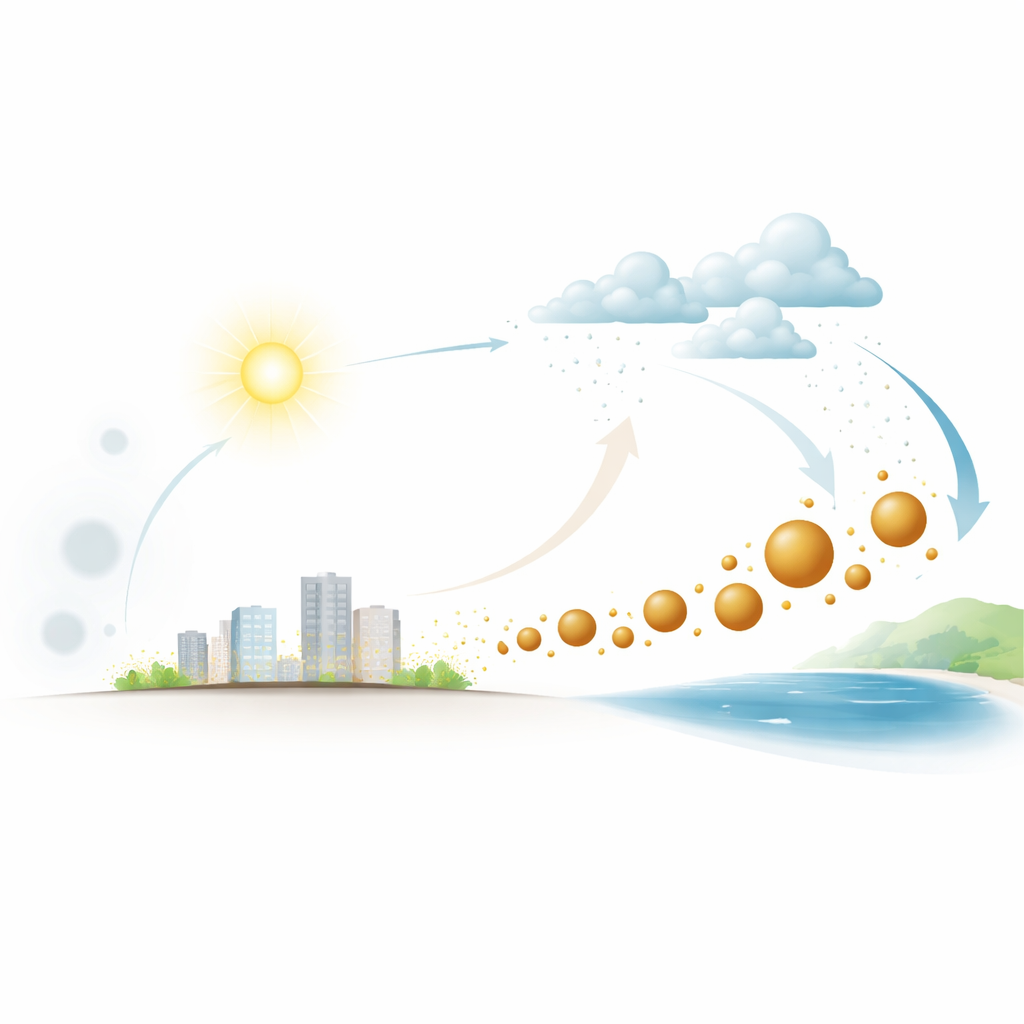
Weather, Winds, and City Life Working Together
To untangle the roles of weather and human activity, the team applied a machine learning technique that “de-weathered” the data—essentially asking what particle levels would look like if the meteorology stayed constant. This analysis showed that changes in emissions from people and vehicles were the dominant force behind long-term shifts in particle numbers, including the rebound after 2022. Among weather factors, sunlight and north–south winds stood out. Stronger sunlight favored the birth of new particles by driving chemical reactions, while winds along the coast funneled polluted or cleaner air into the city. A clustering analysis of particle size patterns further revealed several distinct “source fingerprints,” including background urban air, everyday and heavy traffic, pollution transported from other regions, particles formed by daytime sunlight chemistry, and particles produced or transformed at night.
What This Means for Coastal City Air
In simple terms, this work shows that even in a coastal city with relatively modest particle pollution, what people do on the ground and how the air moves overhead tightly control the invisible dust we breathe. New particle formation alone supplied roughly one-sixth to one-quarter of all ultrafine particles, especially in the warm seasons, while traffic remained a major year-round contributor. The study’s five-year record demonstrates that sustained emission controls can lower particle numbers, but that gains can quickly erode as activity rebounds. By clarifying how local emissions, chemical reactions, and regional winds interact over the land–sea boundary, the findings offer a scientific foundation for smarter air-quality policies that protect both public health and climate in coastal cities.
Citation: Li, L., Li, M., Fan, X. et al. Trends and source contributions of particle number size distribution over 2020-2024 in coastal city of Southeast China. npj Clean Air 2, 25 (2026). https://doi.org/10.1038/s44407-026-00069-2
Keywords: ultrafine particles, coastal air pollution, new particle formation, urban emissions, atmospheric chemistry