Clear Sky Science · en
Unified modeling of the formation and evolution of secondary organic aerosol from oxygenated aliphatic precursors over long-time oxidation
Why this research matters for city air
Fine particles in city air are linked to heart and lung disease, climate change, and hazy skies, yet scientists still struggle to predict exactly where many of these particles come from. This paper focuses on a surprisingly important and fast-growing source: everyday products and activities that release oxygen-rich vapors, such as cooking and modern paints. By building a simpler but still accurate way to model how these vapors turn into harmful fine particles over many days, the study helps improve air-quality forecasts and supports smarter pollution controls.
Invisible vapors from kitchens and products
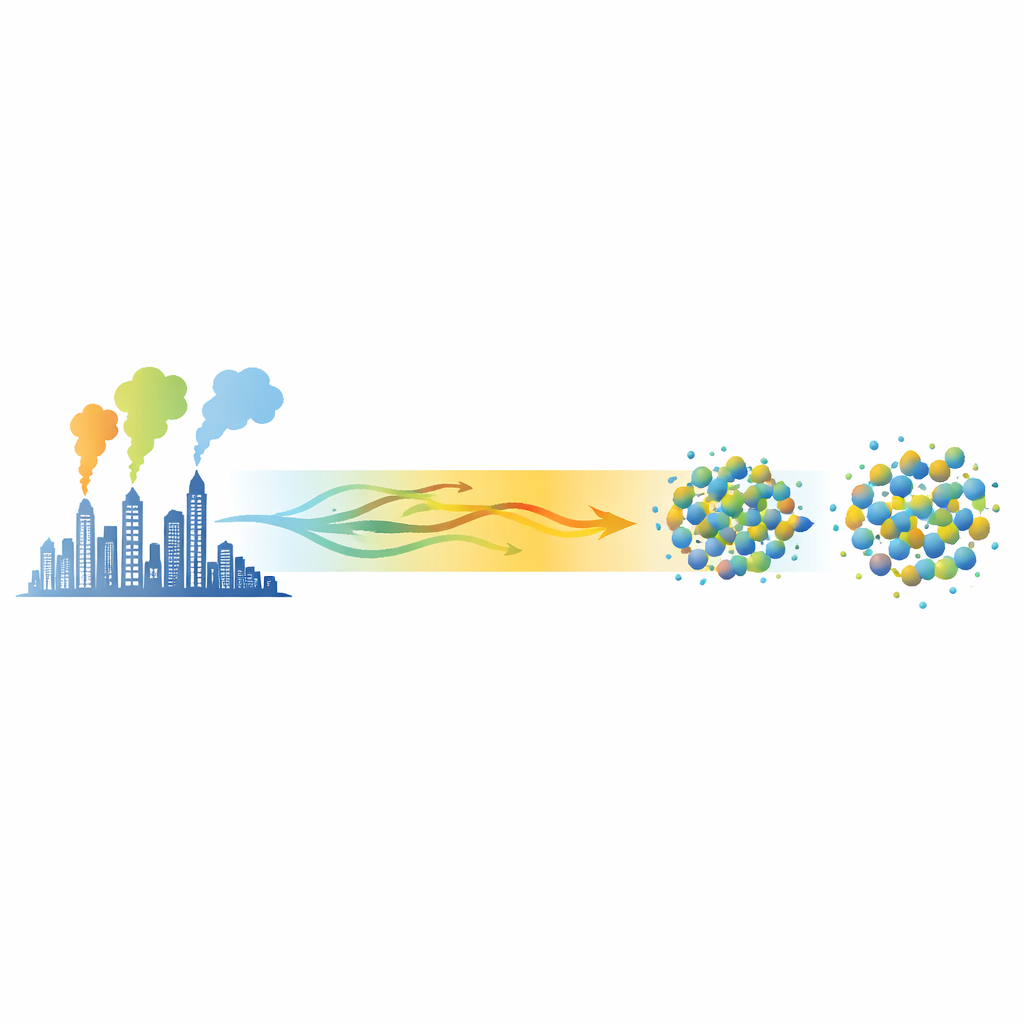
When we cook with high heat or use paints and other chemical products, we release a cocktail of organic gases into the air. A large share of these are oxygenated aliphatic compounds—molecules that already contain oxygen and often smell like solvents or flavorings. In Chinese cities, they dominate emissions from cooking and water-based paints and are also found in traffic and other sources. As these vapors drift outdoors, sunlight and atmospheric oxidants gradually transform them into secondary organic aerosol (SOA): tiny particles that can lodge deep in the lungs and influence clouds and climate. Because this family of vapors is chemically diverse and evolves through many reaction steps, existing air-pollution models either oversimplified them or treated each compound separately, making calculations slow and sometimes misleading.
A unified way to follow particles over many days
The authors set out to build a single, efficient framework that could capture how a broad set of oxygenated vapors turn into particles and then continue to age in the atmosphere. They combined detailed lab experiments in oxidation flow reactors—devices that mimic days to weeks of sunlight in a compact chamber—with a powerful modeling approach. First, they used an explicit chemistry tool to simulate the very first round of reactions that each gas undergoes, generating a realistic mix of early products. Then they fed these products into a two-dimensional “map” that tracks how compounds change in volatility (how easily they evaporate) and in oxygen content as they keep reacting. Using a genetic algorithm, they tuned a small set of parameters so that the model matched measured particle masses and chemical fingerprints for nine representative oxygenated compounds, including long- and short-chain aldehydes, ketones, and alcohol esters.
How particles grow, age, and sometimes shrink
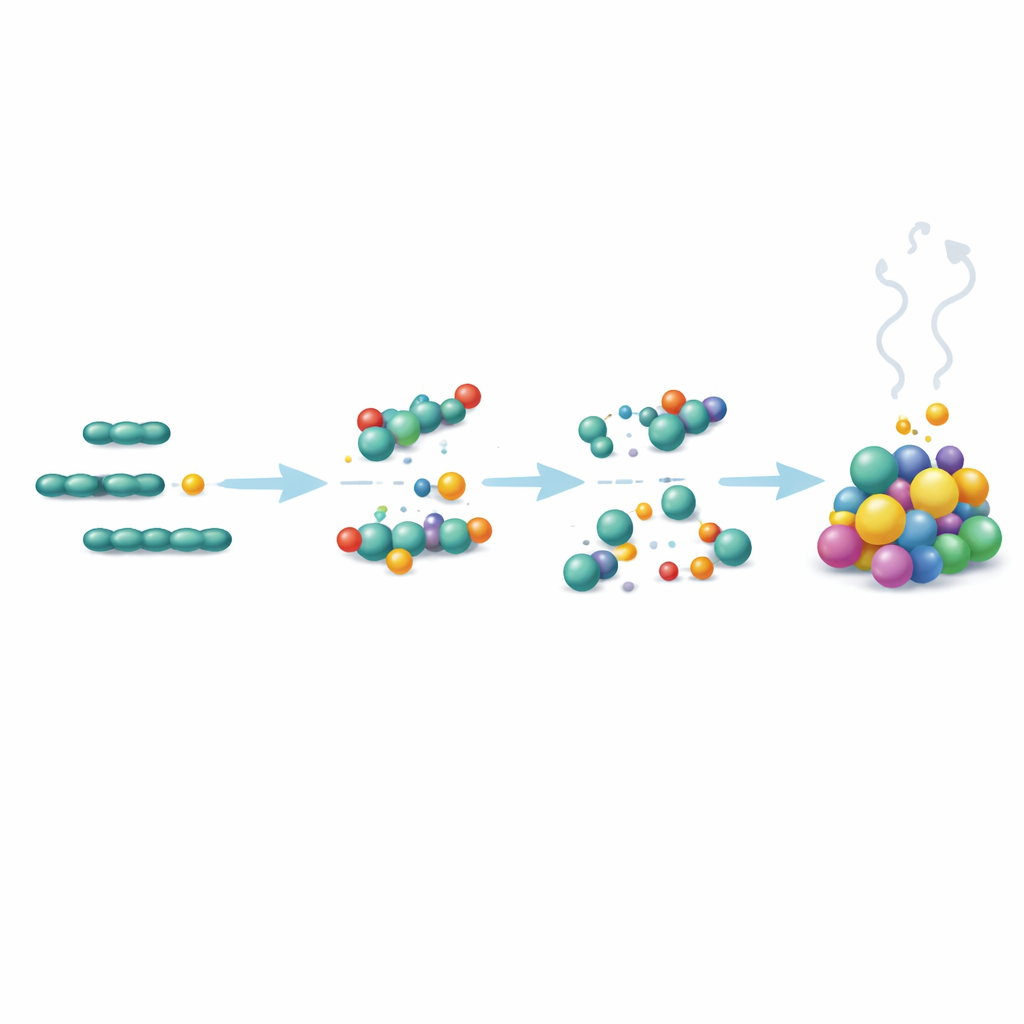
The long-duration experiments revealed a two-stage life story for particles from these vapors. Early on, reactions tend to add oxygen without breaking the carbon backbone, creating heavier, stickier molecules that readily condense into the particle phase, so particle mass rises quickly while the oxygen content also increases. Later, fragmentation reactions dominate: large molecules are chopped into smaller, more volatile pieces that escape back into the gas phase. As a result, particle mass declines even as the remaining particles continue to become more oxygen-rich. The unified model reproduced this rise-and-fall pattern for most compounds and clarified that explicitly representing the very first reaction step is crucial. When the model tried to skip that step and treat everything as generic aging, it badly underestimated particle formation or had to rely on unrealistic parameter values.
Real-world sources: cooking and paints under the microscope
With the unified framework in hand, the team turned to real emission mixtures from four major urban sources in China: cooking, solvent-based paints, water-based paints, and gasoline vehicles. They grouped hundreds of detected vapors into broad chemical classes and applied tailored but compact parameter sets for each group. The simulations showed that cooking emissions have an especially high ability to form particles, producing about one fifth of a gram of SOA for every gram of organic vapor emitted. Oxygenated aliphatics were the main drivers, responsible for roughly four-fifths of the cooking-related SOA nationwide in 2021. In the paints sector, solvent-based products still formed more SOA overall, mainly from aromatic solvents, but water-based paints produced only about half as much SOA per gram of emission, with oxygenated aliphatics again playing the leading role.
What this means for cleaner urban air
To a lay observer, the key message is that not all invisible vapors are equal when it comes to forming harmful fine particles. Oxygen-rich gases from kitchens and from modern consumer and industrial products are major contributors to urban particle pollution, especially over the long lifetimes typical of real atmospheric conditions. This study shows that their complex chemistry can be handled with a compact, unified model that still respects the crucial early reaction steps. That makes it more practical to include these processes in large-scale air-quality and climate simulations. The results suggest that targeting oxygenated emissions from cooking—for example through better ventilation and controls—and encouraging a shift from solvent-based to water-based paints could significantly cut particle formation in cities, improving both public health and visibility.
Citation: Hou, S., He, Y., Liang, C. et al. Unified modeling of the formation and evolution of secondary organic aerosol from oxygenated aliphatic precursors over long-time oxidation. npj Clean Air 2, 26 (2026). https://doi.org/10.1038/s44407-026-00067-4
Keywords: secondary organic aerosol, oxygenated volatile emissions, cooking pollution, urban air quality, paint solvents