Clear Sky Science · en
Climate-driven synchronization of solar extremes threatens the resilience of Africa’s regional power pool
Why shared solar power can sometimes fail together
Across Africa, linking national power grids is meant to make electricity supply steadier and cheaper, especially as countries invest heavily in solar power. The idea is simple: if cloudy skies or heat cut solar output in one country, neighbors can help out. This study asks a hard question about that promise: what if bad weather hits many countries at the same time, weakening solar power across whole regions just when hundreds of millions of people are counting on it?
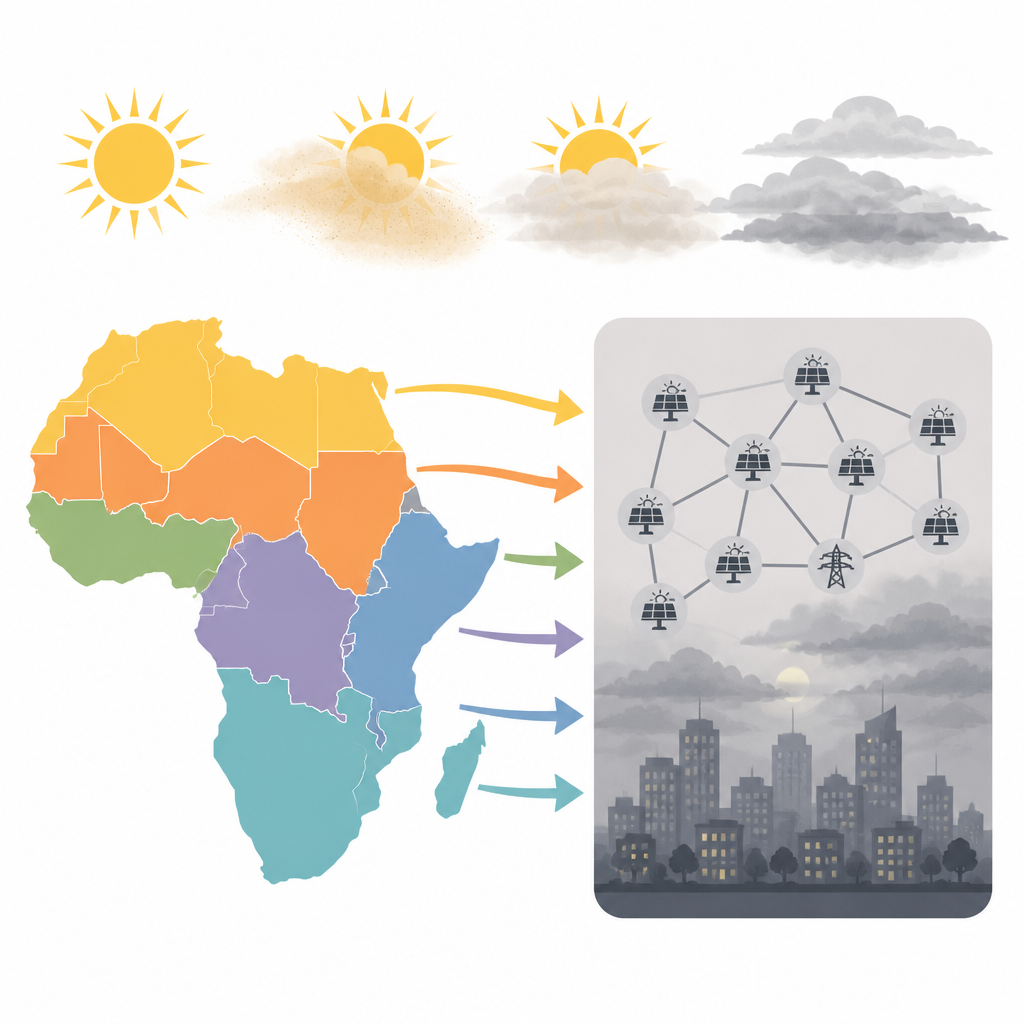
Big hopes for a sun powered continent
Regional power pools now knit together most of Africa’s national grids, and solar panels are expected to supply a large share of new electricity over the next two decades. Governments and planners assume that extreme dips in sunshine do not line up across borders very often, so each country can lean on others when its own solar farms underperform. But the atmosphere does not respect political boundaries. Giant dust storms sweeping out of the Sahara, continent scale heatwaves and slow moving pressure systems can dim sunlight or overheat solar panels across thousands of kilometers, raising the risk that many countries will face low solar output at the same time.
When weather patterns line up against solar power
The researchers combined detailed climate observations with simulations from 30 global climate models to track how often African countries fall into the lowest tenth of their potential solar output. They then checked how frequently those low solar days occurred together within each of the five regional power pools. They found a clear three step pattern of risk. West and Central Africa are most exposed, with many days when large parts of each pool are simultaneously in solar drought. Eastern Africa shows a strong increase in such events later this century, while Southern Africa appears more robust because its member countries span very different climate zones from equatorial to subtropical.
Heat and haze as hidden enemies of solar panels
The study teases apart two physical forces that shape these extremes. One is temperature: hotter conditions steadily reduce how efficiently panels turn sunlight into electricity. This thermal effect grows across all regions as the planet warms. The other is incoming sunlight itself, which can drop sharply when dust, clouds or storms block the sky. Here the picture varies. In West Africa, thicker dust and longer dry seasons combine with rising heat to strongly increase the frequency and length of low solar periods, especially in Sahel countries such as Mali and Niger. Some parts of Southern Africa may actually see fewer radiation driven slumps, partly offsetting the damage from higher temperatures. Overall, however, no region escapes more frequent stress on its solar systems.
Shared grids under shared stress
Because power pools depend on countries helping one another, the authors focus on synchronized events days when at least half of a pool’s members, or half of its planned solar capacity, are in deep solar deficit together. Under a high emissions future, West and Central Africa could see such pool wide low solar days jump from a few weeks per year to more than three months. In the worst cases, more than 70 percent of member countries are hit at once, leaving little room for support from within the pool. By contrast, Southern Africa’s wide north south reach preserves some natural protection, since weather systems that dim solar farms in the far south often spare more tropical members, and vice versa.
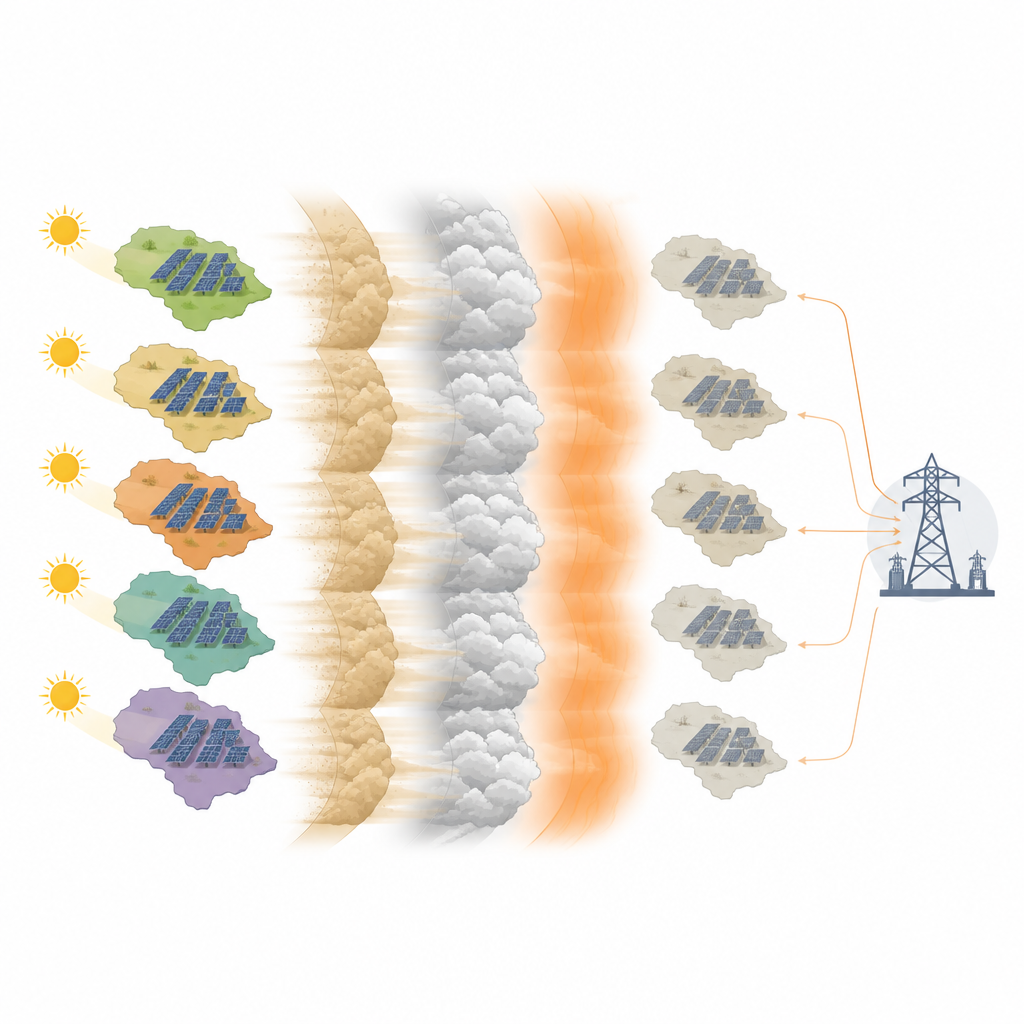
Planning smarter links and backups
The authors argue that planners should move beyond simple averages and look closely at which cross border lines are most likely to carry synchronized trouble. Some country pairs, such as Nigeria and Burkina Faso in West Africa or Algeria and Mauritania in the north, account for a large share of region wide solar droughts. Other connections, such as those between Southern and Eastern Africa, often tie together areas with opposite weather patterns and could boost resilience. The study does not claim that regional power sharing will fail, but it shows that climate driven synchronization of solar extremes can quietly erode the safety margins that planners currently rely on. Factoring these patterns into decisions about storage, backup power and new transmission lines will be crucial if Africa is to build a reliable, solar heavy grid for the decades ahead.
Citation: Adigun, P., Dairaku, K., Ogunrinde, A.T. et al. Climate-driven synchronization of solar extremes threatens the resilience of Africa’s regional power pool. npj Clean Energy 2, 11 (2026). https://doi.org/10.1038/s44406-026-00027-7
Keywords: solar power, climate extremes, Africa electricity, grid resilience, regional power pools