Clear Sky Science · en
Mobilizing sustainable energy – the importance of rural regions, small units and energy villages
Why The Countryside Could Power Our Future
This article explores a surprising idea: many small rural communities already hold the raw ingredients to power not only themselves, but also nearby towns and cities. By looking closely at real regions in Finland, the authors show how farms, forests, and village-scale energy projects could become the backbone of a cleaner, more resilient energy system—and a powerful engine for local jobs and income.
From Big Power Plants To Local Energy Hubs
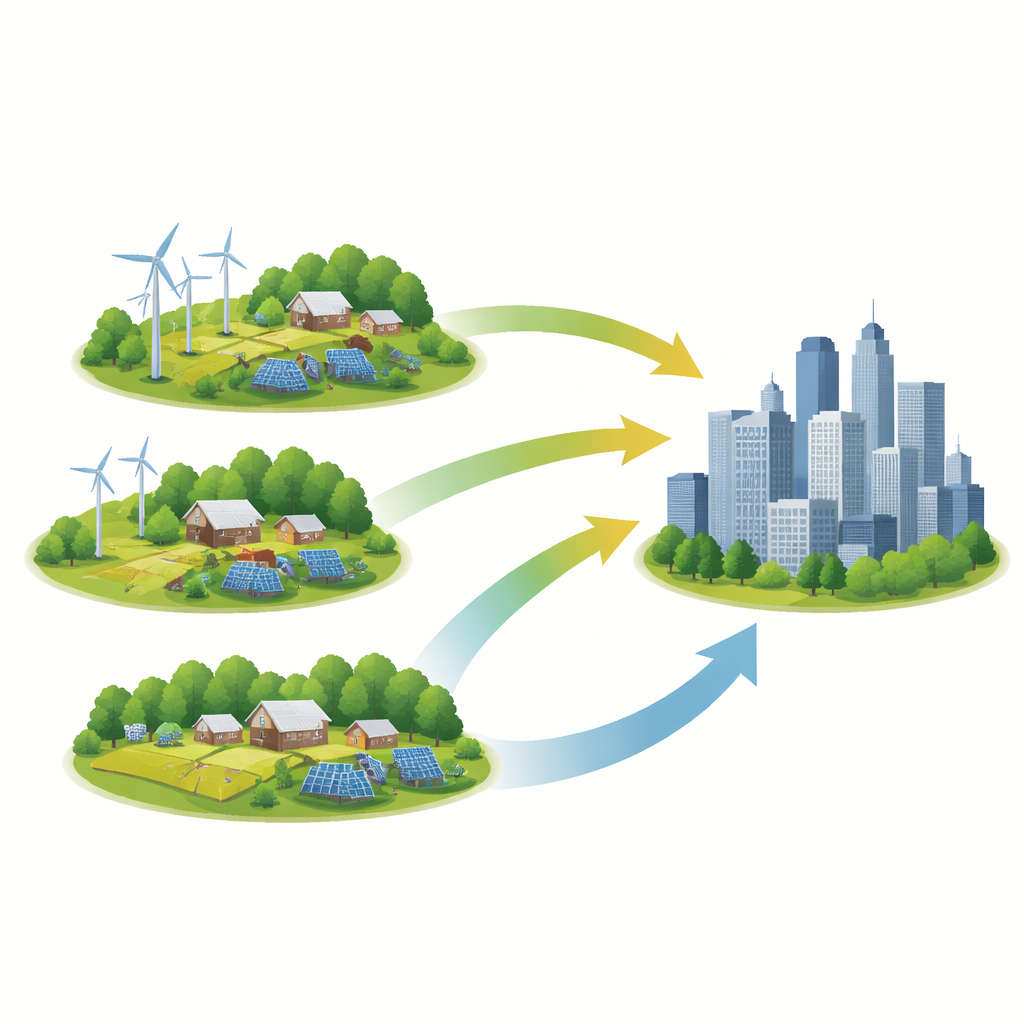
For more than a century, energy has flowed mainly from large, centralized power plants—often burning coal, oil, or gas—toward homes, factories, and cities. The shift to renewable sources such as wind, solar, and bioenergy changes this pattern. These new sources are spread out and tied to land, weather, and local resources. That makes long-distance shipping of fuel less practical and pushes energy production closer to where people live and work. The authors argue that this naturally favors rural regions, which have the space, biomass, and wind conditions needed to harvest large amounts of clean energy.
The Idea Of The Energy Village
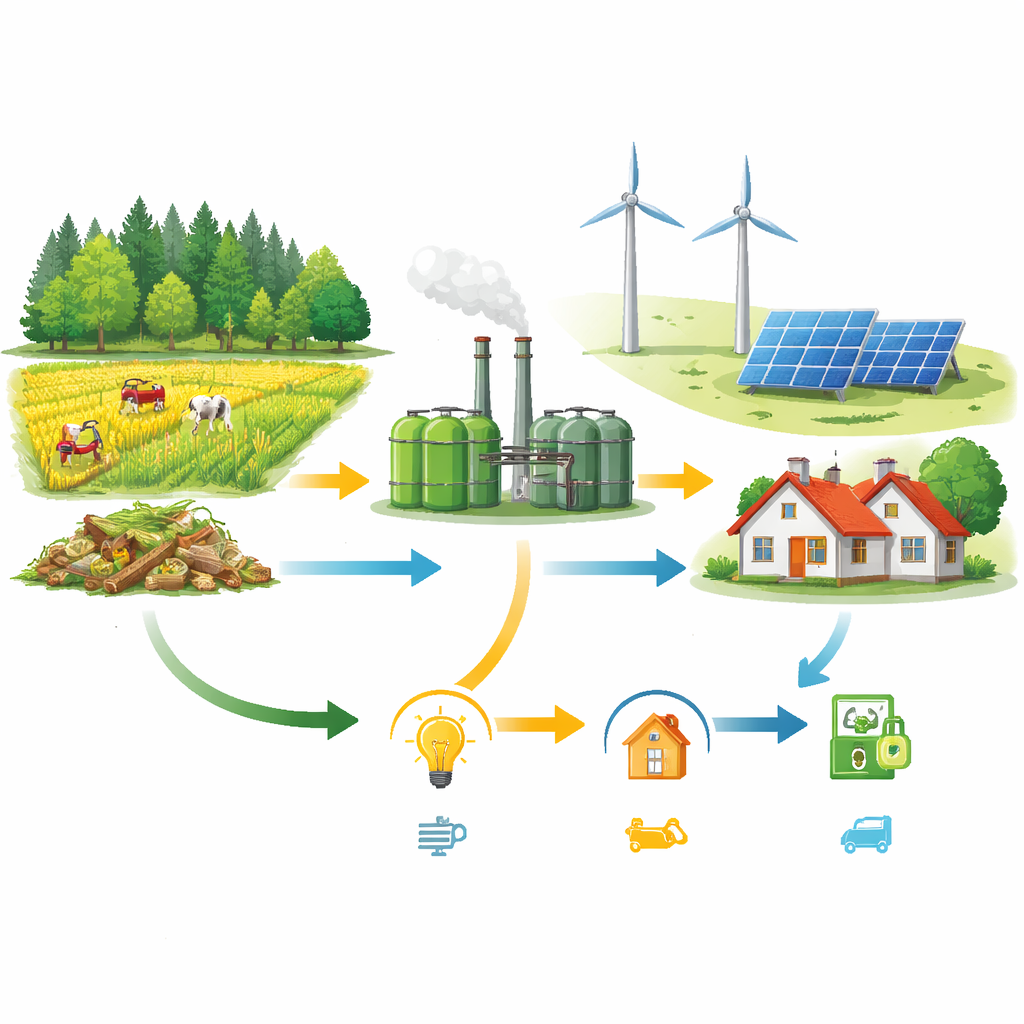
To capture this potential, the paper introduces the concept of the “energy village.” An energy village is a typical small town or rural community, together with its surrounding fields and forests, treated as a single unit that both uses and produces energy. The goal is for each village to meet its own needs—electricity, heating, transport, and farm machinery—from nearby renewable sources, and in many cases to produce a surplus. Instead of focusing on one gadget or technology, the concept combines several options: biogas from manure and organic waste, energy from logging residues and straw, and electricity from wind and, where available, solar and small hydropower.
Measuring Real-World Potential
The authors applied this idea to 16 villages and 27 municipalities in western and northern Finland, covering about 11.5% of the country’s land area. They first estimated how much energy these places currently use—for lights and appliances, heating buildings, running vehicles, and powering farm machines—drawing on national statistics and local interviews. They then compared this consumption to the realistic renewable potential in the same areas, using detailed maps of available biomass and data on existing and planned wind farms. Across all study sites, the total renewable potential was almost twice current energy use. Even when wind power was removed from the calculation, local bioenergy sources alone came to roughly one third of all energy consumed, and in many villages nearly matched their combined electricity and heating needs.
When Villages Outproduce Cities
The pattern that emerges is striking. Larger cities and heavy industrial sites inside the study area—such as ports, mining towns, or greenhouse clusters—often cannot cover their own energy use with local renewables alone. By contrast, the surrounding rural municipalities and small villages usually have more potential than they need, especially where large wind farms are possible. In some villages, the planned wind capacity would produce more than ten times their current consumption. This means that, in principle, linked networks of energy villages could power nearby cities and industries, turning today’s “peripheral” countryside into tomorrow’s energy heartland.
Money Staying In The Community
Energy is not just about kilowatt-hours; it is also about money. The study estimates that the research areas together spend almost 1.4 billion euros every year on energy, most of it on transport fuels and other uses beyond electricity and heating. In many rural municipalities, the average person effectively sends more than 5000 euros a year out of the region to pay for imported fossil energy; in some places the figure exceeds 10,000 euros. If that spending were redirected toward local renewable projects—such as biogas plants, district heating, or community wind farms—it would instead circulate through village economies, supporting local jobs, services, and tax income. The authors suggest that this “regional value added” could give rural areas a new economic role and greater bargaining power.
Challenges Beyond Technology
Turning this vision into reality is not just an engineering task. The paper stresses that social acceptance, fair sharing of costs and benefits, and trust in local decision-making are all crucial. Large wind farms or bioenergy plants can change landscapes, create noise or odors, and compete with other land uses, raising concerns about who truly benefits. There is also a risk that outside investors capture most of the profits while local communities bear the impacts. Because of this, the authors argue for inclusive, democratic planning and for public bodies such as municipalities to play an active role in shaping projects and keeping the gains local.
A New Role For The Countryside
Overall, the study concludes that many rural regions already have the physical and economic potential to become net exporters of renewable energy, even when transport and agriculture are included. Bioenergy can often cover all electricity and heating needs, while wind and solar can make areas strongly surplus. Rather than being seen mainly as sources of raw materials or as declining backwaters, rural areas could emerge as key players in climate action, energy security, and regional development. In this picture, energy villages form the building blocks of a smarter, cleaner energy system where the countryside does not simply feed the cities—it powers them.
Citation: Girgibo, N., Peura, P. & Haapanen, A. Mobilizing sustainable energy – the importance of rural regions, small units and energy villages. npj Clean Energy 2, 6 (2026). https://doi.org/10.1038/s44406-026-00021-z
Keywords: rural energy, renewable energy, bioenergy, energy self-sufficiency, energy transition