Clear Sky Science · en
Spatially heterogeneous and nonlinear factors influencing intercity patient mobility for chronic kidney disease: a nationwide study in China
Why people travel for kidney care
Many people in China who live with chronic kidney disease cannot get the care they need close to home, so they travel to other cities for treatment. This paper asks where those patients are going, where they are leaving, and which city features encourage or discourage that travel. By following millions of hospital stays, the researchers show how hospital capacity, kidney specialists, local population, and transport links together shape these journeys, with lessons for making access to care fairer and more efficient.
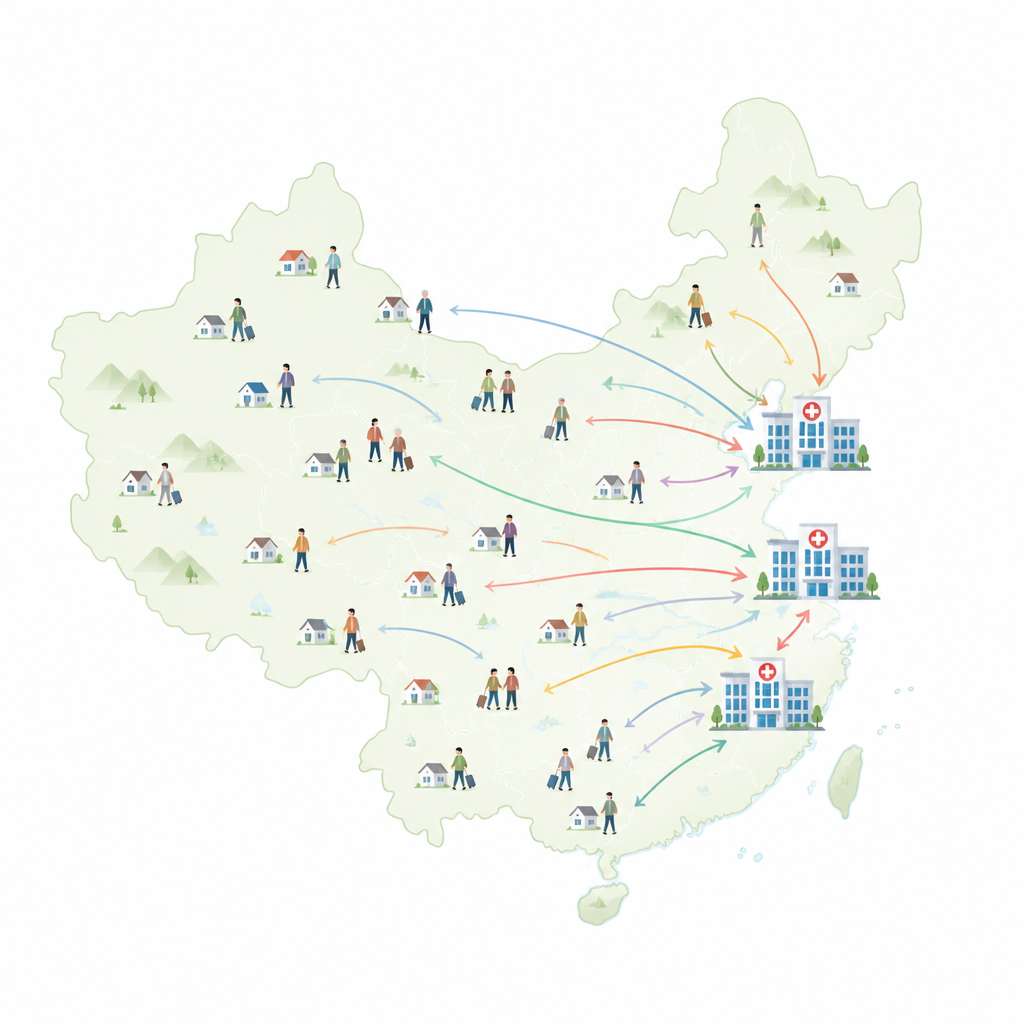
Kidney disease and the move to big cities
Chronic kidney disease is a long lasting illness that often develops from conditions such as diabetes and high blood pressure, and it is becoming more common in China. Yet kidney specialists and advanced hospitals are not spread evenly across the country; many are concentrated in large coastal and provincial capital cities. At the same time, newer insurance rules make it easier to get reimbursed for treatment outside one’s home city. As a result, patients increasingly travel across city lines to seek better kidney care, especially to large hubs like Guangzhou, Zhengzhou, and Changsha, while cities with weaker services see more people leaving for treatment elsewhere.
Following millions of patient journeys
The team analyzed more than 6.4 million kidney related hospital stays recorded from 2014 to 2018 in China’s top tier hospitals. About one in five of these stays involved people crossing from their home city to another city for care, creating more than 7000 distinct travel routes between city pairs. The researchers looked separately at “outflow” cities, where patients mainly leave, and “inflow” cities, which attract patients. They then matched these flows with 13 measures that describe each city’s population, wealth, health services, and travel connections, such as how many beds and doctors local hospitals have, how many kidney specialists practice there, how quickly the population is growing, and how well the city is linked by trains and flights.
What drives people to leave or arrive
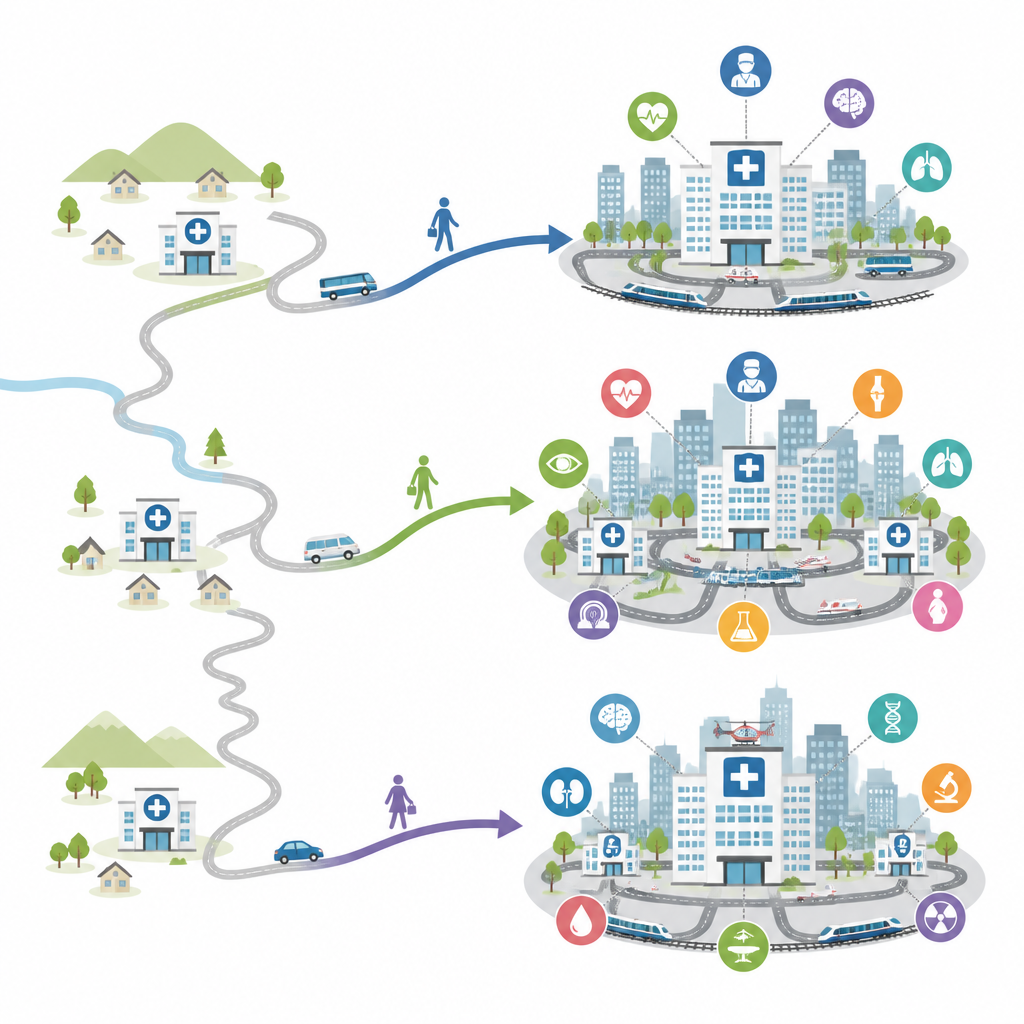
Using a method that tests how well each city feature explains differences in patient travel, the study found that outflow from a city was most closely tied to general health resources and population pressure. Cities with very low or very high numbers of hospital beds and doctors tended to send out more patients, while those with moderate levels saw fewer people leaving. Rapid population growth also pushed more residents to seek care elsewhere, likely because demand outpaced local capacity. In contrast, inflow to a city depended more on kidney specific services and who lives there. Places with more nephrologists, higher shares of older residents, and more hospital beds pulled in large numbers of kidney patients, especially when they were easy to reach by major transport routes.
Local patterns, not one size fits all
The researchers also applied a mapping technique that allows the strength and even the direction of these links to vary across space. This revealed that the same factor can matter differently in different regions. In many areas, having more beds and doctors helped cities hold onto their own patients, but in some well served cities it also coincided with more people traveling out, perhaps because residents are more aware of treatment options and have the means to travel. In northern China, the sheer number of kidney doctors and beds strongly boosted inflows, suggesting basic capacity is still the key. In the southeast, where health systems are already denser, the presence and focus of kidney specialists mattered more, hinting that specialization and efficiency become more important once a basic level of resources is in place.
What this means for patients and planners
The study shows that patient travel for kidney care reflects a complex mix of where doctors and beds are, how fast cities are growing, how old and wealthy their residents are, and how easy they are to reach. Travel can help some patients reach better treatment but can also overload major hospitals and deepen gaps between regions. The authors argue that health planners should use these insights to guide where to build kidney centers, how to link cities with transport and referral networks, and how to design insurance so that people are not forced to travel long distances unless it clearly benefits their care.
Citation: Guo, C., Wu, J., Zuo, Q. et al. Spatially heterogeneous and nonlinear factors influencing intercity patient mobility for chronic kidney disease: a nationwide study in China. npj Health Syst. 3, 32 (2026). https://doi.org/10.1038/s44401-026-00086-z
Keywords: chronic kidney disease, patient mobility, healthcare access, China health system, nephrology resources