Clear Sky Science · en
Introducing sustainable neuromorphic computing in Engineering Mechanics
Why this new kind of computer matters
From designing safer cars to planning wind turbines, engineers rely on heavy computer simulations that eat large amounts of electricity and add to carbon emissions. This paper explores a brain-inspired way to run those simulations using far less energy, suggesting that future engineering software could become faster, cleaner, and more flexible without sacrificing accuracy. 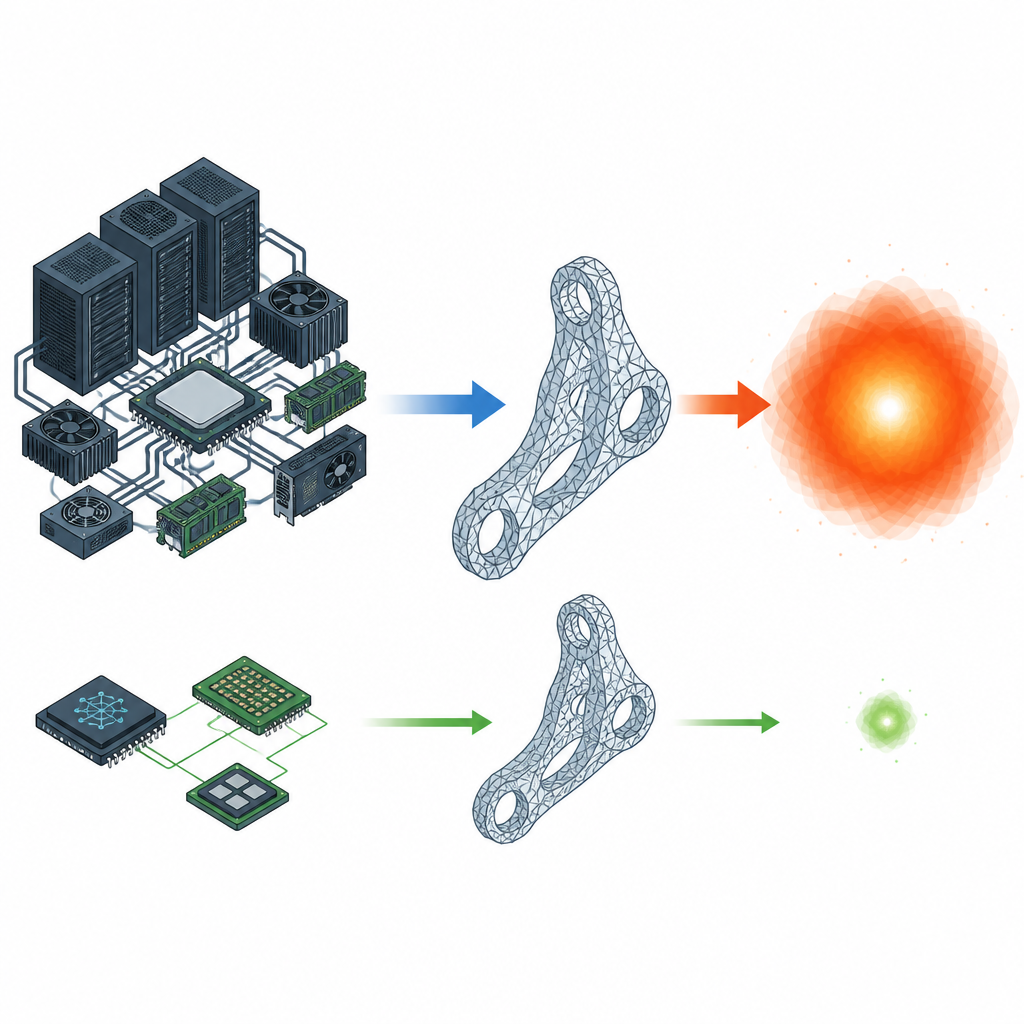
Rethinking how we simulate mechanical structures
Most modern engineering design uses the finite element method, a numerical workhorse that breaks a bridge, car, or aircraft into many small pieces and calculates how each one bends or stretches. These models are powerful but extremely hungry for computing power, especially when they capture real-world complexities such as large deformations and inelastic materials. At the same time, common artificial intelligence tools like deep neural networks also require vast data centers, adding further energy demand. The authors argue that keeping this trajectory will make high-fidelity simulations increasingly costly and environmentally burdensome.
Borrowing ideas from the brain to save energy
The study focuses on spiking neural networks, a class of algorithms that more closely mimic how biological neurons work. Instead of constantly shuffling numbers as standard networks do, these models communicate only through brief electrical spikes when something important happens. Neuromorphic chips that run such networks are built to exploit this sparse communication, consuming energy only when spikes occur. In careful measurements, the authors show that for a basic operation like matrix–vector multiplication, specialized neuromorphic chips use tiny fractions of the energy required by standard central and graphics processors, sometimes by factors of hundreds of thousands. This difference, scaled up to full engineering simulations, translates into huge potential reductions in electricity use and associated emissions.
Teaching brain-inspired networks to understand mechanics
A key challenge is that most neuromorphic research targets pattern recognition, while engineering needs accurate numerical predictions of stresses, strains, and other state variables. The authors build spiking versions of several advanced network types, including graph neural networks that operate directly on the mesh used in finite element models and recurrent networks that track how materials evolve over time. These networks act as surrogates for parts of the simulation, learning to reproduce the responses of full mechanical models. For a car bumper crash test, a conventional graph network already cut energy by more than 99 percent relative to a standard finite element run, while spiking variants promise even larger savings. 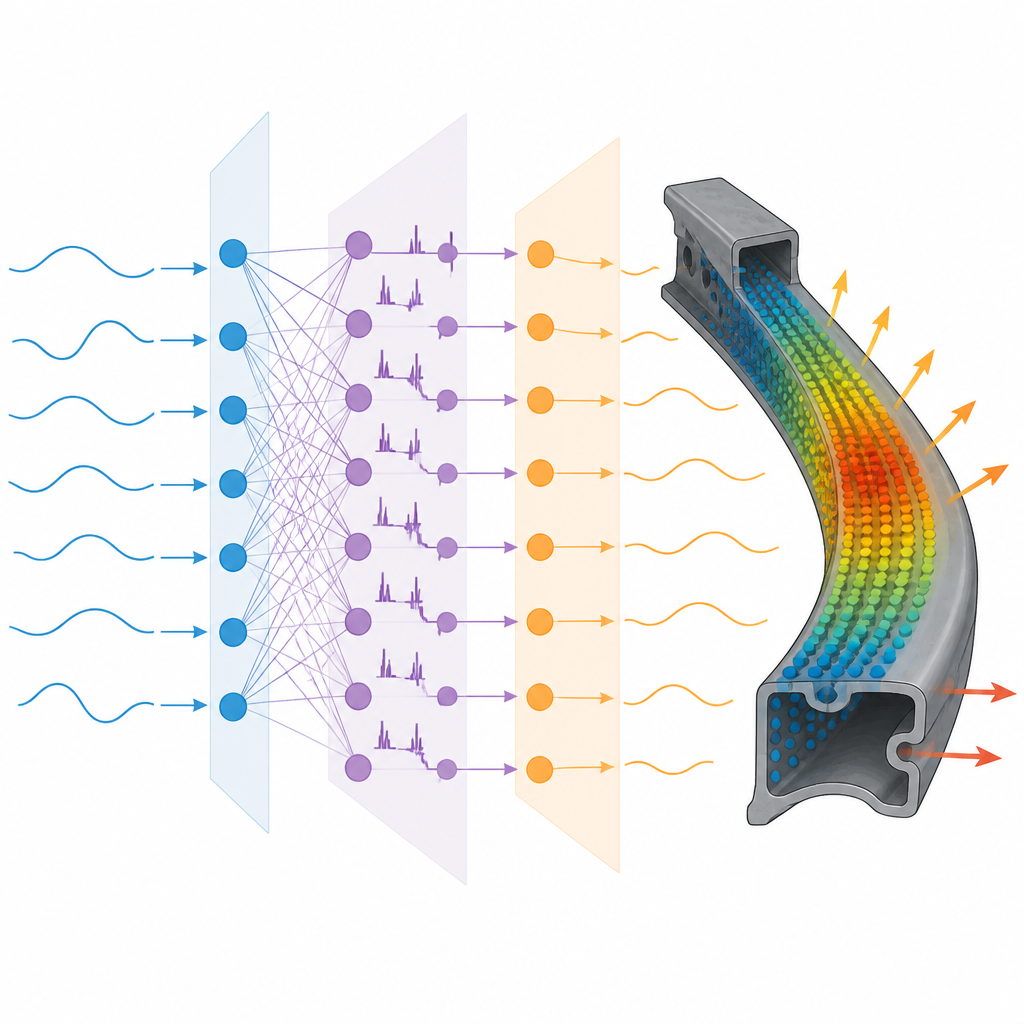
Blending physics knowledge with self-learning
To move beyond one-off surrogates tailored to a single geometry, the authors embed their spiking networks inside the finite element procedure itself. At many integration points inside each element, a hybrid network of spiking and conventional neurons predicts how the material will yield and harden, guided by both data and a penalty on breaking known physical rules. This "self-learning" setup allows the solver to improve during the simulation without labelled training data, because the loss function comes directly from the weak form of the governing equations. Tests show that replacing traditional material updates with these hybrid spiking units can shrink estimated carbon emissions for a large vehicle simulation from well over 100 kilograms of CO2 to only a few kilograms, while maintaining accuracy.
Hardware choices for greener simulations
Neuromorphic chips are not yet widely available as plug-in aids for standard computers, so the authors also explore field-programmable gate arrays, a flexible hardware platform. They demonstrate that binarized neural networks running on such devices can evaluate material laws faster and more efficiently than both high-end processors and graphics cards. They further argue that everyday building blocks of finite element solvers, such as multiplying global stiffness matrices by vectors, could also be moved to these specialized devices, potentially cutting the overall energy use of a complete simulation by more than 90 percent when combined with spiking networks.
What this means for future engineering tools
Overall, the paper shows that brain-inspired computing can handle demanding mechanical problems, not just pattern recognition, and can do so with orders-of-magnitude lower energy use. By combining spiking networks, physics-guided training, and specialized chips, the authors outline a path toward simulation tools that learn on the fly, generalize across different structures, and sharply reduce the power needed for complex engineering analysis. For readers, the takeaway is that future designs for cars, buildings, and machines could be developed with high realism while putting much less strain on data centers and the climate.
Citation: Stoffel, M., Gulakala, R., Polydoras, V. et al. Introducing sustainable neuromorphic computing in Engineering Mechanics. npj Artif. Intell. 2, 51 (2026). https://doi.org/10.1038/s44387-026-00118-x
Keywords: neuromorphic computing, spiking neural networks, finite element method, engineering simulation, energy-efficient AI