Clear Sky Science · en
Field-space autoencoder for scalable climate emulators
Why shrinking climate data matters
As climate models become sharper and more detailed, they also become incredibly data heavy, producing amounts of information that are hard to store, share, and explore. This paper introduces a new way to squeeze these huge global simulations into a much smaller form while keeping the important patterns of weather and climate intact. The approach could make it easier to study extreme events, compare different climate futures, and build faster tools that mimic full-scale climate models.
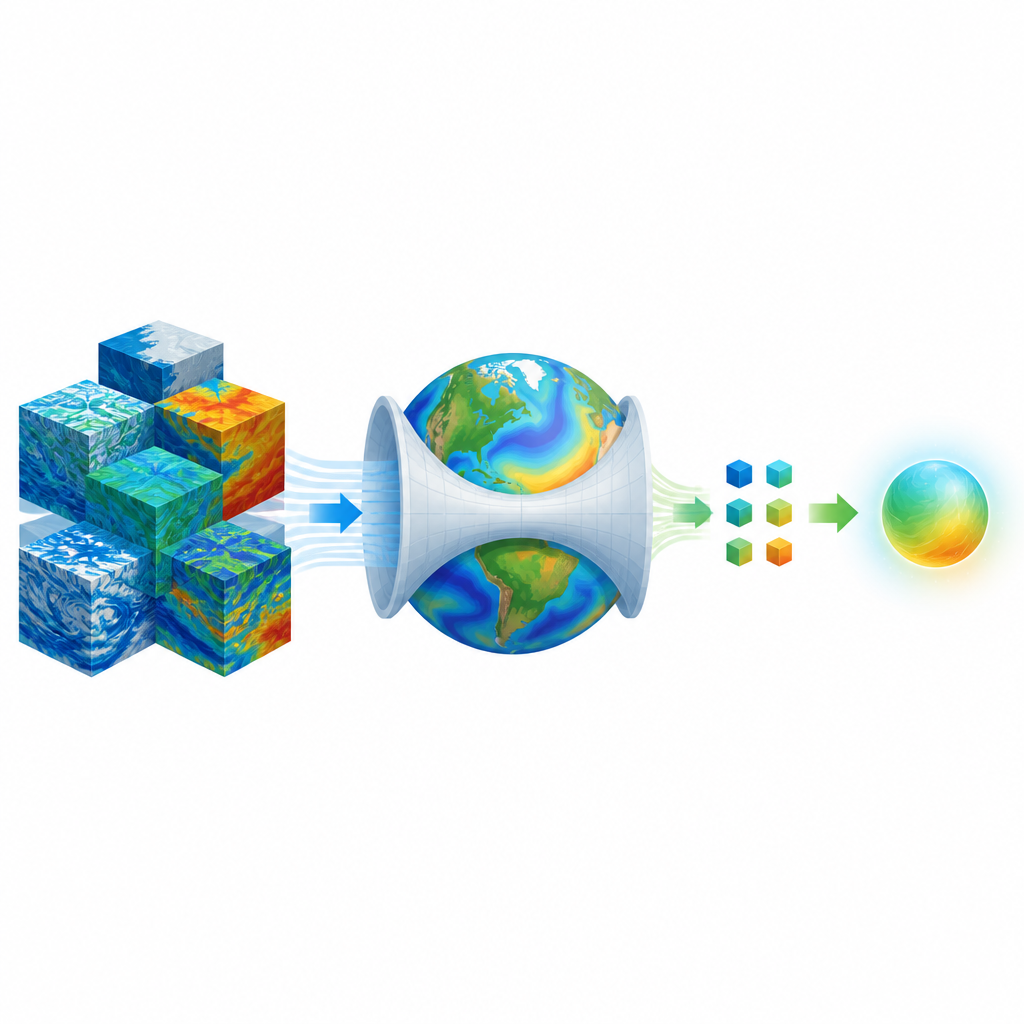
From planet-sized files to pocket-sized patterns
Modern climate simulations can resolve storms and winds on scales of a few tens of kilometers, but each run can generate petabytes of output. Researchers need many such runs to estimate risks and uncertainties, yet storing and working with so much data quickly becomes impractical. Earlier machine learning tools, inspired by image compression, helped reduce file sizes but struggled with the curved shape of the Earth and with handling different spatial resolutions. They often worked on flat grids that distort the poles and had trouble moving between coarse and fine scales without retraining from scratch.
A new map for the digital Earth
The authors propose the Field-Space Autoencoder, a family of models built directly on a spherical grid called HEALPix, which treats every patch of the globe with equal area. Instead of compressing everything in one shot, the method breaks the data into several layers of detail: a coarse global picture and a series of finer corrections. The model keeps the roughest layer as a stable background and learns how to encode and decode only the added detail. Special processing layers move information up and down between these layers of detail, allowing the network to handle multiple scales at once and to respect the round shape of the planet.
Sharper reconstructions with smaller files
When tested on daily surface air temperature from a widely used reanalysis dataset, the Field-Space Autoencoders reproduced the original fields more accurately than a strong convolutional baseline across all compression settings. At a typical setting, they reached similar error levels while squeezing the data about four times more than the older model. Even under extremely strong compression, they preserved key structures and avoided the rapid loss of detail seen in the baseline. The hidden space learned by the new models also revealed meaningful climate behavior: when visualized, encoded states arranged themselves along smooth loops that matched the seasons and showed a gradual shift consistent with long term warming, even though the models were not explicitly trained to track these trends.
One model for many variables and resolutions
The approach was extended to handle several climate variables at once, including temperature, winds, surface pressure, and rainfall. Performance stayed strong across these fields, with all models finding precipitation especially difficult, highlighting a known challenge rather than a weakness of the new design. Because the Field-Space Autoencoder understands multiple levels of detail, it can also perform a kind of zero shot super resolution. When given only coarse input from a climate model, it can fill in plausible fine scale structure similar to that seen in higher resolution observations, effectively acting as both a compressor and a smart upscaler that upgrades older, coarser simulations.
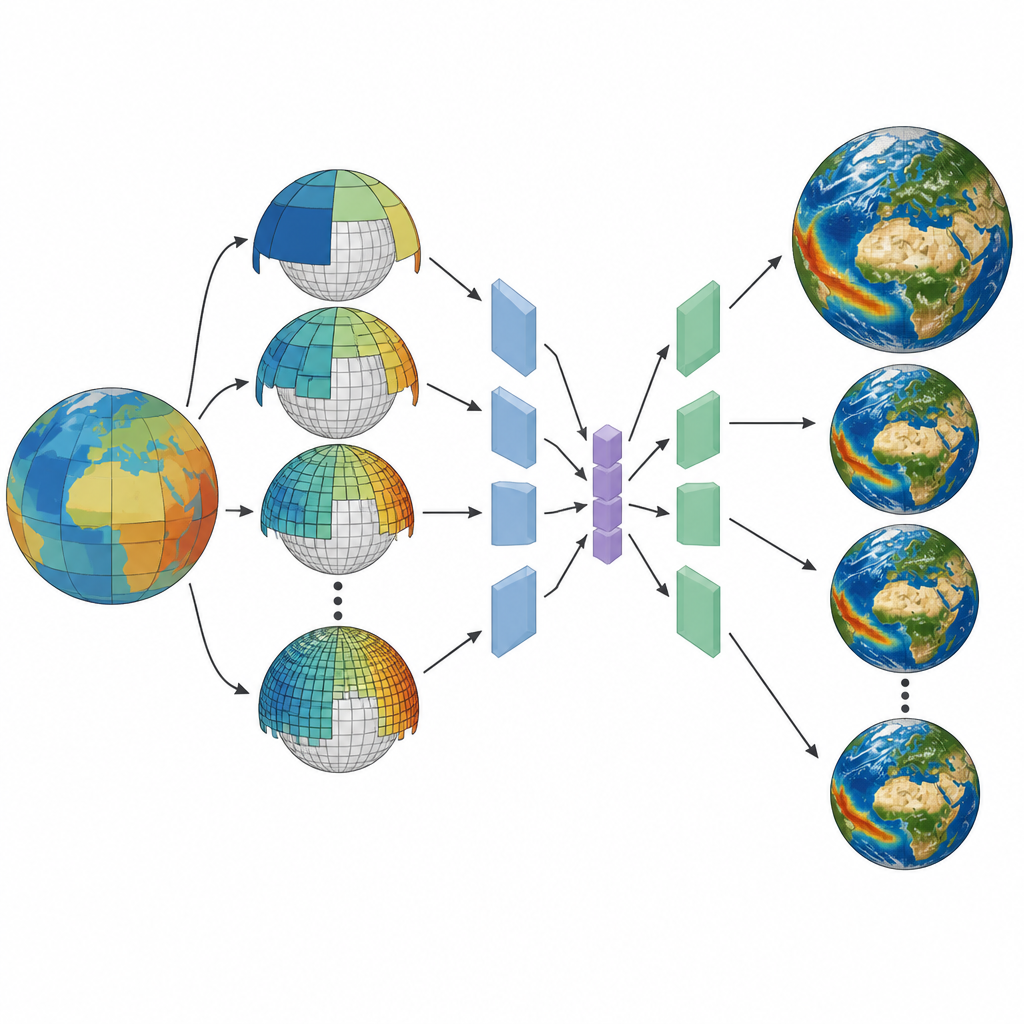
From compressed fields to synthetic worlds
To show that the compressed climate fields are useful beyond storage, the authors trained a diffusion based generator directly in this compact space. Using ensembles from a high resolution climate model as input, the generator learned to create new sequences of compressed fields that, once decoded, resemble high resolution simulations. These synthetic runs recovered much of the missing small scale variation compared with the original low resolution model while preserving its overall patterns of internal climate variability. In other words, the method enriches existing climate records with finer detail without losing their statistical character.
What this means for future climate tools
For a lay reader, the key message is that we now have a more efficient way to shrink global climate data while keeping its essential physics, and this same compressed format doubles as a playground for advanced generative models. The Field-Space Autoencoder framework can link rich but scarce high resolution simulations with abundant but coarser ensembles, making it easier to explore possible futures and extremes without rerunning expensive models. As it is extended to more variables, higher resolutions, and smarter treatment of noisy phenomena like rainfall, this approach could underlie a new generation of compact, sharable climate archives and fast emulators that still respect the structure of the real Earth.
Citation: Meuer, J., Witte, M., Plésiat, É. et al. Field-space autoencoder for scalable climate emulators. npj Artif. Intell. 2, 50 (2026). https://doi.org/10.1038/s44387-026-00116-z
Keywords: climate data compression, autoencoder, spherical grids, climate emulation, diffusion models