Clear Sky Science · en
User preference-based human-in-the-loop tuning of exoskeleton assistance during walking
Helping People Walk with Less Effort
Imagine being able to adjust a wearable walking aid as easily as tuning the sound on your headphones. This study explores whether people can quickly teach a robotic hip device how to help them walk in a way that feels good and uses less energy, simply by relying on their own sensations rather than on complex lab equipment.
A Robot Helper at the Hips
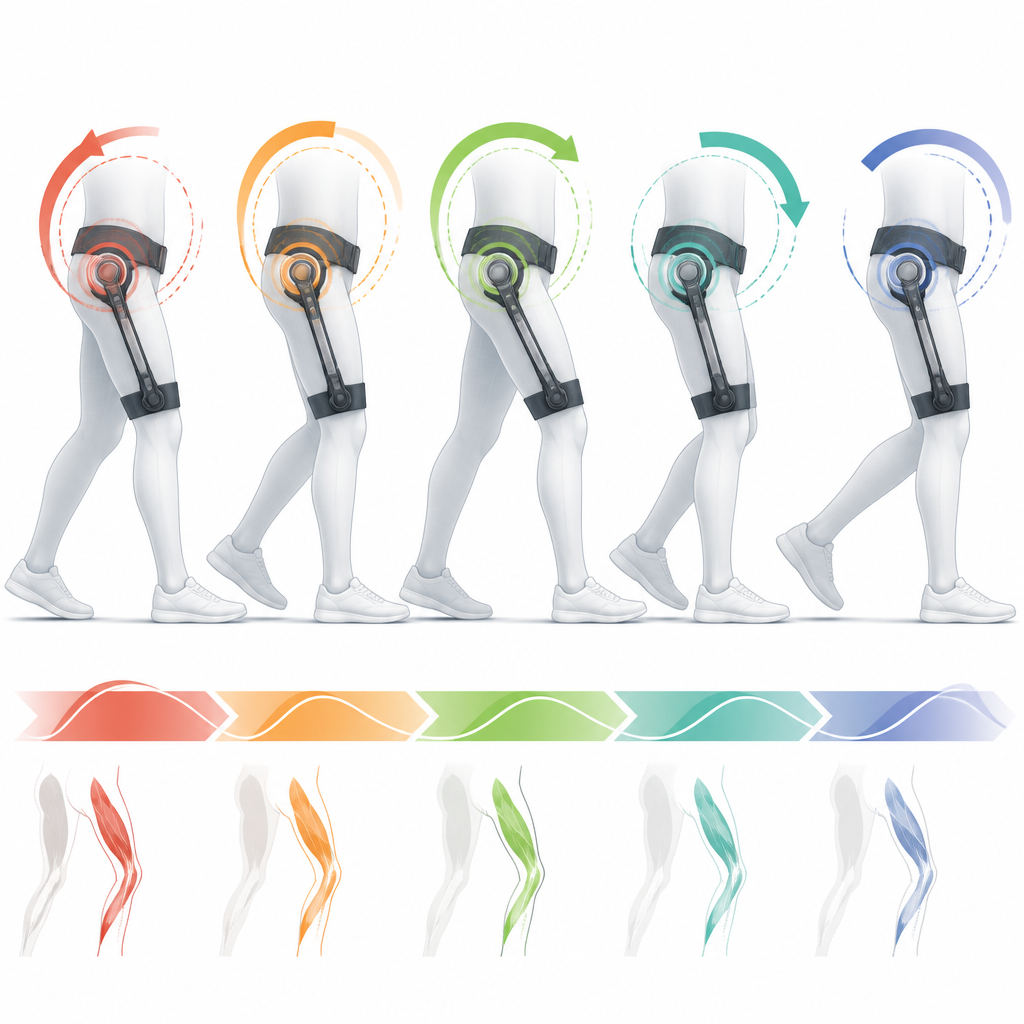
The researchers used a hip exoskeleton, a lightweight frame with motors at the hips that assist leg movements while a person walks on a treadmill. Instead of having engineers preprogram how and when the device should push or pull, the team gave each walker a small handheld controller. With it, they could shift four key moments in the walking cycle when the exoskeleton switched direction or delivered its strongest help. A screen in front of them showed simple curves of the assistance pattern so they could see how their changes affected the support they felt.
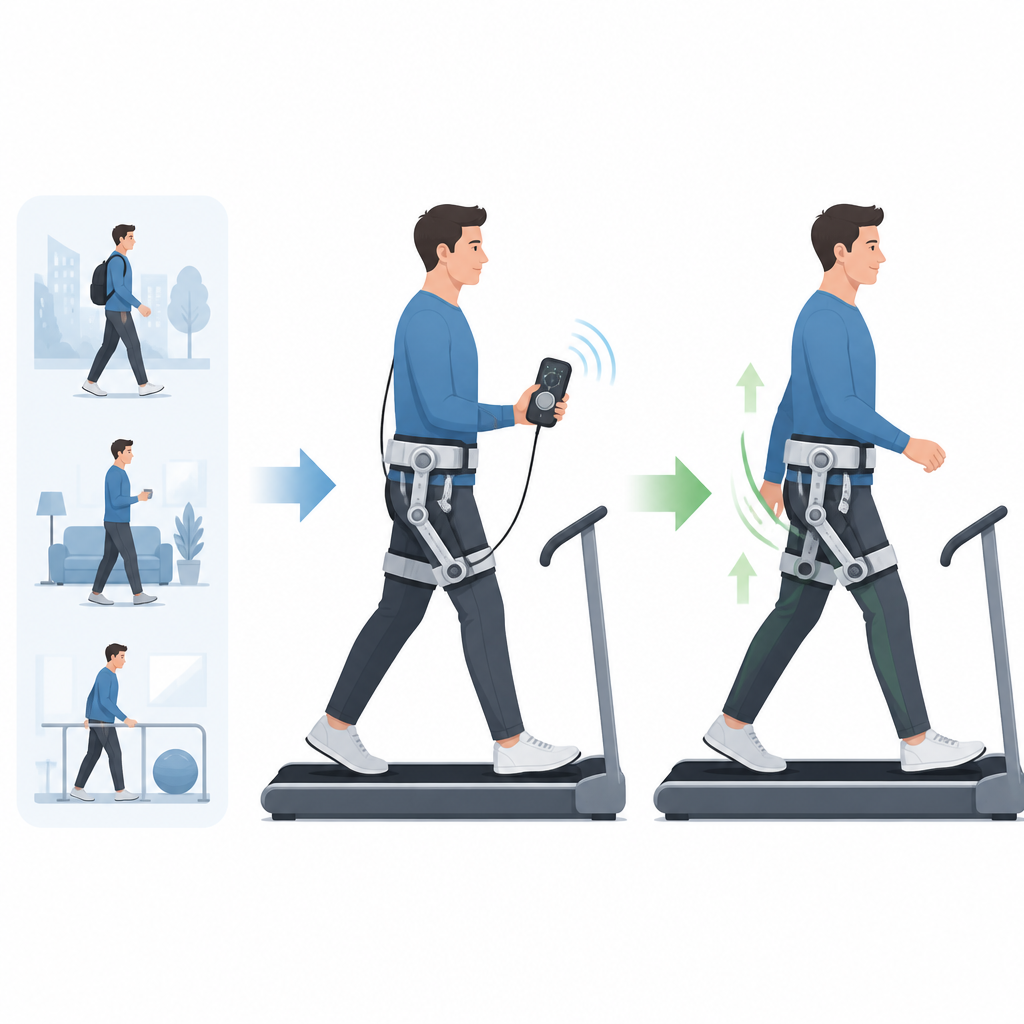
Letting Users Tune Their Own Support
Eleven adults without walking problems took part. After a short familiarization period, each person walked with the exoskeleton and used the controller to explore different assistance patterns. They were asked to search the full range of possibilities and to settle on the pattern that felt best and seemed to reduce their effort. There was no fixed time limit. On average, participants tried about thirty different settings and needed roughly eleven minutes to decide they had found their preferred way of being assisted. Interestingly, they almost always changed only one timing at a time, suggesting a careful, stepwise search rather than random trial and error.
Energy Savings Without Heavy Math
Even though walkers relied only on their own sensations, their choices paid off in measurable energy savings. When the exoskeleton used a person’s preferred timing pattern, the energy cost of walking dropped by about 17 percent compared with wearing the same device that provided no helpful torque. When the added weight of the device itself was considered, this still meant a noticeable reduction compared with walking without it. The researchers then nudged each of the four timings earlier or later in the step cycle. These shifts, even when fairly large, hardly changed the energy savings, which suggests that the user-chosen patterns were not only effective but also forgiving to small timing errors.
What Control Still Feels Like to the User
Beyond energy use, the team wanted to know how using the exoskeleton affected people’s sense of being in charge of their own movements. After walking either with the device switched to zero help or with their tuned assistance pattern, participants rated statements about how much it felt as if they were causing the motion. As expected, people felt more in control when the device was not actively helping. Yet even with only partial assistance, the scores dropped noticeably, showing that the device’s pushes and pulls changed how the walkers experienced ownership of their movements. This suggests that future designs should balance physical benefits with how natural the movement feels.
Why This Approach Matters
This study shows that letting users tune a hip exoskeleton by feel can quickly produce personalized walking assistance that cuts energy cost to levels similar to more time-consuming lab-driven methods. The preferred settings differed widely from person to person, underlining the need for individual adjustment rather than a one-size-fits-all program. Because the method is fast and does not require bulky measurement gear, it could make exoskeletons more practical for older adults, patients in rehabilitation, and people using such devices in daily life. The findings also point toward future systems that combine user feedback with smart algorithms, creating walking aids that adapt not only to the body but also to how each person wants to move.
Citation: Schäfer, N., Zhao, G., Li, B. et al. User preference-based human-in-the-loop tuning of exoskeleton assistance during walking. npj Biomed. Innov. 3, 32 (2026). https://doi.org/10.1038/s44385-026-00085-7
Keywords: hip exoskeleton, walking assistance, user tuning, human in the loop, metabolic cost