Clear Sky Science · en
Harnessing normal-shear coupling in metabarriers for deep sub-wavelength underwater noise control
Why quiet oceans matter
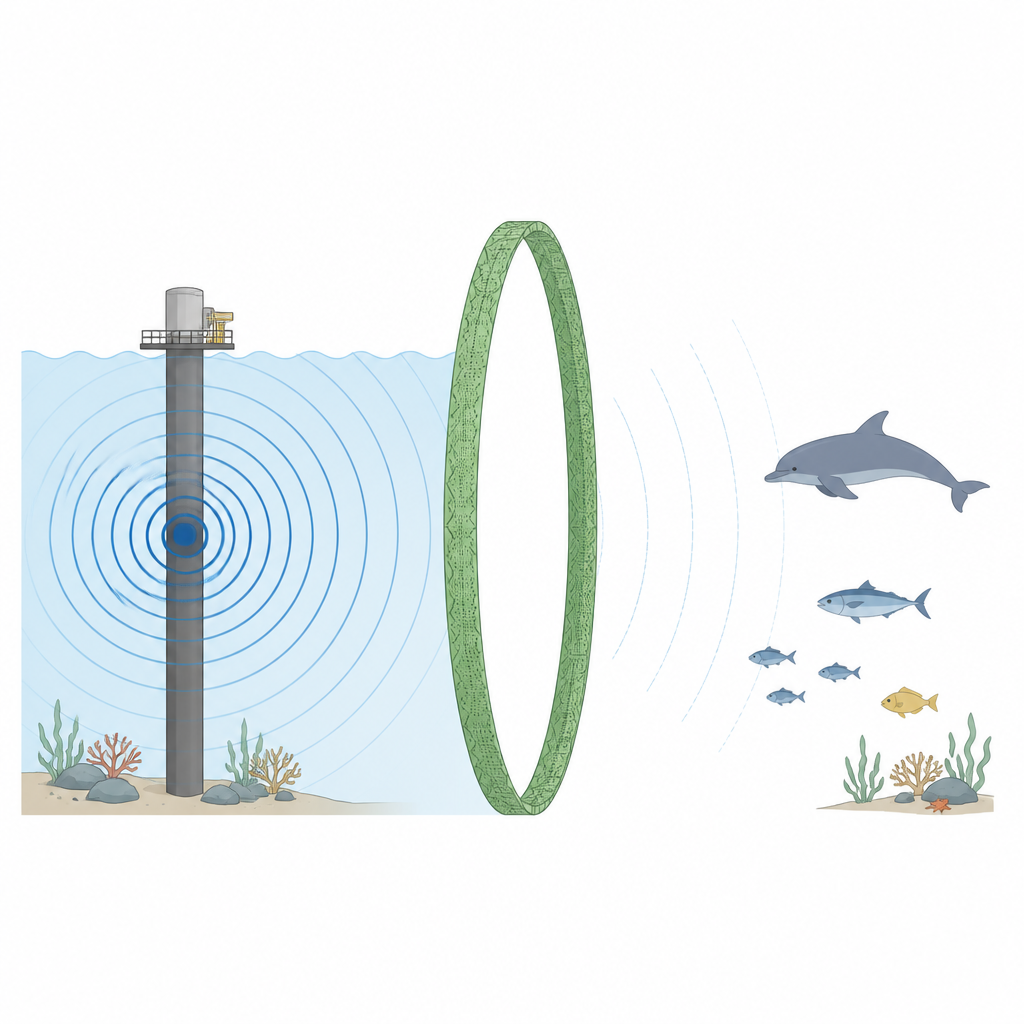
Human-made noise in the oceans is getting louder as we build more offshore wind farms, ship more goods, and expand military and industrial activity. Many marine animals rely on sound the way we rely on sight, using it to find food, communicate, and navigate. This paper explores a new kind of ultra-thin underwater wall, called a metabarrier, that can block a wide range of low-frequency noise without taking up much space, offering a possible way to better protect sea life.
Limitations of today’s underwater noise shields
Existing underwater noise control tools tend to be bulky, narrow in the range of sounds they block, or hard to operate offshore. Some designs absorb sound using soft plastics filled with tiny cavities or resonators, but they often work well only at mid to high pitches and lose effectiveness at the deep, low tones most damaging to marine mammals. Others try to reflect sound using rigid casings or curtains of air bubbles, which can require large structures, energy input, and careful control of bubble size. These systems struggle especially below about 1 kilohertz, exactly where much industrial noise is strongest, and they can be disrupted by pressure changes and ocean currents.
A new way to trick sound inside a thin wall
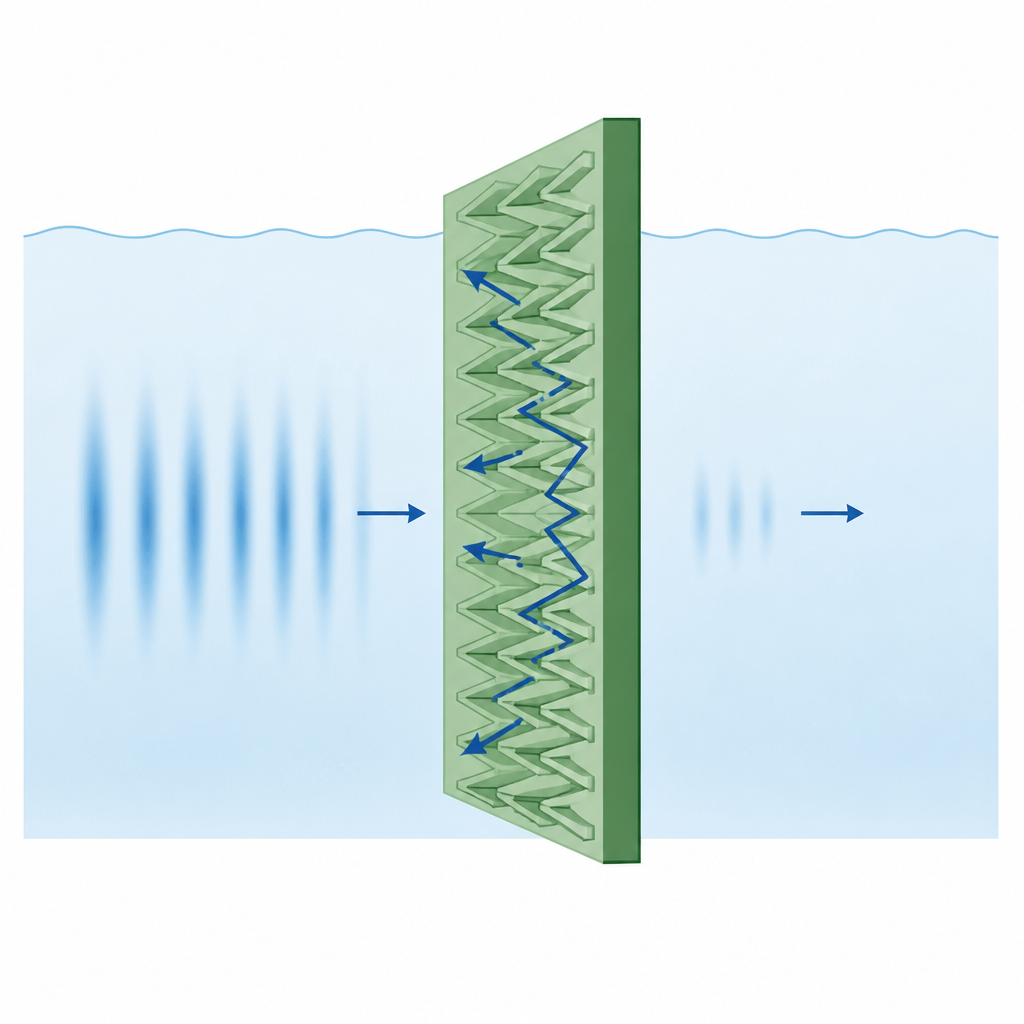
The authors propose a very different strategy based on architected materials, which are solids built from repeating tiny patterns. Instead of relying on many separate resonators, they design a repeating building block whose internal geometry forces a strong interaction between normal squeezing motions and sideways shearing motions inside the solid. This normal–shear coupling is captured by a single dimensionless number that approaches one when the coupling is very strong. By carefully shaping the unit cell so this factor comes close to its upper limit, the barrier makes incoming pressure waves from water excite complex mixed motions that do not carry sound efficiently through the material.
Designing the metabarrier from the ground up
To find a powerful geometry, the researchers use topology optimization, a numerical search method that adds or removes material inside a small square cell until a target property is maximized. Here, the target is the strength of the normal–shear coupling, and the search is carried out in the static limit, meaning they only need the effective elastic properties of the solid, not the acoustic behavior of water. Once they identify a promising layout made from a standard 3D-printable plastic, they smooth the shape and analyze how waves move through a chain of these cells. The dispersion diagrams show that even though the design was optimized at zero frequency, it produces mixed longitudinal and transverse motion over a wide band of audible underwater frequencies.
How well the thin wall blocks underwater sound
When they simulate the metabarrier submerged in water, the results show strong sound transmission loss over a broad range. A single 10 millimeter cell can reach around 29 decibels of loss near 2 kilohertz, despite being about seventy times thinner than the wavelength of the sound in water. Stacking three cells to make a 30 millimeter barrier yields peaks approaching 90 decibels, still with the overall thickness far below the sound wavelength. Below 1 kilohertz the barrier maintains useful reductions of roughly 20 to 30 decibels. The authors also study how the performance shifts with thickness, angle of incoming sound, and the presence of additional high-frequency effects such as Bragg scattering, finding that the main low-frequency behavior is governed by the engineered coupling inside the material.
Making it practical in the real ocean
Real underwater barriers must survive strong static pressure at depth without deforming too much or losing performance. The team tests this numerically by adding thin solid skins on both sides of a three-cell wall and applying hydrostatic pressure equivalent to 50 meters of water. These skins greatly reduce peak stress while only slightly shifting the frequencies where the barrier works best. They then bend the unit cells into a circular ring around a point-like noise source and simulate a square patch of ocean with absorbing edges. In this setting, the metabarrier reduces the transmitted acoustic energy by about 98 percent for a short pulse centered at 500 hertz, suggesting it could shield sensitive areas such as breeding grounds or equipment zones.
What this means for quieter seas
The study shows that by tailoring how a material couples different kinds of internal motion, it is possible to build very thin underwater walls that reflect a wide band of low-frequency noise. Instead of relying on heavy structures or active systems that need power, these passive metabarriers use geometry alone to create an extreme mismatch between the material and water, sending most sound back toward the source. While further work is needed to test full-scale prototypes in natural waters, the approach points to compact, robust noise shields that could help reduce the acoustic footprint of human activities in the ocean.
Citation: Dal Poggetto, V.F., Miniaci, M. Harnessing normal-shear coupling in metabarriers for deep sub-wavelength underwater noise control. npj Acoust. 2, 20 (2026). https://doi.org/10.1038/s44384-026-00056-7
Keywords: underwater noise, acoustic metamaterials, sound transmission loss, marine ecosystems, metabarrier design