Clear Sky Science · en
Optimized ultrasound neurostimulation of ventromedial prefrontal cortex reverses depression behaviours and normalizes brain metabolism
Why this brain study matters for mood
Depression that does not improve with standard drugs is a serious problem, and current brain stimulation options either reach only the brain surface or require surgery. This study explores a new, non-invasive way to gently focus ultrasound waves on a tiny mood-related region deep in the brain of mice, aiming to lift depression-like behaviour without damaging tissue. The results hint at a future treatment that could combine the precision of brain implants with the safety of treatments delivered from outside the skull. 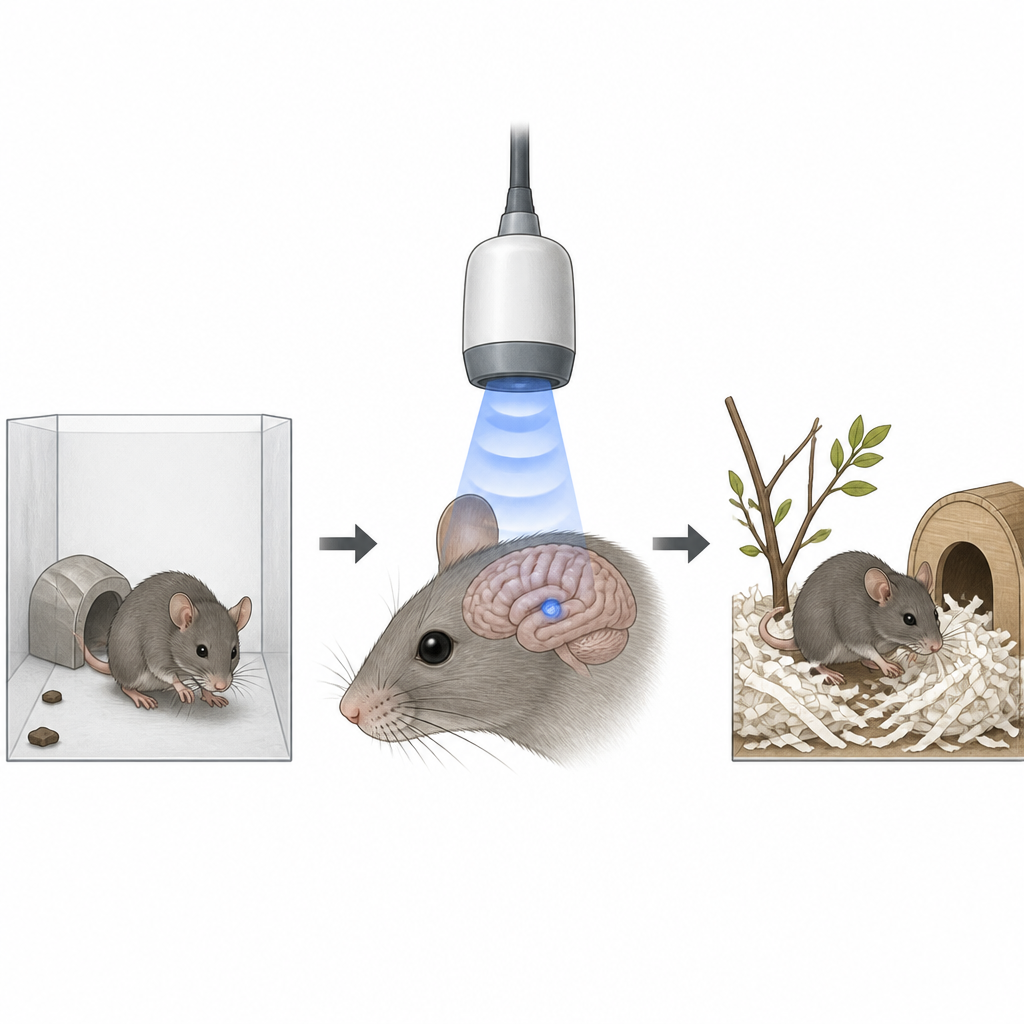
A new way to reach deep mood circuits
The researchers focused on a small region behind the forehead called the infralimbic cortex in mice, which closely mirrors a mood hub in humans involved in controlling emotions and stress. Instead of using surgery or magnetic coils, they used carefully tuned ultrasound pulses, delivered through the skull, to nudge this region into a more active and balanced state. Before trying it as a treatment, they spent time adjusting the ultrasound strength and timing in healthy mice, using muscle responses and brain activity markers to find settings that were strong enough to affect neurons but still safe and sharply focused.
Testing the approach in stressed animals
To mimic key features of human depression, the team used a long-lasting mild stress regimen in mice that leads to poor self-care and increased anxiety. Stressed animals built ragged nests and were hesitant to explore the bright centre of an open arena, both signs of low motivation and high anxiety. During the final week of stress, some mice received brief daily ultrasound sessions targeting the infralimbic cortex, while others received sham sessions or the common antidepressant fluoxetine. The ultrasound-treated mice showed striking improvements: their nests returned to the quality seen in non-stressed animals, and they explored the centre of the arena more quickly and moved more overall, suggesting reduced anxiety and restored drive, whereas fluoxetine offered little benefit in these measures.
Changes across brain networks and chemistry
To see what was happening inside the brain, the scientists looked at both activity patterns and small molecules involved in brain chemistry. In the short term, a single ultrasound session increased a protein marker of neural activity specifically in the infralimbic cortex, confirming that the stimulation was hitting the intended target while leaving neighbouring regions mostly unchanged. Days after a five-day course of treatment, brain scans using a glucose tracer showed higher metabolism not only in the targeted prefrontal region, but also in connected areas such as the hippocampus, periaqueductal grey, and raphe nuclei, which together help regulate mood, anxiety, and responses to stress. 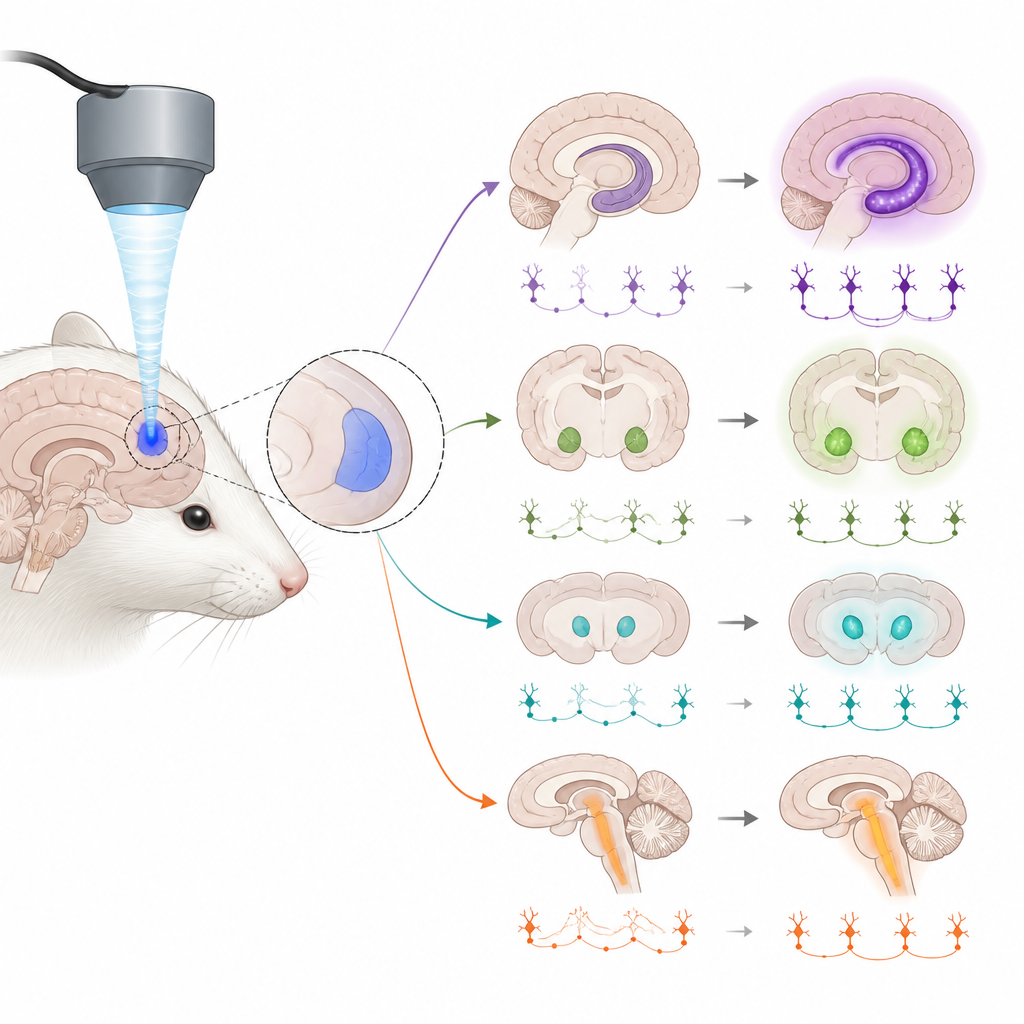
Resetting a key signaling balance
Ten days after the final session, the team analysed hundreds of small molecules in the infralimbic cortex, amygdala, and hippocampus. They found consistent shifts in pathways centred on glutamate, an important chemical messenger that helps control how strongly brain cells talk to one another. Levels of glutamic acid and related amino acids changed in ways suggesting a broad rebalancing of this system, rather than simple overactivation. These chemical changes appeared long after the last ultrasound pulse, hinting that the treatment may trigger lasting adjustments in how mood circuits process information, rather than just causing a brief jolt.
What this could mean for future treatments
Overall, the study shows that a short series of focused ultrasound sessions aimed at a tiny mood hub in the mouse brain can reverse depression-like behaviours, restore everyday activities such as nest-building, and reshape activity and metabolism across connected brain networks. Because the method is non-invasive, uses low ultrasound intensity, and did not show signs of tissue damage or harmful inflammation, it may offer a safer route to reach deep brain regions than surgery-based approaches. While more work is needed in different animals, in both sexes, and eventually in people, these findings support focused ultrasound as a precise tool that could one day help treat stubborn forms of depression by gently re-tuning the brain circuits that underlie mood.
Citation: Legrand, M., Galineau, L., Novell, A. et al. Optimized ultrasound neurostimulation of ventromedial prefrontal cortex reverses depression behaviours and normalizes brain metabolism. npj Acoust. 2, 18 (2026). https://doi.org/10.1038/s44384-026-00050-z
Keywords: ultrasound brain stimulation, depression, ventromedial prefrontal cortex, mouse stress model, brain metabolism