Clear Sky Science · en
Exploring the behavior of a strung computational Stradivarius violin
Turning a Legendary Violin into a Digital Twin
For centuries, violin makers and players have wondered what makes a great Stradivarius sing. This work takes that mystery into the realm of high-performance computing by building a virtual version of a famed 1715 Stradivarius, the Titian, that can actually play music. By doing so, the authors show how musicians and instrument makers could one day test design ideas on a computer, hearing the results as clearly as if they were holding the real instrument.
Building a Virtual Stradivarius
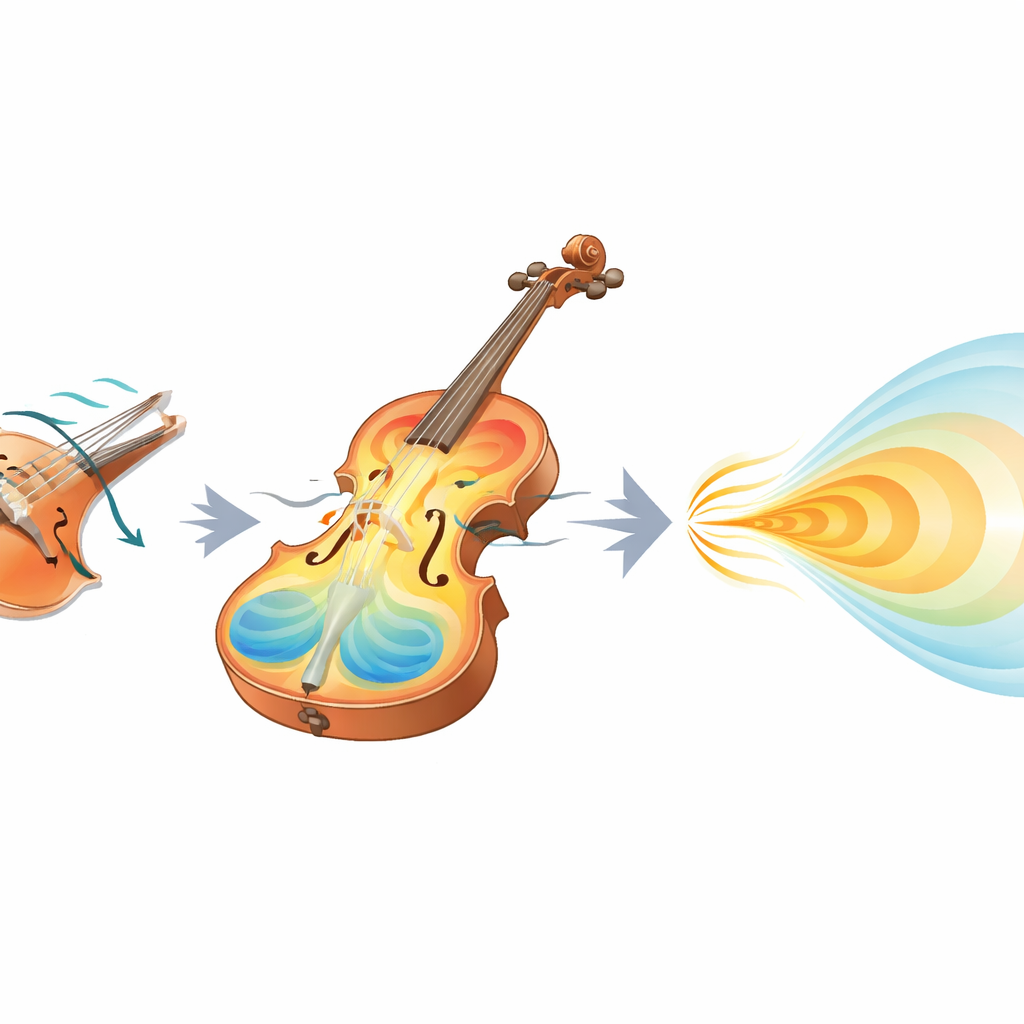
The researchers began with detailed CT scans of the Titian Stradivarius, capturing the subtle arching, thickness variations, and internal structure that luthiers prize. They combined this geometry with measurements of how spruce, maple, ebony, varnish, and strings bend, stretch, and lose energy when they vibrate. Using finite-element methods, they modeled the wooden body, the varnish coating, the tensioned strings, and the air both inside and around the violin. Crucially, the air and the structure talk to each other in both directions: moving wood pushes air, and moving air pushes back on the wood. This two-way coupling turns the virtual Titian into a complete physical system rather than a silent drawing.
Making the Digital Violin Play
To make the computational violin produce sound, the team simulated plucked strings (pizzicato) instead of bowed playing, which involves still poorly understood friction behavior. They used an empirically based pluck force that rises and falls over a few thousandths of a second at a point near the bridge on the chosen string. Once the virtual finger lets go, the string vibrates, drives the bridge, shakes the plates, and pumps air through the instrument’s body and f-holes. From this, the model computes the sound a listener would hear at any position and distance, and the authors demonstrate recognizable renderings of passages from Bach’s G-minor Fuga and the song “Daisy Bell.” Comparisons with measurements on real violins show that key resonant frequencies and bridge motion fall within the spread seen among high-quality instruments, lending confidence that the virtual violin behaves realistically.
Where the Power Really Comes From
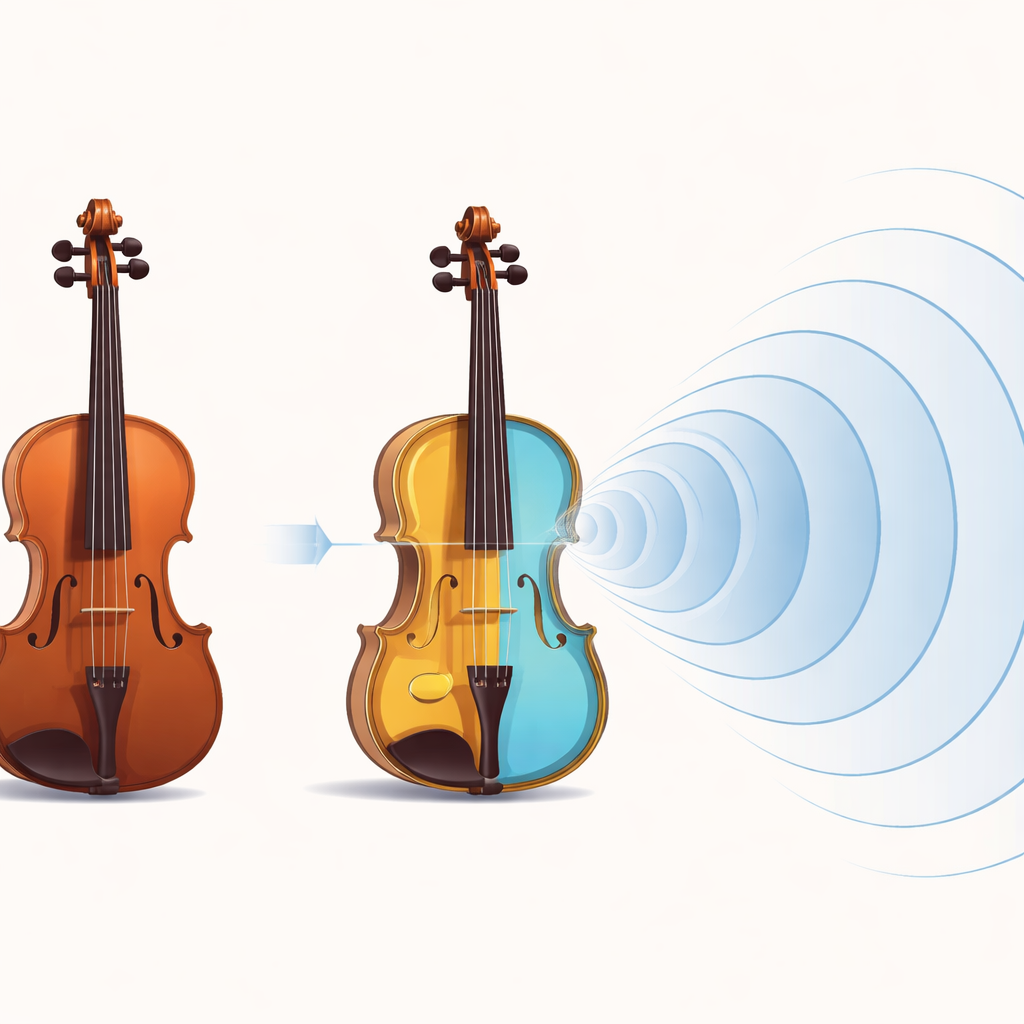
With a full physical model in hand, the authors could ask questions that are almost impossible to answer experimentally. They computed how efficiently input energy at the bridge or string is turned into radiated sound across the violin’s range. The result is far from even: some notes, especially the lowest ones on the G string, are inefficient and require more player effort, while higher notes on the thin E string are notably efficient. On average, only about one-tenth of the mechanical power becomes sound; the rest is lost mostly in internal damping of the wood. The team also tracked how much acoustic power flows through separate parts of the instrument. In the lowest register, air motion through the f-holes dominates, so the violin “sings” largely through these openings. At higher pitches, the top plate, particularly around the bridge, carries much of the radiated power, while the back plate plays a stronger role only in certain narrow bands linked to specific vibration patterns.
How Direction and Design Shape What We Hear
Sound from the violin does not spread uniformly in all directions. The simulations reveal that very low notes radiate almost equally in every direction, but as frequency rises the pattern becomes more complex, with lobes and nulls that depend on direction and frequency. Different overtones of the same note can be strong in some directions and weak in others, which can subtly affect how chords and harmonies are perceived by listeners placed around the player. The team then explored what happens when they digitally alter the design. Making the plates uniformly thinner boosts many lower-frequency components and shifts resonances downward, producing stronger but less high-rich sound. Thickening the plates has the opposite effect: weaker fundamental power and longer, less vibrant decay. Similar tests with f-hole closure and wood substitutions show how the Titian’s original plate thickness, materials, and openings appear tuned to amplify the full harmonic series of notes in a way that suits classical ideas of consonance.
A New Way to Experiment with Sound
In the end, this work shows that a carefully built digital twin of a classic violin can not only match many measured acoustic traits but also actually play music that reflects realistic physics. Such a model lets makers, players, and scientists experiment with plate thickness, wood choice, or f-hole shape and hear the consequences without carving new instruments or altering priceless ones. As computing power grows, the same approach could extend to bowed playing and real-time control, opening possibilities for instruments whose physical design parameters become part of musical expression itself.
Citation: Krishnadas, A., Liu, Y., Campbell, B. et al. Exploring the behavior of a strung computational Stradivarius violin. npj Acoust. 2, 13 (2026). https://doi.org/10.1038/s44384-026-00049-6
Keywords: violin acoustics, finite element modeling, Stradivarius, musical instrument design, sound radiation