Clear Sky Science · en
Ultrasound modulates microglial activity and reduces neuroinflammation in a parameter-dependent manner
Sound Waves as Gentle Brain Helpers
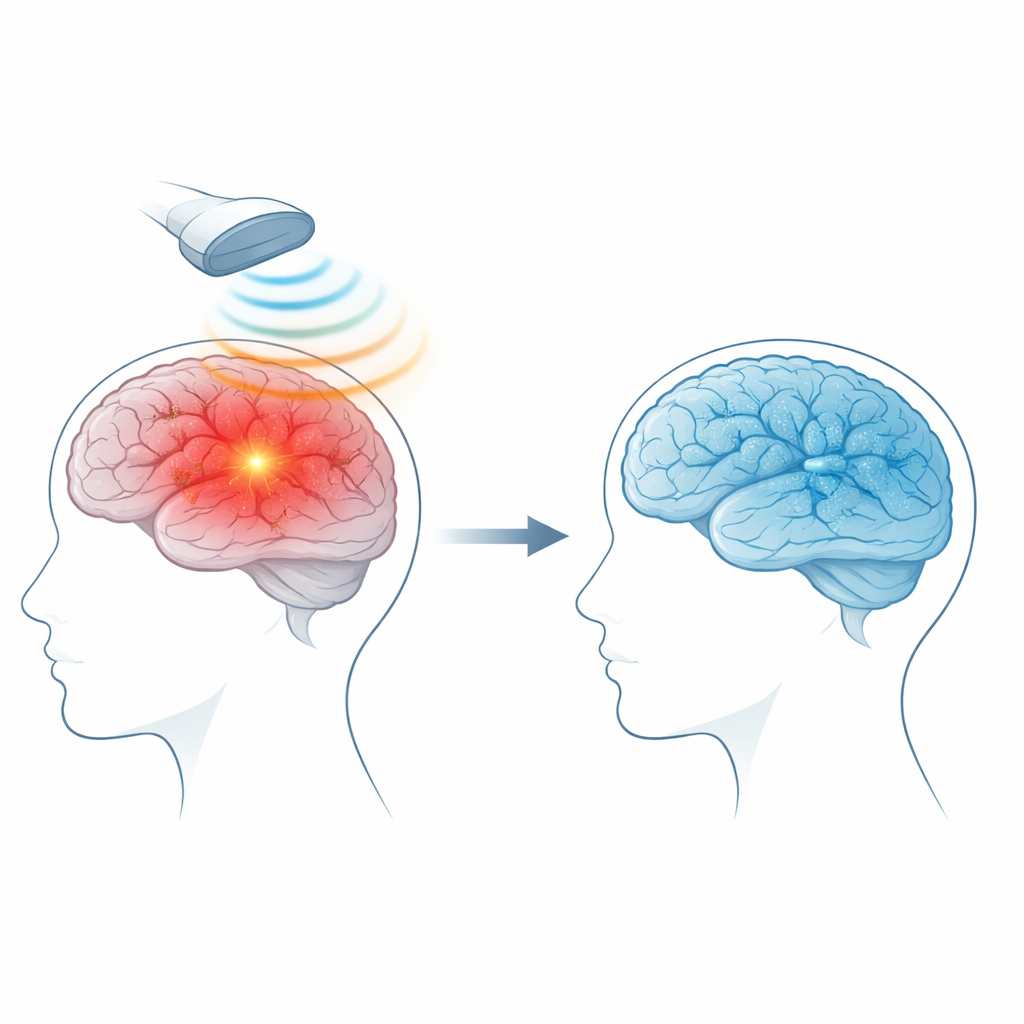
Many brain disorders, from Alzheimer’s disease to stroke, share a common culprit: long‑lasting inflammation driven by the brain’s own immune cells. This study asks a deceptively simple question with big implications: can carefully tuned ultrasound—sound waves beyond what our ears can hear—quiet these over‑alert immune cells and ease inflammation without surgery or drugs? The answer, tested in cells and in mice, suggests that with the right settings, ultrasound may become a non‑invasive tool to help restore a healthier balance in the inflamed brain.
When the Brain’s Guardians Go Too Far
The work centers on microglia, the brain’s resident immune sentinels. In healthy conditions, these tiny cells constantly patrol brain tissue, pruning connections, clearing debris and standing ready to respond to injury or infection. When they detect danger, microglia rapidly change shape and release chemical messengers called cytokines that rally an inflammatory response. This burst of activity can be helpful in the short term, but if microglia stay in attack mode, the same cytokines—especially TNF‑α, IL‑1β and IL‑6—can damage surrounding neurons and worsen diseases such as Alzheimer’s, Parkinson’s and traumatic brain injury. Finding safe ways to gently dial down this chronic overreaction has become a major goal in brain medicine.
Tuning Ultrasound Like a Treatment Knob
Ultrasound has already transformed medicine as an imaging tool and, at high power, for destroying tissue. Here, the researchers used much lower intensities, aiming not to burn or break cells but to nudge their behavior. In dishes of microglial cells made artificially inflammatory with a bacterial fragment called LPS, the team systematically varied three key ultrasound settings: the sound frequency (0.5, 1 or 2 megahertz), the pressure of the waves, and how long each treatment lasted. They then measured how much of the three major inflammatory cytokines the cells released and whether the cells showed signs of stress or damage.
Quieting Harmful Signals While Sparing Cells
The patterns that emerged reveal ultrasound as a surprisingly precise dial. Certain combinations of settings, especially a frequency of 2 megahertz and, separately, a more clinically practical 0.5 megahertz at moderate pressure for just five minutes, markedly lowered the levels of TNF‑α, IL‑1β and IL‑6. Importantly, this calming of microglia was not because the cells were being harmed; tests of a cell‑damage enzyme (LDH) showed that, if anything, ultrasound reduced stress compared with the inflamed state alone. Temperature checks and computer simulations confirmed that heating was negligible, reinforcing the idea that mechanical, not thermal, forces were responsible. At the genetic level, treated cells showed sustained reductions—lasting up to 72 hours—in genes tied to inflammation and a key control switch called NF‑κB, alongside boosts in genes linked to anti‑inflammatory, tissue‑repairing responses.
From Dish to Living Brain
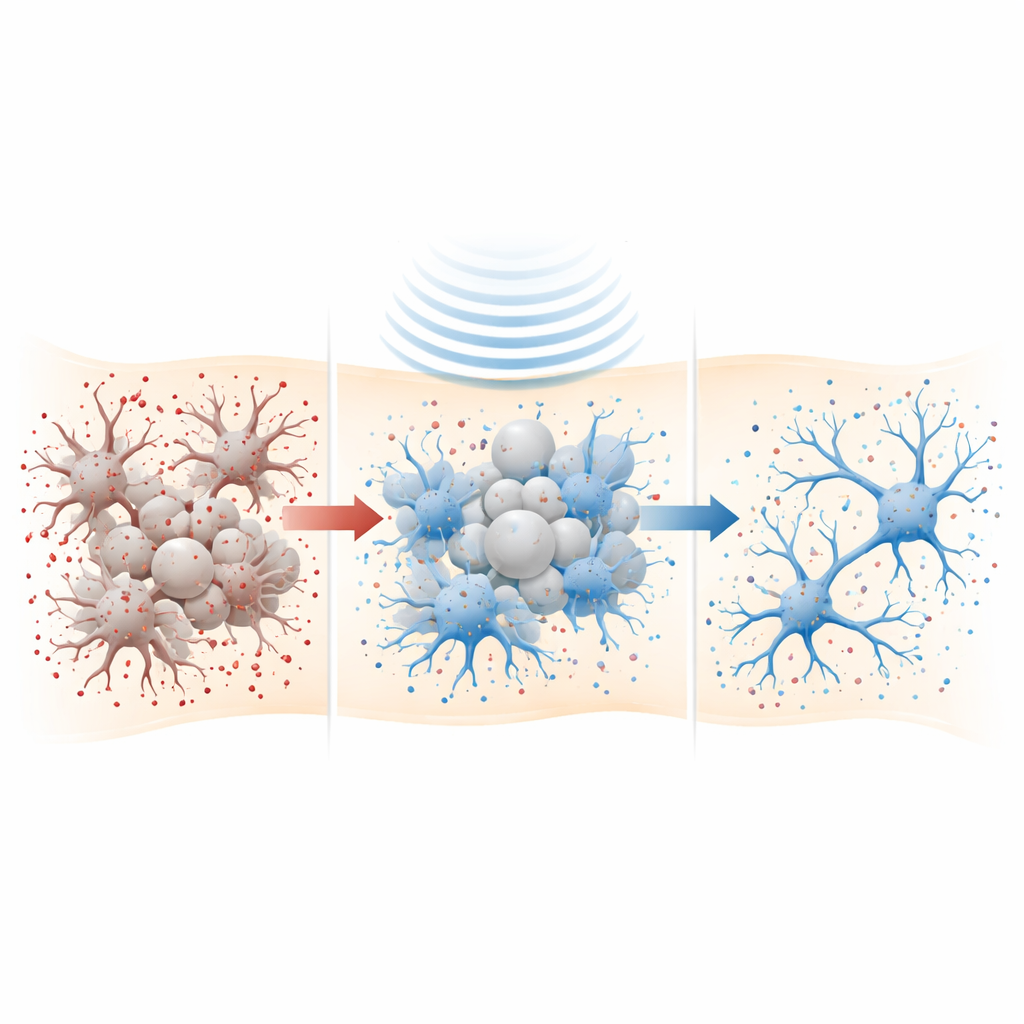
To see whether these benefits extend beyond a dish, the team turned to a mouse model of brain‑wide inflammation. Mice received repeated LPS injections to trigger strong microglial activation, then a single session of focused ultrasound covering the whole brain at the selected 0.5 megahertz setting. Just four hours later, the hippocampus—a memory‑related region especially vulnerable in neurodegenerative disease—showed lower levels of TNF‑α compared with untreated inflamed mice. Under the microscope, microglia in ultrasound‑treated animals began to shift away from the chunky, “bushy” shapes typical of aggressive inflammation toward more branched forms associated with a calmer, home‑maintaining state. At the same time, certain internal structures tied to waste processing and debris clearance expanded, hinting that ultrasound may not only cool inflammation but also prepare microglia to clean up damaged material.
What This Could Mean for Future Brain Care
Overall, the study shows that low‑intensity ultrasound, when tuned to specific settings, can soften harmful inflammatory signals from microglia, both in controlled cell experiments and in the brains of living mice, without relying on drugs or causing heat damage. For a layperson, the key message is that sound waves might someday act like a gentle external “thermostat” for the brain’s immune system—turning down damaging over‑activity while preserving, or even enhancing, its protective roles. Although much work remains, including studies in more disease‑like models and in both sexes, these findings strengthen the case for ultrasound as a promising, non‑invasive approach to help keep the brain’s delicate immune balance in check.
Citation: Grewal, S., Iacoponi, F., Chan, L.Y.N. et al. Ultrasound modulates microglial activity and reduces neuroinflammation in a parameter-dependent manner. npj Acoust. 2, 15 (2026). https://doi.org/10.1038/s44384-026-00047-8
Keywords: ultrasound therapy, brain inflammation, microglia, neurodegenerative disease, noninvasive neuromodulation