Clear Sky Science · en
Flexible ultrasound array for subcortical brain stimulation in humans: a simulation study
Reaching Deep into the Brain without Surgery
Many brain disorders, from Parkinson’s disease to chronic pain, arise from circuits buried deep beneath the brain’s surface. Today, reaching those circuits often requires invasive surgery or bulky machines that are hard to use in everyday clinics. This study explores a new idea: a soft, wearable ultrasound cap that gently molds to each person’s head and could one day stimulate deep brain regions from outside the skull, helping to treat neuropsychiatric conditions without opening the skull.
Why Sound Waves Struggle to Enter the Head
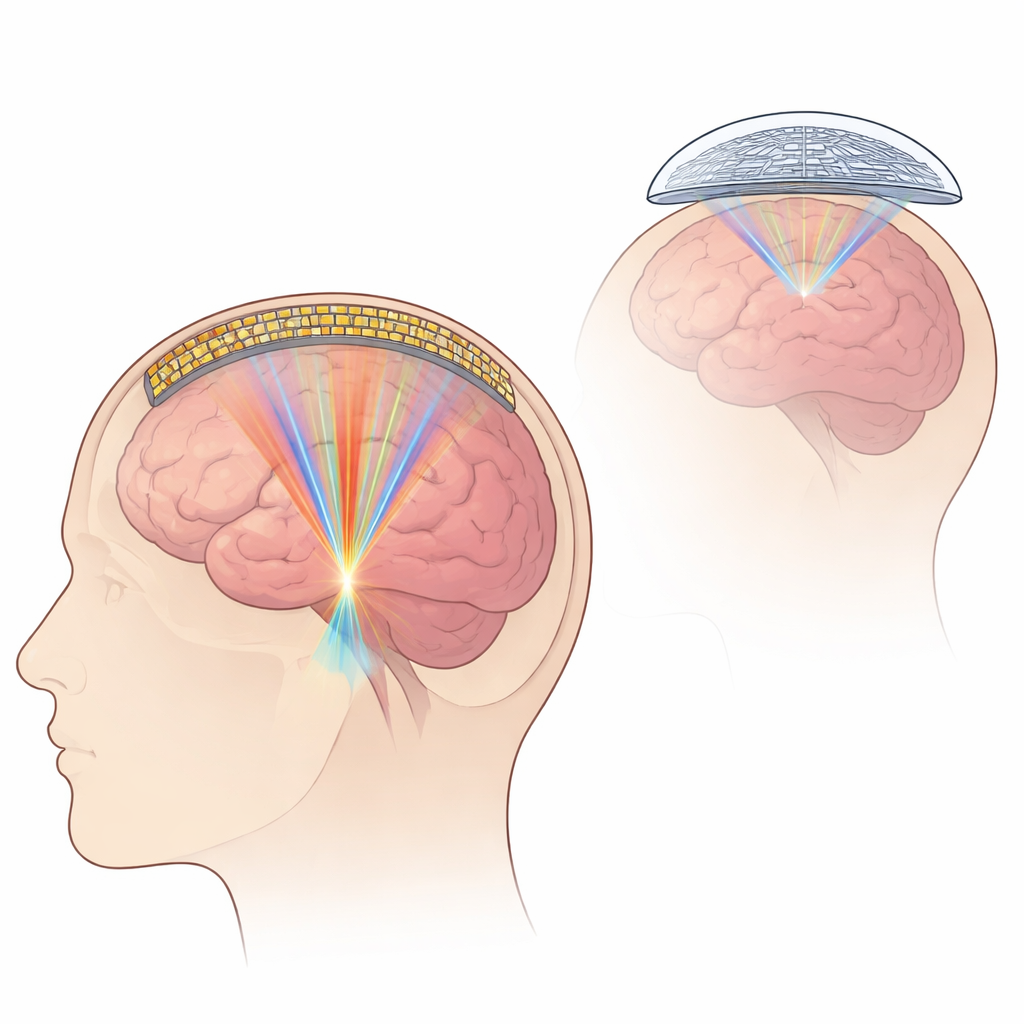
Transcranial focused ultrasound uses concentrated sound waves to heat, nudge, or modulate brain tissue. Unlike magnetic or electrical stimulation, it can reach several centimeters below the surface with pinpoint precision. But the human skull is an acoustic obstacle course. Its hard, irregular bone reflects and bends ultrasound, blurring the focus and wasting much of the energy before it ever reaches the target. Current clinical systems use large, rigid dome-shaped arrays of ultrasound emitters surrounding the head in a water bath. These machines can work, but they are cumbersome, expensive, and lose efficiency when the beam is steered away from the center of the dome.
A Flexible Cap that Hugs the Skull
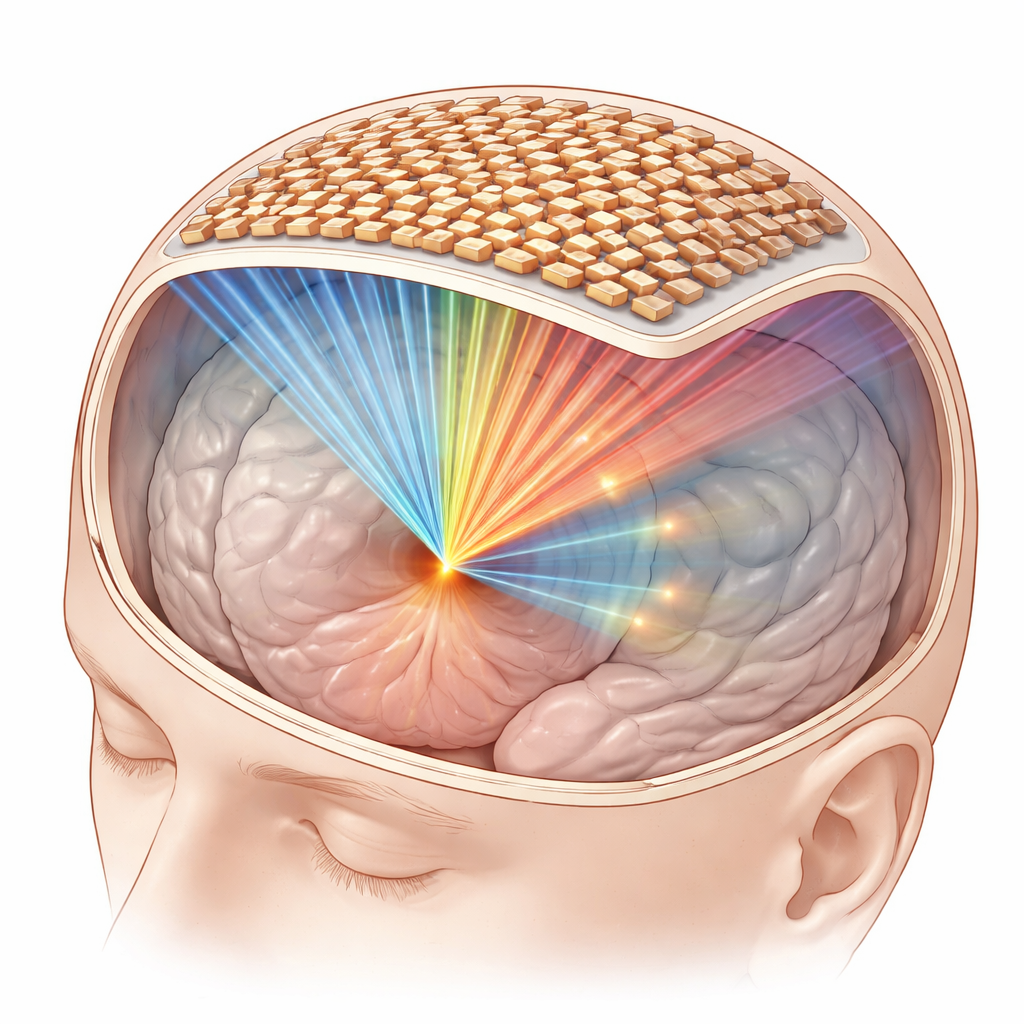
The authors propose a very different design: a thin, flexible array of many small ultrasound elements arranged over an area about 8 by 8 centimeters and bent to match each person’s scalp. Because the device lies directly on the head instead of hovering above it, the sound waves can enter the skull at gentler angles, reducing reflections and improving transmission. Using detailed computer models built from MRI scans of four human heads, the team simulated how sound waves travel from this flexible cap through scalp, skull, and brain to a target roughly 4 centimeters under the skull—close to structures like the thalamus and basal ganglia that are important in movement and mood.
Tuning the Pattern for a Sharper Focus
In their simulations, the researchers varied two basic design knobs: the spacing between elements (pitch) and the size of each element. Increasing the spacing widened the overall aperture of the array and produced a narrower, more concentrated beam, but if the pattern was too regular, bright “echo” spots—called sidelobes—appeared away from the target. Larger individual elements slightly broadened the focal spot but improved how much energy passed through the skull. The team then went a step further and abandoned rigid grids altogether. They explored spiral and randomly distributed patterns of elements, using an optimization algorithm inspired by thermal annealing in materials to search for layouts that kept the main focus tight while suppressing sidelobes.
Outperforming the Traditional Rigid Dome
When the optimized, random-pattern flexible array was compared with a standard rigid hemispherical array, the flexible design clearly won in the simulations. It produced a focal spot nearly one-third shorter in depth and a smaller area in the horizontal plane, meaning the stimulated region was more tightly confined. At the same time, the peak pressure at the target was about 44% higher than with the rigid dome, despite using the same number of elements. The flexible cap also preserved good focus over a steering region about 30 by 20 millimeters, allowing the simulated beam to be shifted around a patch of deep brain tissue while maintaining most of its strength—something the rigid dome struggled to do without losing intensity and sharpness.
Toward Gentler, More Precise Brain Treatments
To a non-specialist, the key message is that careful reshaping and rearranging of many tiny ultrasound emitters into a soft, skull-hugging cap could make it easier to send precise, powerful pulses of sound to deep brain targets without surgery. While this work is purely computational and still needs to be tested in real devices and patients, it lays out quantitative design rules for future prototypes. If confirmed experimentally, such flexible arrays could help turn focused ultrasound into a more practical, patient-friendly option for treating conditions like Parkinson’s disease, epilepsy, and severe depression, and might even support targeted drug delivery to specific brain regions.
Citation: Huo, H., DiSpirito, A., Wang, N. et al. Flexible ultrasound array for subcortical brain stimulation in humans: a simulation study. npj Acoust. 2, 11 (2026). https://doi.org/10.1038/s44384-026-00046-9
Keywords: transcranial focused ultrasound, flexible brain stimulation array, noninvasive neuromodulation, subcortical brain targets, skull-conformal wearable device