Clear Sky Science · en
Genotype environment interaction effects in multi environment models for Fusarium head blight resistance in wheat
Why healthier wheat matters
Wheat is a cornerstone of human diets worldwide, but a disease called Fusarium head blight (FHB) threatens both harvests and food safety. The fungus that causes FHB not only shrivels grain and cuts yields, it also leaves behind a toxin called DON that can make grain unsafe to eat. Breeders want wheat varieties that stay healthy across many types of weather and locations, yet testing thousands of lines in the field is slow and expensive. This study explores how to use DNA-based tools and advanced statistics to predict which wheat lines will resist FHB in different environments, potentially speeding up the delivery of safer, more reliable crops.
A disease shaped by weather and genetics
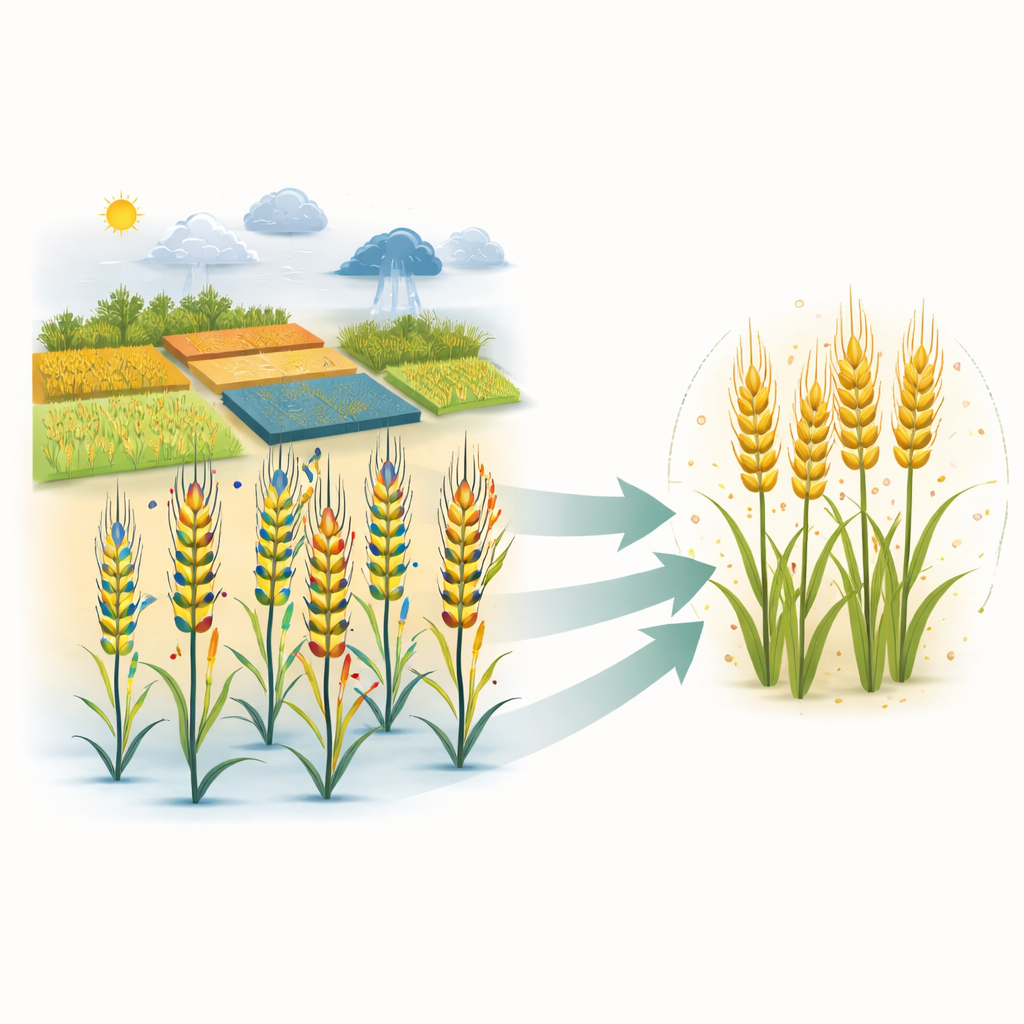
FHB is a complex disease because its severity depends on both the plant’s genes and the conditions it faces in the field. Warm, humid weather during flowering creates ideal conditions for infection, but those conditions can change from year to year and location to location. The same wheat line may look fairly resistant in one trial and badly diseased in another. Breeders also track traits linked to FHB, such as how far the anthers (pollen-bearing parts) stick out of the flower, how tall the plants are, and when they start heading. In this study, the researchers confirmed strong relationships: lines with more anther extrusion and taller plants tended to have less FHB and lower DON toxin levels, while later heading often went along with higher toxin levels. These trait connections become useful clues when trying to predict disease resistance.
From field plots to prediction models
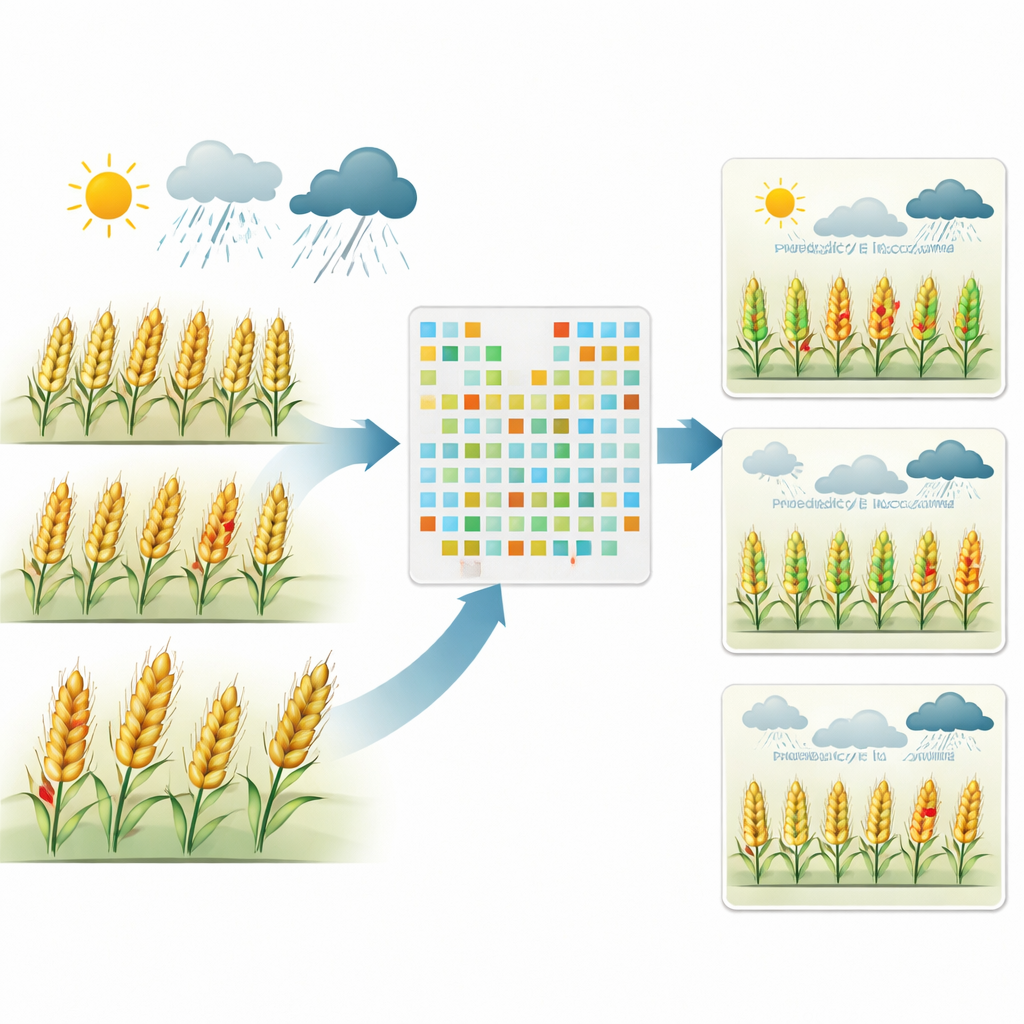
The team analyzed two large collections of spring wheat: a genetically diverse international panel and a panel of elite Nordic breeding lines. Both were tested for FHB, DON, and related traits over several years in Norway, Austria, and Canada. At the same time, each line was characterized with tens of thousands of DNA markers across the genome. With this combined field and DNA information, the researchers built several types of prediction models. One model used only information about each line and the environments where it was tested. A second model added genomic relationships between lines. A third, more advanced model also incorporated how each genetic profile interacted with each environment—capturing the crucial “genotype-by-environment” (G × E) effects that make a line perform differently under different conditions.
Learning from multiple traits and locations
To mimic real breeding decisions, the study tested two scenarios. In one, models had to predict completely new wheat lines that had never been grown before. In the other, they predicted how known lines would behave in a new environment, using results from other sites and years. The researchers also compared single-trait models, which focus on FHB or DON alone, with multi-trait models that simultaneously use FHB, DON, plant height, heading time, and anther extrusion. In the more diverse panel, multi-trait models generally outperformed single-trait ones, especially when they included G × E terms. In the elite Nordic panel, where the genetic and environmental variation was narrower, multi-trait models did not always help and sometimes performed slightly worse. Across both panels and scenarios, prediction accuracy improved when data from multiple environments were used, reflecting the power of borrowing information across trials.
Why environment-aware DNA models work better
The most successful approach was the model that combined genomic information with explicit G × E interaction effects. For difficult traits like FHB severity and DON content—both strongly shaped by weather—this model often produced the highest prediction abilities. In particular, when correlations between environments were strong, such as similar disease pressures in different years or locations, the interaction model could exploit these links to make more reliable predictions. The study also highlighted other factors that matter for prediction quality: larger and more diverse training sets, higher marker density, and well-measured field data all contributed to better performance, especially in the more diverse panel that had been tested for many years.
What this means for safer, more stable wheat
To a non-specialist, the key message is that breeding for FHB resistance can be made faster and more precise by combining DNA information with careful modeling of how plants respond to different environments. Instead of waiting years for field tests of every candidate line, breeders can use these models to forecast which lines are likely to stay healthier and accumulate less toxin across a range of climates. While the study did not find dramatic gains from multi-trait models in every case, it showed that paying attention to the interaction between genes and environment consistently improves predictions. In the long run, such environment-aware genomic tools could help deliver wheat varieties that produce safer grain and more stable yields under increasingly unpredictable weather.
Citation: Nannuru, V.K.R., Dieseth, J.A., Dong, Y. et al. Genotype environment interaction effects in multi environment models for Fusarium head blight resistance in wheat. npj Sci. Plants 2, 11 (2026). https://doi.org/10.1038/s44383-026-00022-y
Keywords: wheat disease resistance, Fusarium head blight, genomic prediction, genotype-by-environment interaction, plant breeding