Clear Sky Science · en
Human colonic organoid monolayers reveal biological sex and psychological state influence epithelial responses to Campylobacter jejuni infection
Why mind and gut health travel together
Many people know that food poisoning can ruin a week, but fewer realize it can trigger long‑lasting bowel troubles, including irritable bowel syndrome (IBS). Women and people living with anxiety or depression are at especially high risk after infection with a common food‑borne bacterium called Campylobacter jejuni. This study asks a simple but important question: does a person’s sex and psychological state change how their gut lining reacts to this microbe—and could that help explain who goes on to develop chronic symptoms?
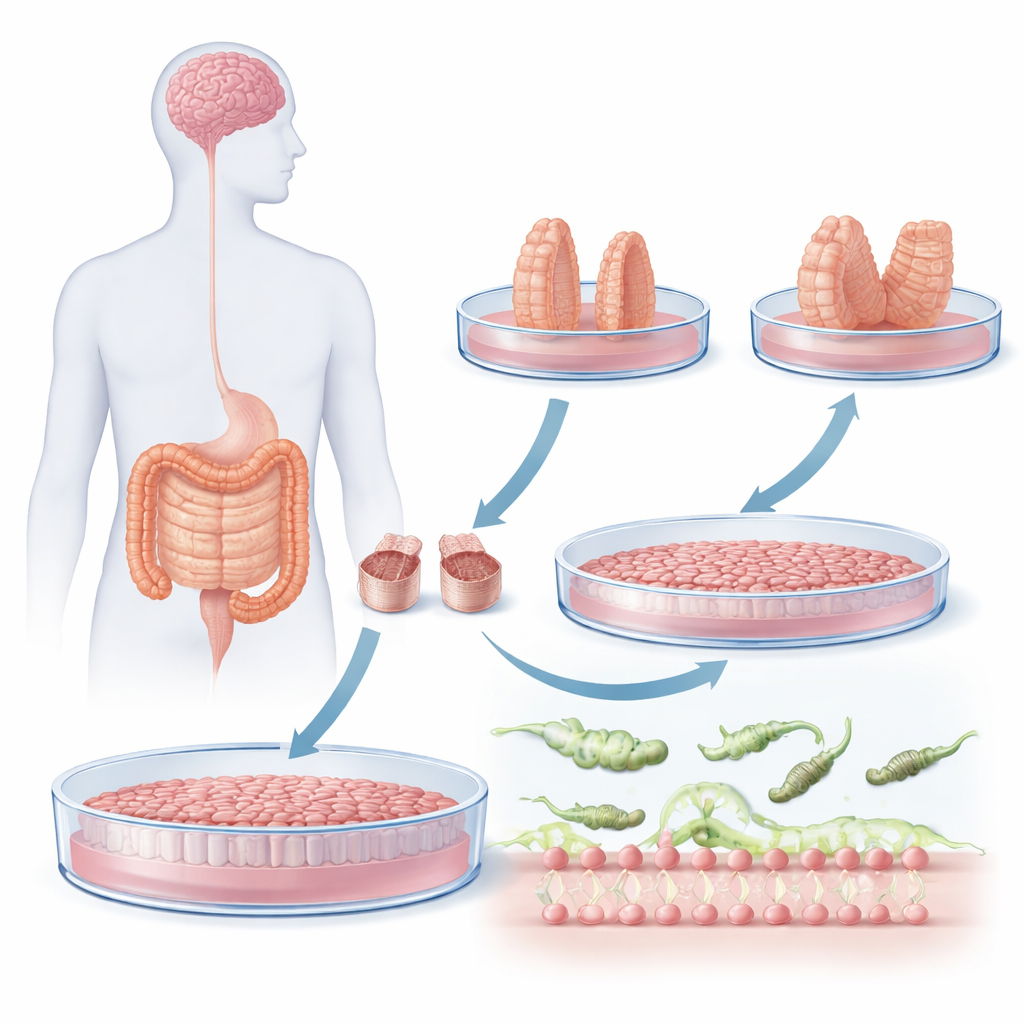
Building tiny replicas of the human colon
Rather than relying on standard laboratory cell lines, which are simple and identical, the researchers created miniature versions of each volunteer’s own colon lining. They collected small biopsies from 20 healthy adults and grew them into three‑dimensional “organoids”—tiny, self‑organized balls of gut tissue containing many of the cell types and genetic programs of the real intestine. These organoids were then spread out into flat sheets, or monolayers, on porous supports so that they formed a continuous barrier, mimicking the inner surface of the colon. Because each culture kept the biological sex and molecular traits of its donor, the team could directly examine how these personal factors shaped responses to infection.
Linking mood scores to bacterial stickiness
Volunteers were grouped using a standard hospital anxiety and depression questionnaire. Those with very low scores were labeled low anxiety/depression (low AD), while those with very high scores formed the high AD group. When C. jejuni was added to the organoid monolayers, the bacterium readily attached to and entered the human gut cells, confirming that this system could model infection. Crucially, monolayers from high AD donors tended to attract more bacteria than those from low AD donors, especially in men. This difference in “stickiness” hints that psychological state is reflected in the biology of the gut lining in a way that may favor pathogen attachment.
When the barrier leaks under stress
The team next monitored how well the organoid barriers held up by measuring electrical resistance across the cell layer—a sensitive readout of tightness between neighboring cells. Uninfected monolayers from both groups remained stable for more than a day. Once exposed to C. jejuni, however, the picture changed. All cultures eventually showed damage, but high AD monolayers lost about half of their barrier strength within 24 hours, while low AD monolayers barely weakened. Microscopy revealed that tight junction proteins such as occludin and ZO‑1, which normally form a neat honeycomb pattern at cell borders, became disorganized and patchy after infection. Protein measurements confirmed that infected monolayers had less occludin overall, providing a molecular explanation for the leaky barrier.
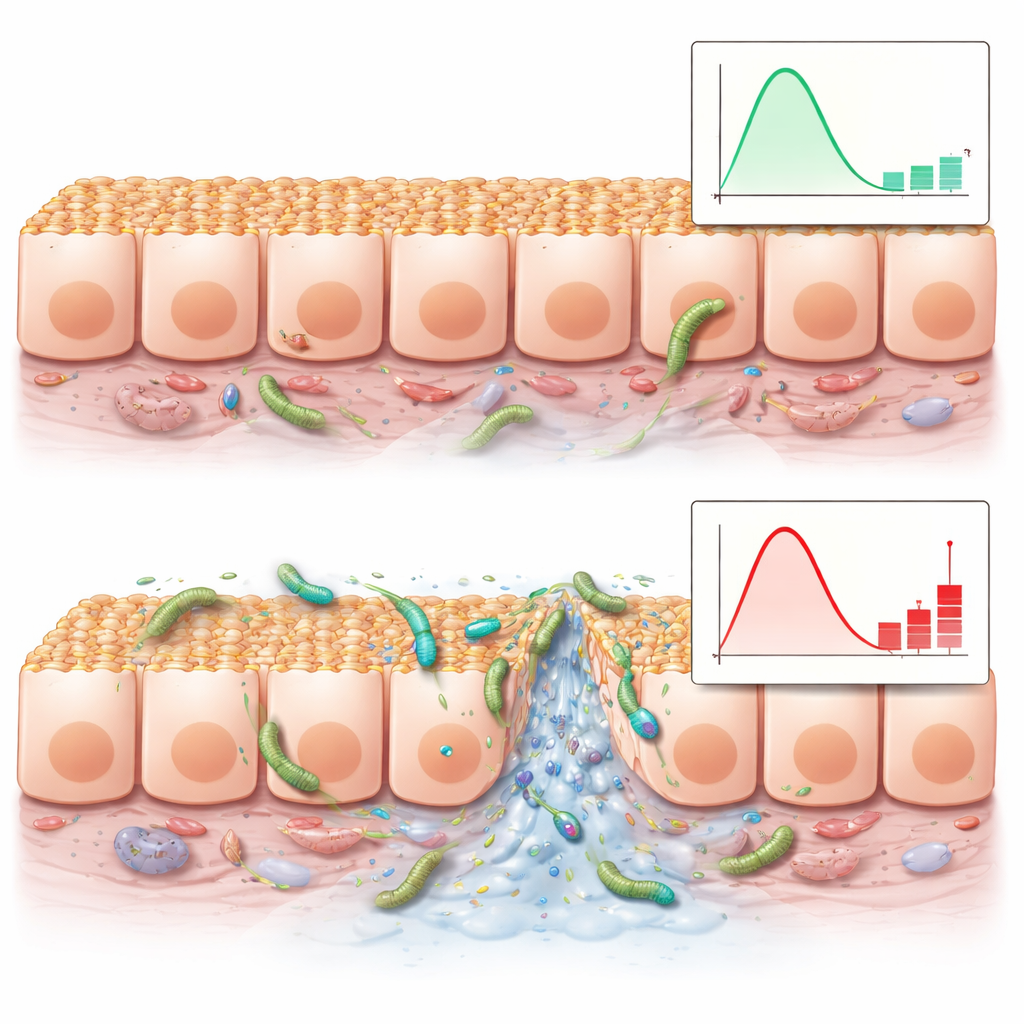
Stress‑linked molecular fingerprints
To see what was happening inside the cells, the researchers analyzed gene activity in infected organoids at early (6‑hour) and later (24‑hour) time points. High AD monolayers switched on a suite of inflammatory messenger molecules, including the chemokines CXCL10 and CXCL11, as well as higher levels of mucus‑forming proteins and digestive enzymes called serine proteases. These factors are known from other work to promote bacterial attachment, increase intestinal permeability, and disturb cell junctions. In contrast, low AD monolayers more strongly activated genes related to cell‑to‑cell adhesion and repair, including a family of adhesion molecules called protocadherins and several barrier‑supporting pathways identified by gene set enrichment analysis. When the team looked separately at men and women, they found distinct patterns: for example, high AD women showed more of another chemokine, CCL5, while high AD men showed particularly elevated CXCL11 and certain mucins, underscoring that sex and psychological state interact in shaping gut defenses.
What this means for people after food poisoning
This work suggests that the mental state of a person—and their biological sex—can leave a detectable imprint on how their colon lining responds to a common bacterial infection. Organoid monolayers from individuals with high anxiety and depression scores were more prone to bacterial attachment, produced more inflammatory and tissue‑remodeling molecules, and suffered greater barrier breakdown. By contrast, tissue from low AD donors mounted a response that favored maintaining and repairing the barrier. While these experiments were done in lab‑grown cells rather than whole people, they support the idea that stress‑related biology in the gut can help determine who develops ongoing problems like post‑infection IBS after an acute bout of diarrhea, and they highlight patient‑specific organoids as a promising tool for designing more personalized prevention and treatment strategies.
Citation: Edwinson, A., Peters, S., Breen-Lyles, M. et al. Human colonic organoid monolayers reveal biological sex and psychological state influence epithelial responses to Campylobacter jejuni infection. npj Gut Liver 3, 10 (2026). https://doi.org/10.1038/s44355-026-00058-y
Keywords: Campylobacter infection, irritable bowel syndrome, gut barrier, organoids, stress and anxiety