Clear Sky Science · en
Multifunctional micro-devices for neuromorphic computing, display and energy saving
Why smarter screens matter
Our lives are filled with glowing screens, from phones to billboards. Yet most displays simply show pictures; they do not sense their surroundings, adapt to changing light, or help process the images they present. This paper reports a tiny light-emitting device that does all three at once: it can sense light, remember signals like a brain cell, and display images while saving energy. Such “thinking pixels” could one day lead to ultra-efficient, intelligent screens for phones, wearables, and augmented reality.
A tiny pixel that can see and remember
The core of the work is a microscopic light-emitting diode, or micro‑LED, carefully built from ultra-thin layers of semiconductor materials. The structure is engineered so that the same device can both emit blue light and act as a light sensor. Even at zero applied voltage it produces a measurable current when illuminated, meaning it can detect light in a self-powered mode. The micro‑LED responds most strongly to near‑ultraviolet and blue wavelengths, and does so quickly, turning on and off in just a few thousandths of a second—fast enough for real-time imaging and sensing.
Learning from the human eye and brain
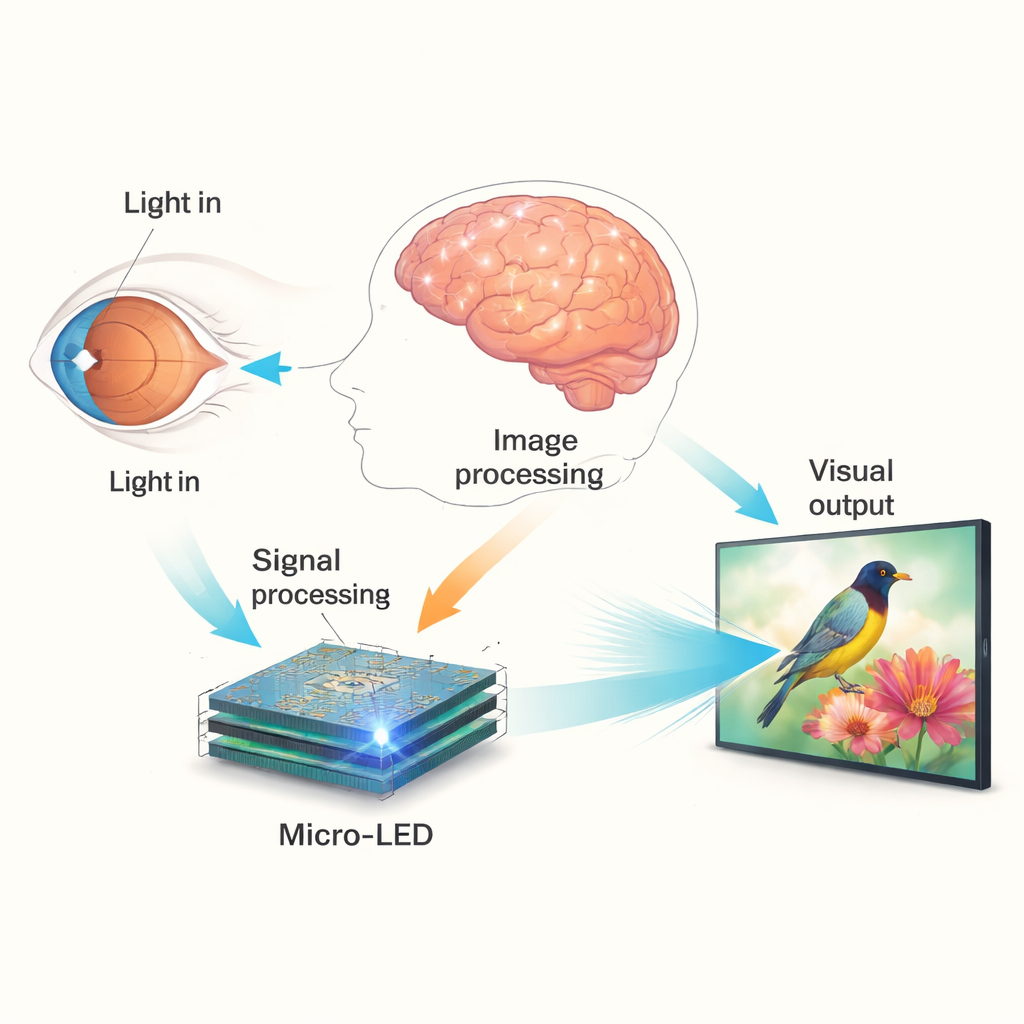
The design is inspired by the way our eyes and brain work together. In biology, the retina converts light to electrical signals, which are then processed in the visual cortex while we continue to see the image. The researchers mirror this idea in hardware: their micro‑LED both converts light to electrical signals and produces visible light for display. Under low or zero voltage, it behaves like a detector, separating light‑generated charges inside its layered structure. Under forward voltage, those charges recombine to emit blue light. By integrating sensing, signal conversion, and light emission into a single pixel, the device avoids the costly back-and-forth between separate chips that wastes energy in today’s displays.
A pixel with a short-term memory
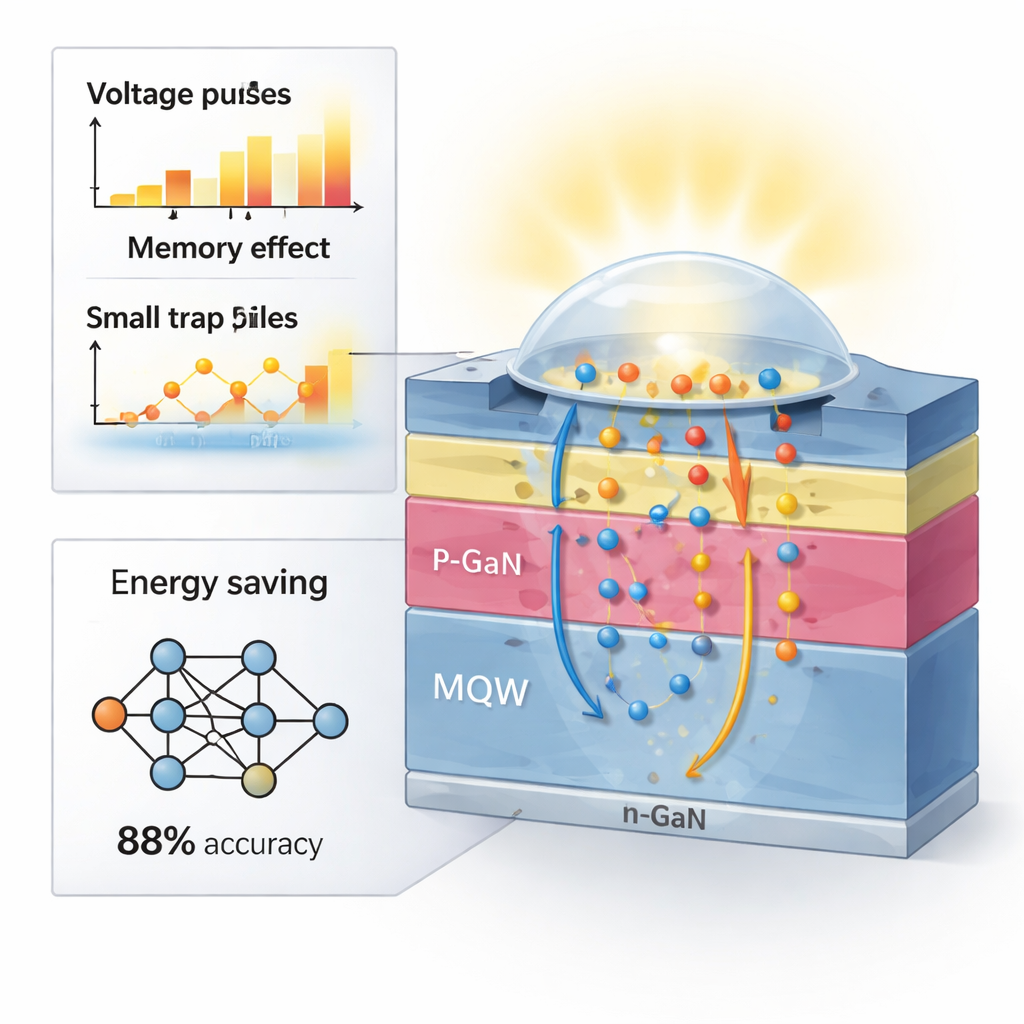
When the team sends a train of short voltage pulses to the micro‑LED, its electrical response does not simply repeat—it grows. Each pulse leaves behind some trapped charges in tiny defects inside the material. When the next pulse arrives, these stored charges are released and added to the new signal, much like a biological synapse that becomes temporarily stronger after activity. This “short-term potentiation” is a basic form of memory. Because the device remembers recent pulses, later pulses can achieve the same brightness with less electrical power. Under optimized conditions, twelve pulses were enough to cut the effective energy use by about 4.5 percent compared with a conventional, continuously driven pixel.
From clever pixels to smart vision
The authors then ask what such synapse-like pixels could do in a larger system. Using measured device behavior as a building block, they simulate an array of 28×28 pixels feeding a brain-inspired computing model called a spiking neural network. This virtual system is trained on a standard set of fashion images—shoes, shirts, coats and more—to test recognition and noise removal. Thanks to the device’s memory-like response, the simulated network can sharpen blurry, noisy pictures while keeping edges and shapes intact. After twenty rounds of training, the recognition accuracy rises above 88 percent, showing that hardware with built-in memory and light handling can support meaningful image processing tasks.
What this could mean for future screens
To a non-specialist, the key message is that a single, carefully engineered micro‑LED can act as a light sensor, a memory element, and a display pixel all at once, while modestly reducing power use. Instead of separate chips for cameras, processors, and screens, future devices might combine these roles into layers of “thinking” pixels that see, remember, and show images in the same place. If scaled up, such neuromorphic displays could lead to thinner gadgets that last longer on a battery and adapt smoothly to changing environments, bringing us a step closer to vision systems that work more like the human eye and brain.
Citation: Hou, B., Yin, J., Zhao, Y. et al. Multifunctional micro-devices for neuromorphic computing, display and energy saving. npj Unconv. Comput. 3, 9 (2026). https://doi.org/10.1038/s44335-026-00058-4
Keywords: neuromorphic display, micro-LED, energy-efficient screens, image recognition, optoelectronic synapse