Clear Sky Science · en
Atomic-scale removal mechanism of chemically enhanced diamond turning of single crystal silicon carbide
Why smoother cutting of tough crystals matters
Electronics, satellites, and high power devices increasingly rely on single crystal silicon carbide, a material that can shrug off heat and harsh environments but is very hard to shape with precision. Making mirror smooth silicon carbide surfaces without cracks is vital for chips and optics, yet traditional polishing is slow and standard cutting often leaves damage. This study explores a new way to help a diamond tool glide through this stubborn crystal by using a special heated lubricant that gently alters only the top atomic layer.
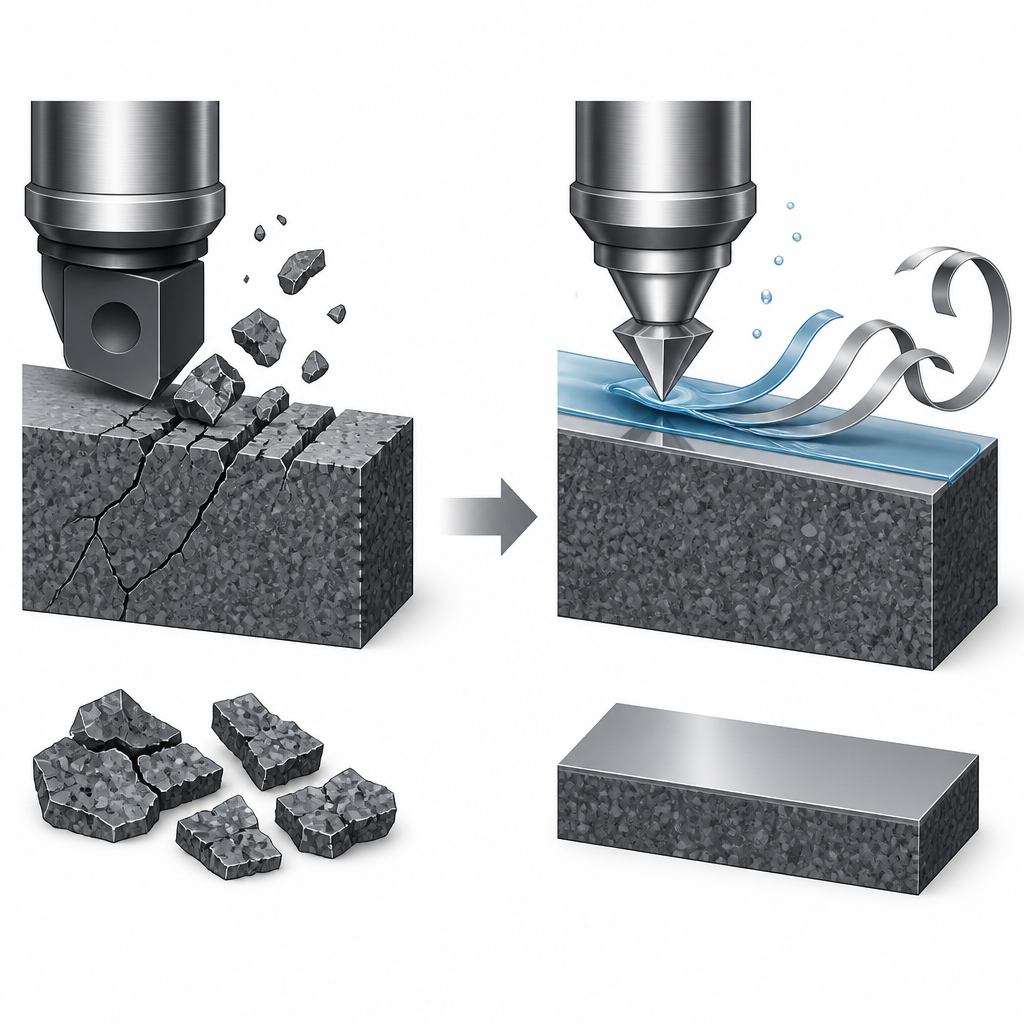
A hard crystal that does not like to be cut
Silicon carbide combines extreme hardness with low fracture toughness, a mix that tends to produce microcracks when it is cut. Conventional lapping and polishing remove material by loose abrasives and are notoriously inefficient for such resistant crystals. Single point diamond turning can, in principle, carve atomically smooth shapes, but when applied directly to silicon carbide it often triggers brittle fractures or rapidly wears down the tool. Engineers have tried adding laser heating to soften the material, yet working nearly dry limits cooling and lubrication, creating new problems for tools and machines.
A smart liquid that activates under gentle heat
The researchers designed a new cutting fluid by dissolving an eco friendly azo compound called ACVA into a common machining solvent, polyethylene glycol. When the diamond tool slides over silicon carbide, friction raises the local temperature to around 50 to 70 degrees Celsius, warm enough for ACVA molecules to split into highly reactive fragments. Using molecular dynamics simulations, the team showed that these fragments quickly attach themselves to the silicon rich surface of the crystal and form a thin layer containing silicon, carbon, oxygen, and hydrogen bonds. In effect, the lubricant does more than reduce friction; it chemically caps the outermost atoms.
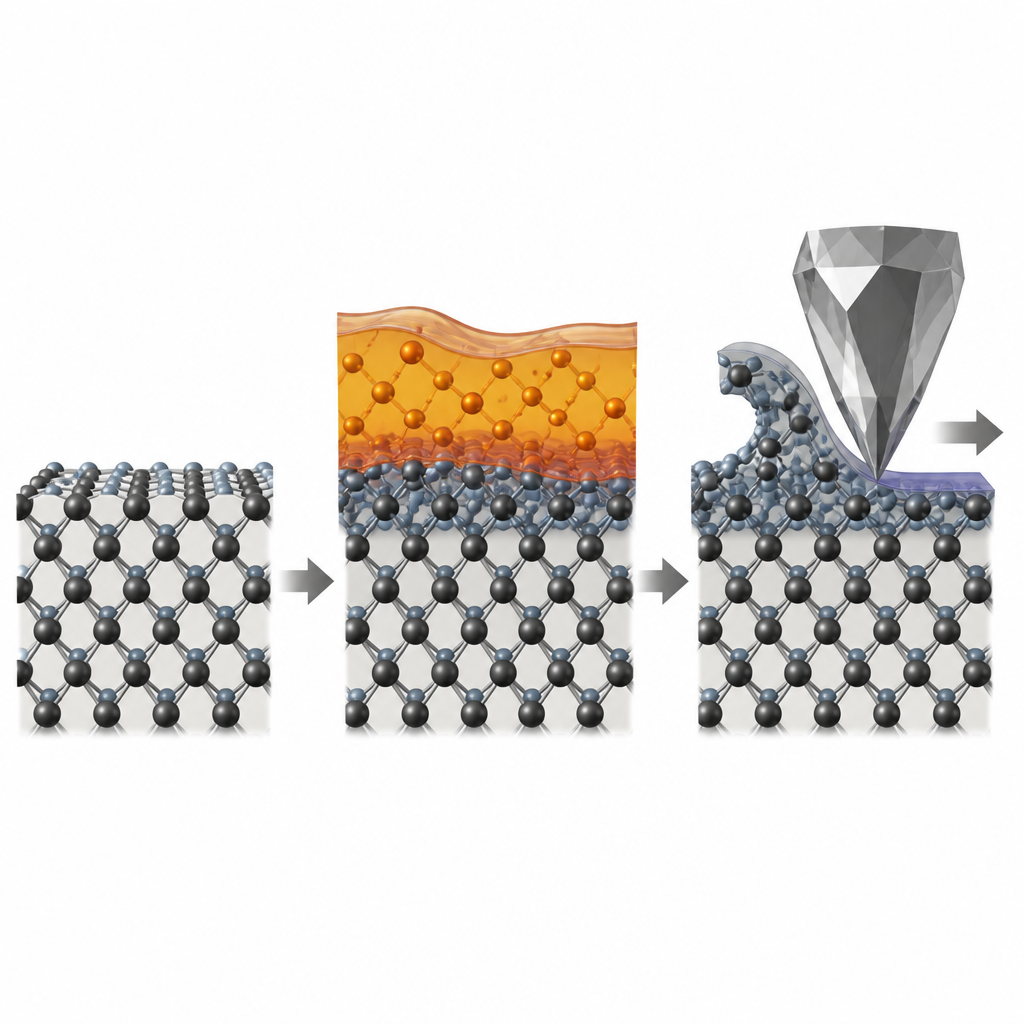
How a thin surface film makes cutting easier
At the atomic scale, this new surface layer slightly stretches the bonds that tie silicon and carbon together in the first few layers of the crystal, making them easier to break and rearrange under the pressure of the moving tool. Simulations of diamond turning with and without the active lubricant reveal that the treated surface produces more disordered, ductile chips and fewer buried defects. The grooves left behind by the chemically assisted process are smoother and show lower internal stress. Experiments with a single diamond grit scratching silicon carbide at controlled temperatures confirmed these trends: with enough ACVA in the fluid, higher temperatures produced better surface finish and maintained or improved removal rates.
A gentle glassy skin that protects what lies beneath
Microscopy of scratched samples uncovered what the simulations suggested. Under conventional lubrication, the near surface region contained microcracks, distorted crystal zones, and residual strain extending hundreds of nanometers deep. In contrast, when the ACVA based fluid was used, the process formed a very thin amorphous silicon oxycarbide film, only about 15 nanometers thick, on top of the crystal. This glassy skin accommodated most of the deformation, so the underlying silicon carbide lattice stayed largely intact, with far fewer defects and much lower strain. Chemical analysis of the surface confirmed the presence of new silicon oxygen carbon structures created by the thermally activated reaction between ACVA fragments and the crystal.
What this means for future ultra clean machining
To a non specialist, the key message is that the authors turned a cutting fluid into an active partner that lightly transforms the very top of an extremely hard crystal, making it behave more like a soft metal just where the tool touches. By creating and renewing a thin, glassy reaction layer during machining, their approach allows a diamond tool to slice silicon carbide in a smooth, crack free manner while also protecting the tool and the deeper crystal. This chemically enhanced diamond turning concept could help manufacturers produce higher quality wafers and precision parts from silicon carbide and related materials in a more efficient and controllable way.
Citation: Liu, S., Huang, S., Liu, C. et al. Atomic-scale removal mechanism of chemically enhanced diamond turning of single crystal silicon carbide. npj Adv. Manuf. 3, 20 (2026). https://doi.org/10.1038/s44334-026-00081-0
Keywords: silicon carbide machining, diamond turning, chemically enhanced lubrication, surface modification, ultraprecision manufacturing