Clear Sky Science · en
From lines to lattices—high-resolution 2D and 3D PDMS microarchitectures via aerosol jet printing
Building Tiny Soft Structures in Thin Air
Imagine being able to 3D-print soft, rubbery structures as thin as a human hair—tiny springs, channels and lattices that could move like muscles or guide droplets of blood. This paper shows how to do exactly that with a popular silicone called PDMS, using a printing method that sprays microscopic droplets into the air and lets them solidify into delicate 3D forms without any supporting scaffold. The work opens doors for new kinds of soft robots, medical devices and lab-on-a-chip systems that were previously very hard, or even thought impossible, to manufacture.
Why Soft Silicone Shapes Are Hard to Make
PDMS is a clear, flexible silicone widely used in biomedical devices, microfluidic chips, and soft robotics because it is gentle to tissues, lets gases pass through, and withstands wear. Until now, most PDMS parts were cast in molds, which works well for flat or simple shapes but struggles with intricate 3D architectures like overhanging beams, hollow lattices or winding channels that climb out of the plane. Existing printing approaches either require support baths, complex chemistries, or produce parts with poor resolution and limited strength. In short, the field lacked a simple, general way to “draw in space” with PDMS at microscopic scales.
Drawing with a Focused Mist of Droplets
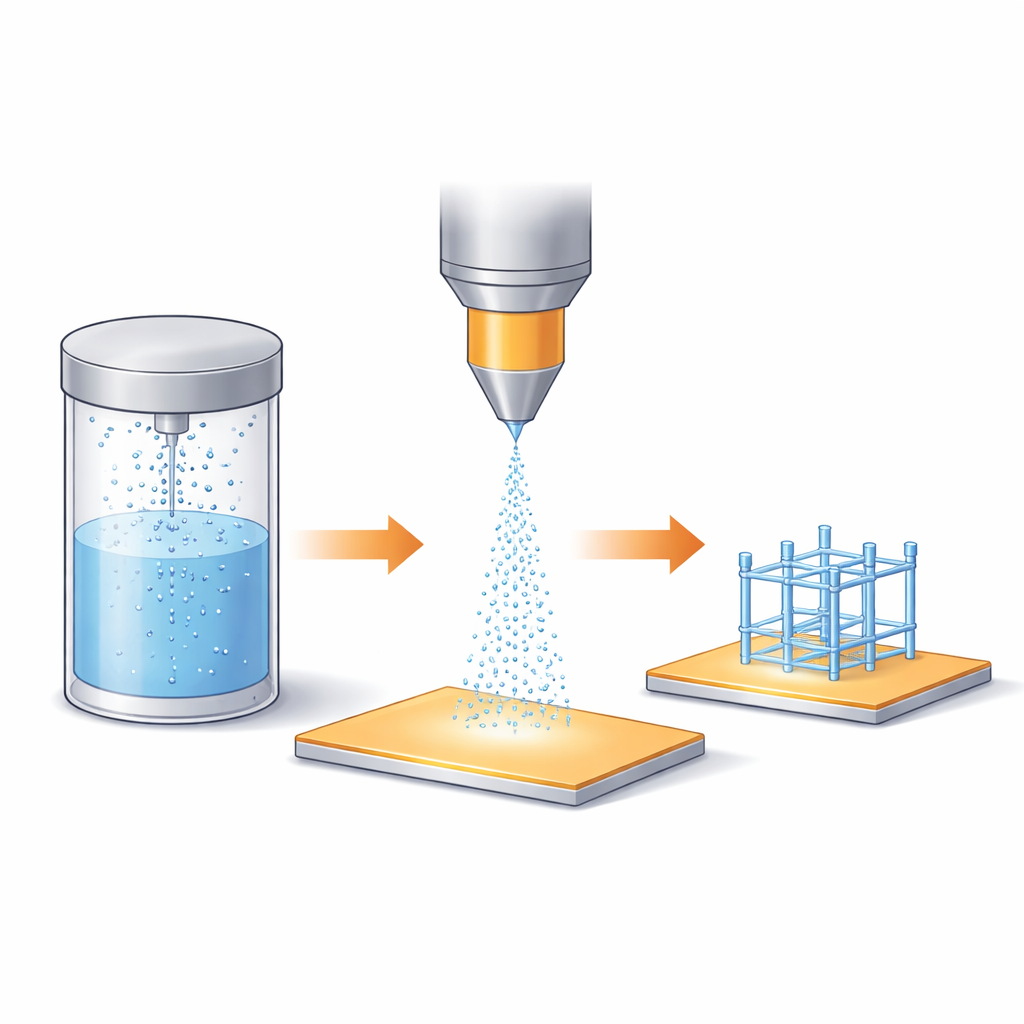
The researchers adapt a technique called aerosol jet printing, which normally sprays metal or electronic inks onto surfaces, and reformulate PDMS so it can be jetted as a fine mist. They dilute the silicone with a solvent to create an ink whose viscosity is low enough to be broken into 1–5 micrometer droplets by an ultrasonic atomizer. A flow of gas then carries these droplets to a nozzle, where a second gas stream squeezes the mist into a narrow jet much smaller than the nozzle opening. When this jet hits a hot surface, the solvent quickly evaporates and the droplets cure into solid PDMS. By scanning the substrate or dwelling in place, the printer can lay down precise lines in 2D or stack droplets vertically to grow pillars and beams up into 3D.
From Straight Lines to Lattices in Space
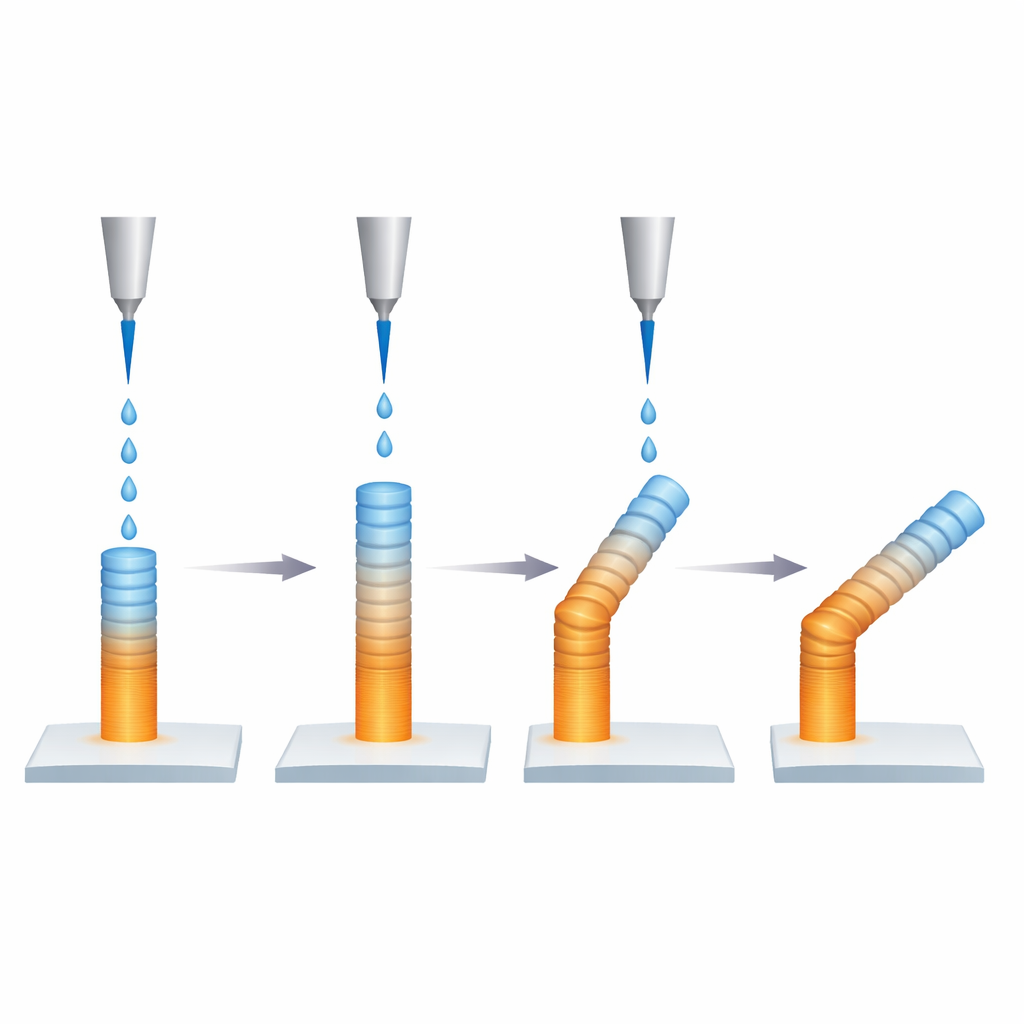
To make the process reliable, the team systematically maps out how temperature and gas focusing affect line width and build height. On heated substrates up to 250 °C, they achieve PDMS lines only about 27 micrometers wide—roughly a quarter of a human hair—while still gaining enough thickness to stack multiple layers. They then study how tall free-standing micropillars can grow before they begin to flare and lose their straight shape, and how steeply angled struts can be printed without sagging. Simulations show that as the pillar rises, its tip cools relative to the base; above a certain height the droplets no longer cure fast enough, causing a bulbous top. By tuning the printing conditions, the authors reach aspect ratios around 22 (height 22 times diameter) and can print beams at angles as shallow as 36 degrees above horizontal, all without any temporary support material.
Soft Lattices, Tiny Pipes, and Magnetic Micropillars
Armed with this design space, the researchers construct a range of microstructures. They print 3D PDMS lattices made of intersecting struts only ~87 micrometers thick and then compress them tens of thousands of times to 30–50% strain. The lattices spring back with little loss in performance, showing strong fatigue resistance and making them promising as soft mechanical components or protective cushions. By printing hollow pillars, they create free-standing microchannels that carry colored fluid under pressure without leaking or peeling off the metal plate beneath—essentially, tiny 3D pipes drawn directly onto hardware. Finally, by mixing superparamagnetic iron-oxide nanoparticles into the PDMS ink, they print magnetic pillars that bend toward a nearby magnet and return when the field is removed, hinting at artificial cilia or other soft robotic actuators that respond to external fields.
Beyond One Material: A General Path to Tiny 3D Polymers
Although PDMS is the main focus, the same printing recipe works for several other polymers, from very soft silicones to stiffer plastics and a conductive organic material. Without heavy re-optimization, the team fabricates microlattices and pillars from polyimide, Ecoflex, SU-8, and PEDOT:PSS, suggesting that the approach is broadly applicable. The key requirements are that the ink can be aerosolized into small droplets and that those droplets can solidify quickly when they hit a warm structure. This versatility hints at future devices where soft, rigid, and conductive elements are all printed together in a single 3D microarchitecture.
What This Means for Future Soft Devices
In everyday terms, this work turns PDMS from something you mostly pour into molds into a material you can “sketch” freely in three dimensions at the scale of blood vessels and hair. By combining a long-lived, sprayable silicone ink with careful control of heat and droplet flow, the authors show that you can build delicate, self-supporting lattices, fluid channels, and magnetically driven pillars in one step and without messy support baths. For future soft robots, wearable sensors, and lab-on-a-chip systems, this means designers can move from flat layers to true 3D architectures, packing more function into smaller, softer, and more intricate devices.
Citation: Kushagr, S., Hu, C., Yuan, B. et al. From lines to lattices—high-resolution 2D and 3D PDMS microarchitectures via aerosol jet printing. npj Adv. Manuf. 3, 19 (2026). https://doi.org/10.1038/s44334-026-00080-1
Keywords: aerosol jet printing, PDMS microstructures, soft robotics, microfluidics, 3D polymer lattices