Clear Sky Science · en
Effects of neutron irradiation on Ni-based alloys: a comparative study between PM-HIP and forging
Why safer reactor metals matter
Future nuclear power plants must run for decades in punishing conditions: high heat, intense radiation, and corrosive coolants. The metal parts that hold everything together have to stay strong and crack‑free under this steady bombardment. Today, many of these parts are made by traditional forging, but a newer route called powder metallurgy with hot isostatic pressing (PM‑HIP) promises cheaper, near‑final‑shape components with fewer internal flaws. This study asks a simple but crucial question: when exposed to real reactor‑like neutron radiation, can PM‑HIP metals perform as well as – or better than – their forged counterparts?
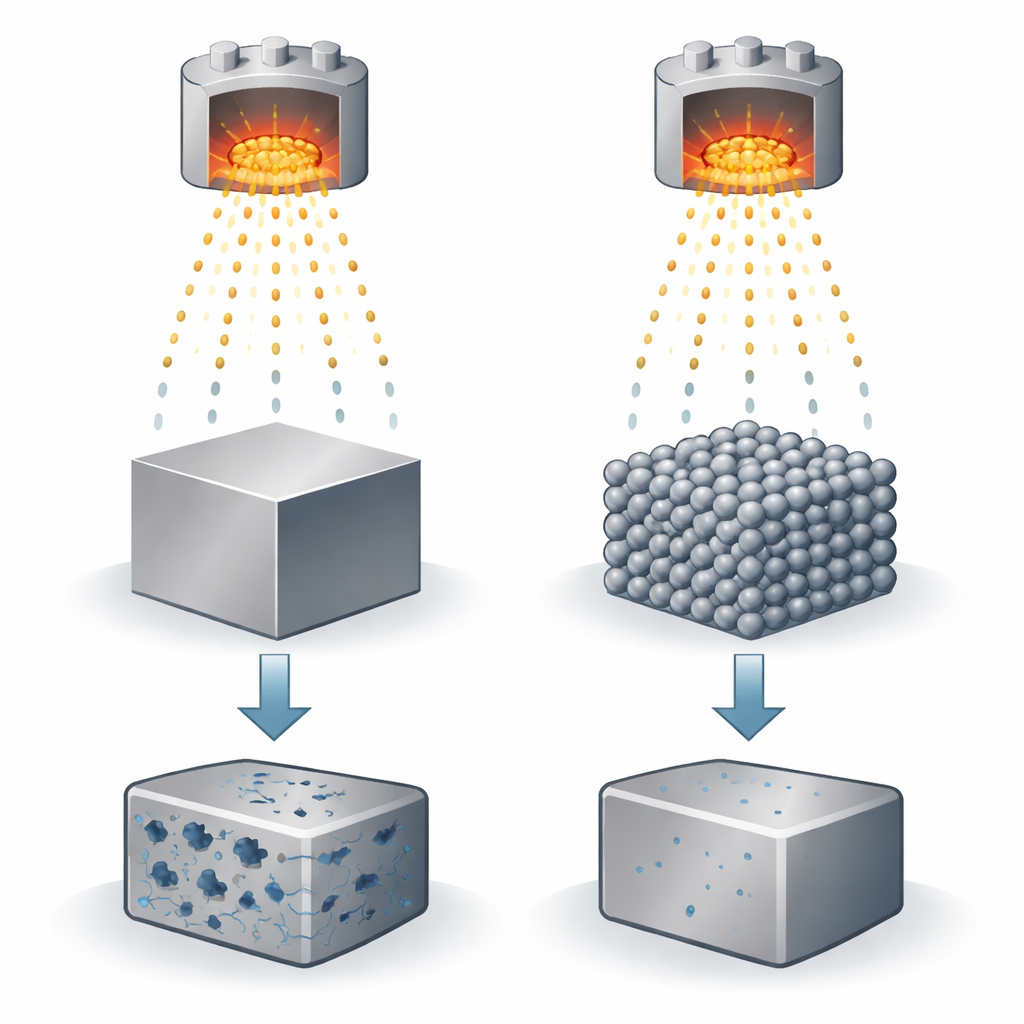
Two ways to build the same metal
The researchers focused on two nickel‑based alloys, known in industry as 625 and 690, which are leading candidates for key structures in advanced reactors. In forging, a large metal ingot is cast and then squeezed and rolled into shape. PM‑HIP starts instead with fine metal powders that are sealed in a container and compressed at high temperature and pressure until they bond into a dense solid. Earlier work hinted that PM‑HIP versions of several steels and nickel alloys might hold up better under radiation, but most tests stopped at low doses. Here, the team directly compared PM‑HIP and forged versions of Alloys 625 and 690 after exposure to neutrons at around 400 °C, to two levels of damage meant to bracket the early life of reactor components.
Testing strength after a neutron onslaught
To see how the metals’ strength and ductility changed, the team pulled small cylindrical samples in tension at room temperature, both before and after irradiation. Neutron damage usually makes metals harder and less stretchable because radiation creates tiny obstacles inside the crystal lattice. For Alloy 625, the PM‑HIP material showed clearly lower radiation‑induced hardening than the forged version at both damage levels. In practice, that means the PM‑HIP 625 retained similar or better ability to stretch before breaking. For Alloy 690, the story was more balanced: PM‑HIP and forged samples showed very similar increases in strength and losses in ductility, especially at the higher damage level where their behavior nearly converged.
Peering into the metal’s hidden landscape
Mechanical tests alone cannot explain why one route fares better than another, so the researchers turned to high‑resolution microscopes and atom‑by‑atom probes. Using transmission electron microscopy, they counted and measured radiation‑induced defects such as tiny loops in the crystal, empty cavities called voids, and small faulted structures. In Alloy 625, PM‑HIP samples developed about the same void size but roughly ten times fewer voids than forged ones, and their loops stayed smaller even as their number increased with dose. Because the forged metal began with a higher density of dislocations – line‑like defects that attract mobile atoms – it tended to trap more vacancies and grow more voids, which stiffen and embrittle the material. In Alloy 690, however, PM‑HIP and forged versions showed almost the same mix of loops and voids, differing mainly by a modest reduction in void count for PM‑HIP at the higher dose, which explains why their bulk properties were closely matched.
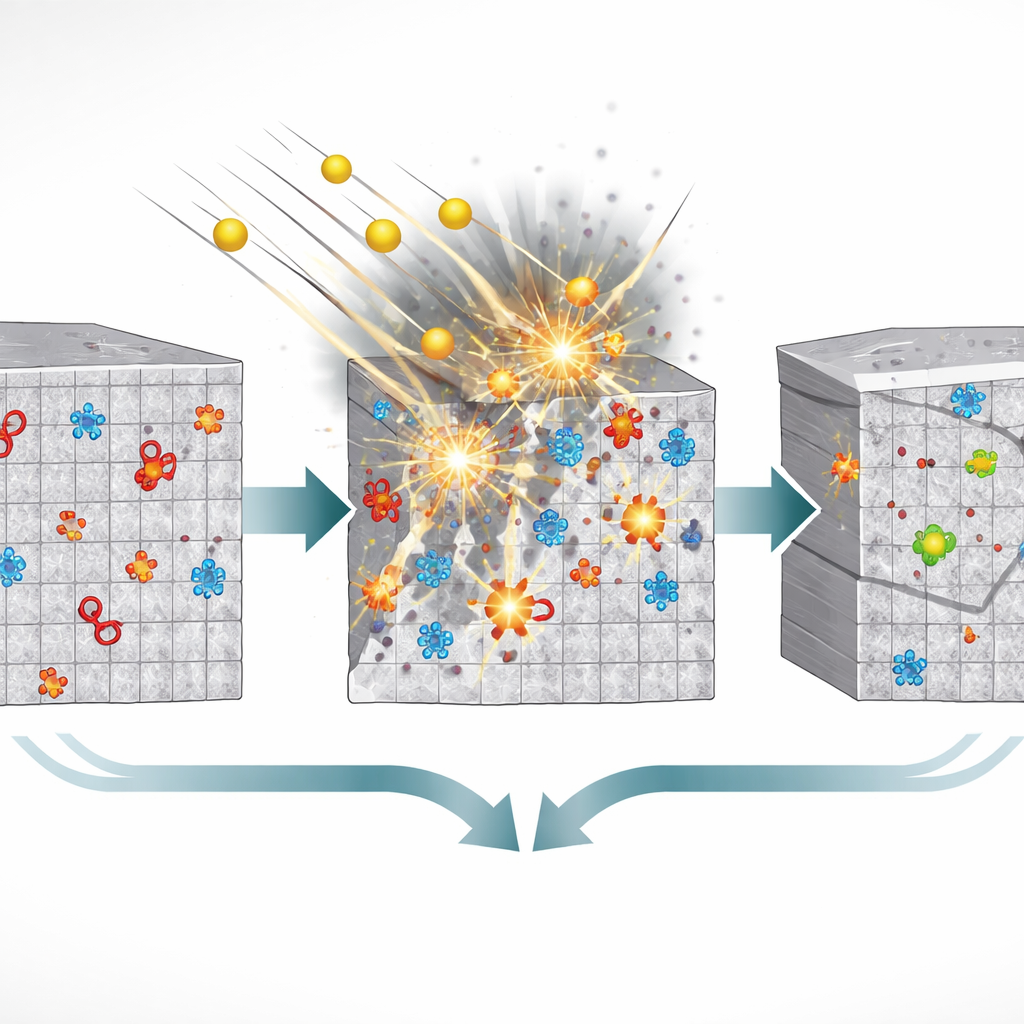
Tiny clusters and model‑based insights
Atom probe tomography, a technique that maps individual atoms in 3D, revealed another subtle distinction. In PM‑HIP Alloy 625, silicon atoms gathered into nanometer‑scale clusters under irradiation, while forged 625 and both forms of 690 showed only faint hints of such clustering at the same doses. The authors suggest that differences in overall composition and in the size and density of radiation‑created loops control how solute atoms like silicon move and group together. They then used a standard “dispersed barrier hardening” model, which links defect populations to strength, to estimate how much each family of defects – loops, voids, stacking‑fault structures, and clusters – should harden the metal. The model reproduced the key trends: PM‑HIP 625 should harden less than forged 625, and both forms of 690 should harden by similar amounts, with voids playing a dominant role in all cases.
What this means for future reactors
From a layperson’s perspective, the bottom line is reassuring: making nickel‑based reactor components from carefully pressed and heated powders does not weaken them under neutron bombardment and can even improve their tolerance to damage. For Alloy 625, PM‑HIP processing leads to a cleaner internal structure that resists the formation of harmful radiation‑induced voids, so the metal stays stronger and more stretchable as it ages. For Alloy 690, where composition and defect behavior blur the differences between routes, PM‑HIP at least matches forging. Together, these findings support the idea that PM‑HIP can safely supply large, complex nickel‑alloy parts for future nuclear plants, potentially lowering costs while helping reactors run reliably for the long haul.
Citation: Roy, R., Mondal, S., Clement, C.D. et al. Effects of neutron irradiation on Ni-based alloys: a comparative study between PM-HIP and forging. npj Adv. Manuf. 3, 17 (2026). https://doi.org/10.1038/s44334-026-00079-8
Keywords: nuclear materials, neutron irradiation, nickel alloys, powder metallurgy, hot isostatic pressing