Clear Sky Science · en
Spectral fabric of stochastic residual stress fields
Why hidden stresses matter
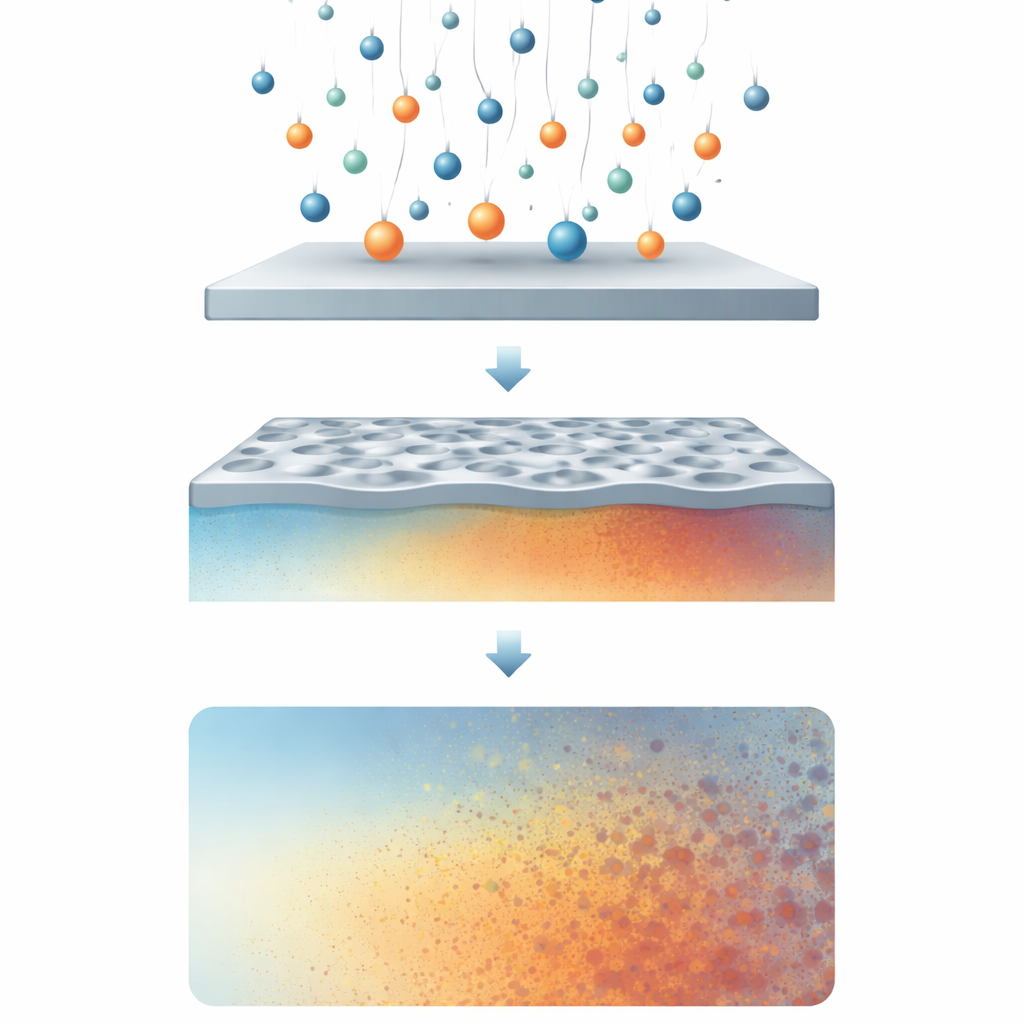
When metal parts are blasted with tiny steel or ceramic beads to make them tougher, they are left with an invisible “ghost” pattern of internal stresses. These residual stresses can dramatically extend or shorten the life of airplane wings, car springs, and many other safety‑critical components. Yet the detailed structure of these stress patterns is hard to measure and even harder to predict quickly. This paper introduces a new way to describe and forecast these hidden patterns, treating them like a kind of fabric woven through the material.
A noisy process with lasting effects
The study focuses on shot peening, a common surface treatment where high‑speed particles strike a metal surface and leave behind compressive stresses that help stop cracks from growing. Although the process is carefully controlled, each individual impact occurs at a random location with slightly different conditions. Traditional engineering models usually average this behavior and predict only how the mean stress changes with depth below the surface. Those approaches miss the fine‑scale ups and downs in stress that can trigger fatigue cracks, especially when impacts overlap and the material starts to harden.
Turning impacts into simple building blocks
To make sense of this complexity, the authors represent each impact as a simple, idealized “inclusion” inside the metal—an embedded region that has been permanently strained. This idea comes from classic micromechanics work by Eshelby and Goodier, who derived formulas for the stress field around such inclusions. The researchers first calibrate this simplified impact model against detailed computer simulations of single particle strikes, adjusting only two parameters: the size of the deformed zone and the strength of the imposed strain. They show that, despite ignoring the free surface and some local details, the inclusion model reproduces the overall shape and depth of the stress field from the full simulation well enough to be used as a basic building block.
From many impacts to a woven pattern
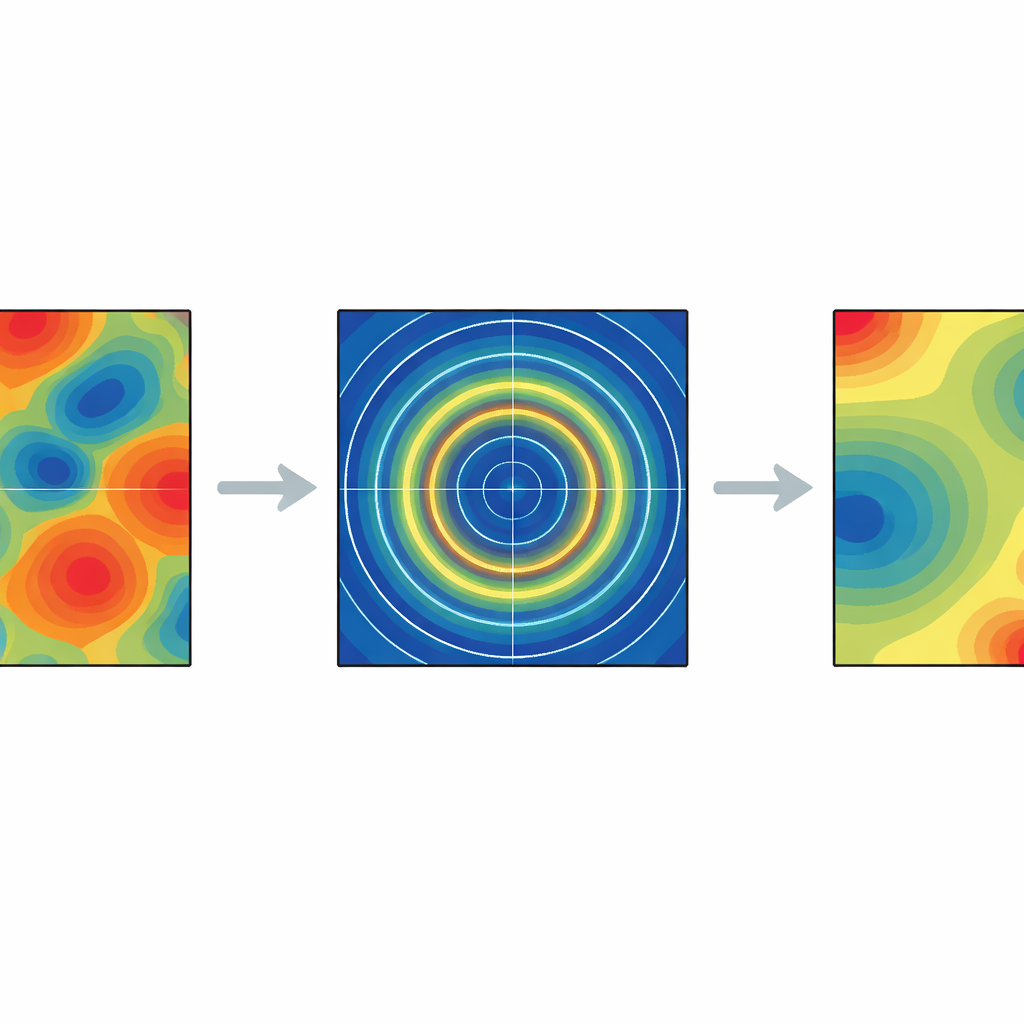
Next, the team studies realistic surfaces subjected to tens to hundreds of random impacts at different speeds. They compare two pictures of the resulting stress fields: one from full three‑dimensional finite element simulations, and one from simply adding up many idealized inclusions. The simple superposition cannot capture material hardening or the way craters pile up at high coverage, and these differences show up clearly near the surface. To diagnose where and how the models diverge, the authors analyze the fields in terms of spatial frequencies—how stress varies over different length scales—using a power spectrum. This allows them to separate long‑range, slowly varying features from short‑range, highly localized ones.
Reading the stress fabric in frequency space
The key tool introduced is the Power Spectral Density Ratio (PSDR), which compares the energy at each spatial frequency in the detailed simulation to that in the inclusion‑based prediction. The authors interpret low‑frequency content as a “macro‑fabric” describing large‑scale coherence, and high‑frequency content as a “micro‑fabric” describing local detail around each impact. They find that, as coverage increases, low‑frequency modes are suppressed: the material cannot build unlimited average stress because it yields, so the long‑range fabric is effectively clamped. By contrast, certain mid‑to‑high frequencies are amplified at the surface, reflecting sharp ridges and craters formed where impacts overlap. Below the surface, plastic smoothing damps most high‑frequency content, but a characteristic wavelength tied to the impact size remains robust. This suggests that the micro‑fabric pattern scales reliably with particle size and speed, while the macro‑fabric is more sensitive to how the material hardens.
From detailed simulations to practical tools
Although spatial alignment between the simple and detailed stress maps eventually breaks down at very high coverage, their overall statistical distributions remain similar. Metrics that compare entire histograms of stress values, rather than point‑by‑point agreement, show good match even under aggressive peening conditions. This means the PSDR‑based correction can preserve the global character of the stress field while acknowledging that the exact location of each hotspot becomes effectively random. The framework therefore provides a scalable way to predict stress variability without always running expensive simulations.
What this means for real‑world parts
In plain terms, the authors have shown how to translate a messy, random peening process into a set of reusable patterns that describe how stress is arranged in space. By treating residual stresses like a fabric composed of long‑range threads and fine‑scale weave, and by using spectral ratios to correct simple models, engineers can forecast not just average stress but also how patchy it is and over what distances it stays correlated. This opens the door to smarter digital twins and in‑process control, where measurements of particle speed and size, or even surface roughness scans, can be fed into compact models that predict fatigue‑relevant stress patterns on the fly. Ultimately, this spectral “fabric” approach could help manufacturers tune treatments like shot peening to reliably extend component life while reducing the need for costly trial‑and‑error testing.
Citation: Feltner, L., Mort, P. Spectral fabric of stochastic residual stress fields. npj Adv. Manuf. 3, 18 (2026). https://doi.org/10.1038/s44334-026-00078-9
Keywords: shot peening, residual stress, spectral analysis, fatigue life, digital manufacturing