Clear Sky Science · en
Ultrasonic-assisted hot-press sintering of Cu-Ti₃AlC₂ composites
Smarter Metals for Fast-Charging Cars
As electric vehicles spread and fast‑charging becomes routine, the metal parts that carry huge bursts of current—such as charging-gun terminals—are pushed to their limits. They must be strong yet lightweight, conduct electricity and heat extremely well, and resist wear and arcing during thousands of plug‑in cycles. This study explores a new way to build such “workhorse” metals by combining copper with a special layered ceramic and using ultrasound to fuse the powders together at lower temperatures.
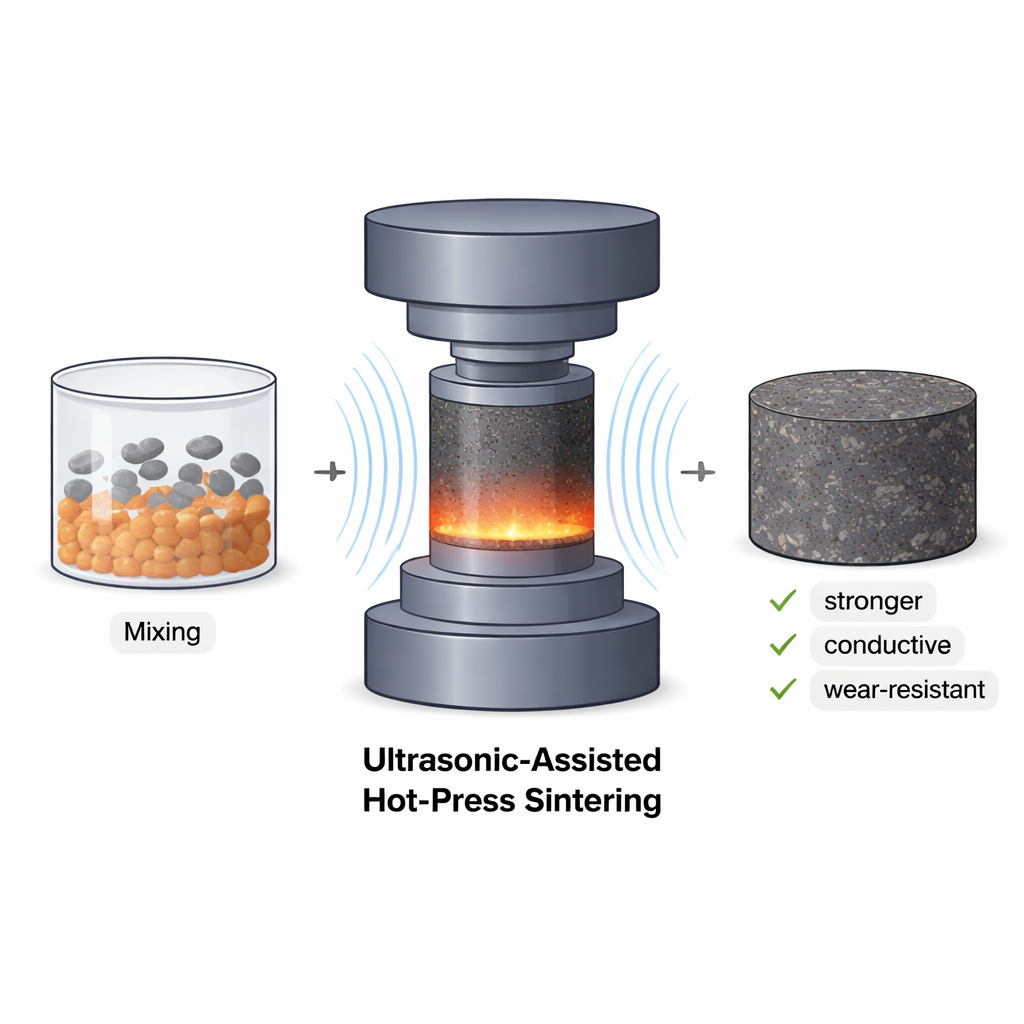
Blending a Soft Metal with a Tough Ceramic
Copper is prized for its outstanding electrical and thermal conductivity, but it is relatively soft and can wear quickly under demanding service. Engineers often strengthen copper by adding hard particles, making what are known as copper matrix composites. In this work, the team chose a ceramic called Ti₃AlC₂, part of the MAX‑phase family. These materials are unusual: they behave partly like metals—conducting heat and electricity—yet keep the strength, stiffness, and wear resistance of ceramics. When Ti₃AlC₂ is mixed into copper in the right amount, the resulting composite becomes stronger, lighter, and more wear‑resistant while still conducting electricity efficiently, an attractive combination for power connectors and heat‑dissipation parts.
Why the Usual Recipe Falls Short
Making dense copper–Ti₃AlC₂ parts is not straightforward. Conventional hot‑pressing requires high temperatures, but above about 860 °C Ti₃AlC₂ starts to break down into other compounds, releasing aluminum into the copper. That breakdown creates tiny voids that reduce density and strength, and the dissolved aluminum seriously harms electrical conductivity—the very property designers want to preserve. If the process temperature is kept lower to protect the ceramic, the powders do not fully fuse, leaving pores that weaken the material. Earlier attempts to solve this used tricks such as coating particles, adding extra alloying elements, or heavy post‑processing steps, but each fix introduced new trade‑offs in cost, performance, or complexity.
Pressing with Sound: The UAHP Approach
To escape this dilemma, the researchers built an ultrasonic‑assisted hot‑press (UAHP) system. In it, copper and Ti₃AlC₂ powders are first mixed and pressed, then heated to only 750 °C—about 100–110 °C lower than typical routes—while high‑frequency vibrations pass through the compact. These vibrations act like a microscopic hammer: they help the copper deform and flow around the ceramic particles, collapse pores, and promote bonding without needing extreme heat. Careful X‑ray and electron‑microscope studies show that on the large scale Ti₃AlC₂ remains intact rather than decomposing. At the interface, a very thin reaction layer forms, made of slightly defective Ti₃AlC₂, tiny TiC particles, and a copper–titanium compound. This nanoscale “solder” locks the phases together without allowing aluminum to leak into the copper, keeping conductivity high.
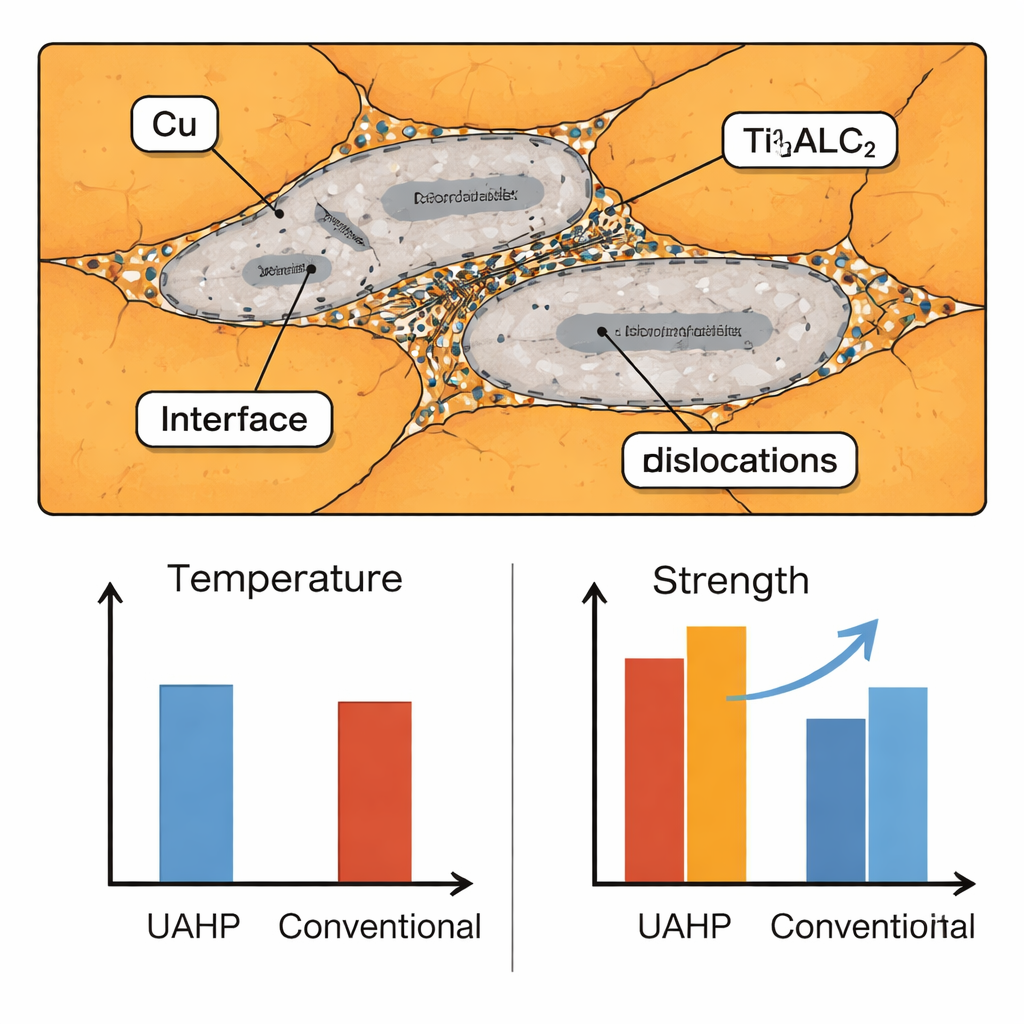
Stronger, Lighter, and Still Conductive
Samples made with different amounts of Ti₃AlC₂ were tested for density, hardness, strength, electrical conductivity, and friction behavior. With up to about 15 percent ceramic by volume, the composites reached more than 95 percent of full density and showed a clear jump in hardness and bending strength; yield strength rose by nearly half compared with pure copper. Even at higher ceramic loadings, the electrical conductivity remained far better than in comparable materials where the ceramic had decomposed. Because Ti₃AlC₂ is lighter than copper, adding up to 30 percent ceramic cut overall density by more than one‑fifth, which could help reduce weight in components such as charging connectors or power busbars. In sliding‑wear tests against a steel ball, the layered ceramic gradually formed a thin lubricating film on the surface, lowering the friction coefficient and cutting wear rates dramatically as its content increased.
What This Means for Real‑World Devices
For non‑specialists, the key message is that the team found a way to “have it both ways” with copper composites: by using sound waves during hot pressing, they could densify a difficult metal–ceramic blend at safer, lower temperatures, keeping the ceramic stable and the copper highly conductive. The resulting material is lighter, stronger, more wear‑resistant, and still an excellent conductor of heat and electricity—traits that are highly desirable in fast‑charging connectors, high‑power switches, and compact cooling hardware. Beyond this specific copper–Ti₃AlC₂ recipe, the ultrasonic‑assisted hot‑pressing method itself offers a promising route to manufacture other advanced metal–ceramic components that were previously hard to sinter without sacrificing performance.
Citation: Zhou, S., Xiang, H., Fang, C. et al. Ultrasonic-assisted hot-press sintering of Cu-Ti₃AlC₂ composites. npj Adv. Manuf. 3, 7 (2026). https://doi.org/10.1038/s44334-026-00067-y
Keywords: copper composites, ultrasonic sintering, MAX phase ceramics, electric vehicle charging, wear-resistant conductors