Clear Sky Science · en
The economics of smart EV charging at home: a review and research agenda
Why your driveway matters for the future of driving
For most new electric car owners in Europe, the main filling station is no longer a gas pump but the socket at home. This review article looks at how “smart” home charging can make driving on electricity much cheaper, while also helping keep the lights on and making better use of solar and wind power. It explains the different ways home charging can be controlled, what they mean for your wallet and for the wider power system, and where today’s research still overlooks real-life driver habits.
How home charging can cut fuel costs
Charging an electric vehicle at home already avoids the profit margins and infrastructure costs baked into public fast charging. Studies show this alone can slash fuel costs by more than half compared with driving a petrol car. The paper explains how smart charging goes further by timing charging to the cheapest hours of the day, when wholesale electricity prices are low or even negative. Instead of plugging in and charging at full speed right away, software can slow, pause, or shift charging while still ensuring the car is ready when needed. The authors group these money-saving tactics under a “market-driven” logic, where the main goal is to take advantage of price swings on power markets to minimize the household’s bill.
Helping the neighborhood grid cope
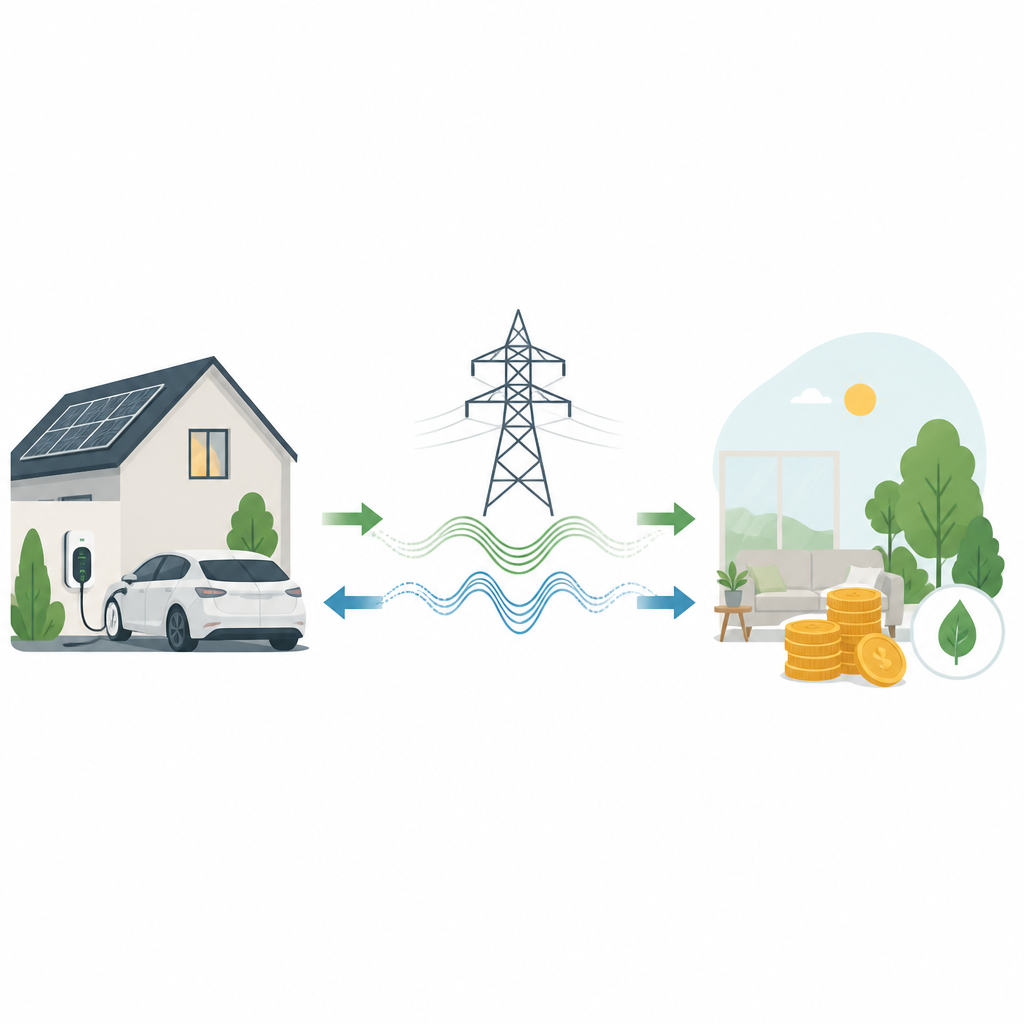
Smart charging is not only about saving money. If many drivers in the same street plug in at the same time after work, cables and transformers can become overloaded. The review describes “grid-conscious” charging strategies that spread charging over the night or reduce power when local demand is high. Some European countries are testing new network fees that vary by time, place, or peak usage, giving households a price signal to be more grid friendly. In some cases, groups of parked cars can even act like a flexible power plant, briefly feeding electricity back into the grid to provide support services. Done well, this can delay costly grid upgrades and create new income streams, but it also raises questions about who captures this value and how much ends up with drivers.
Turning drivers into home power producers
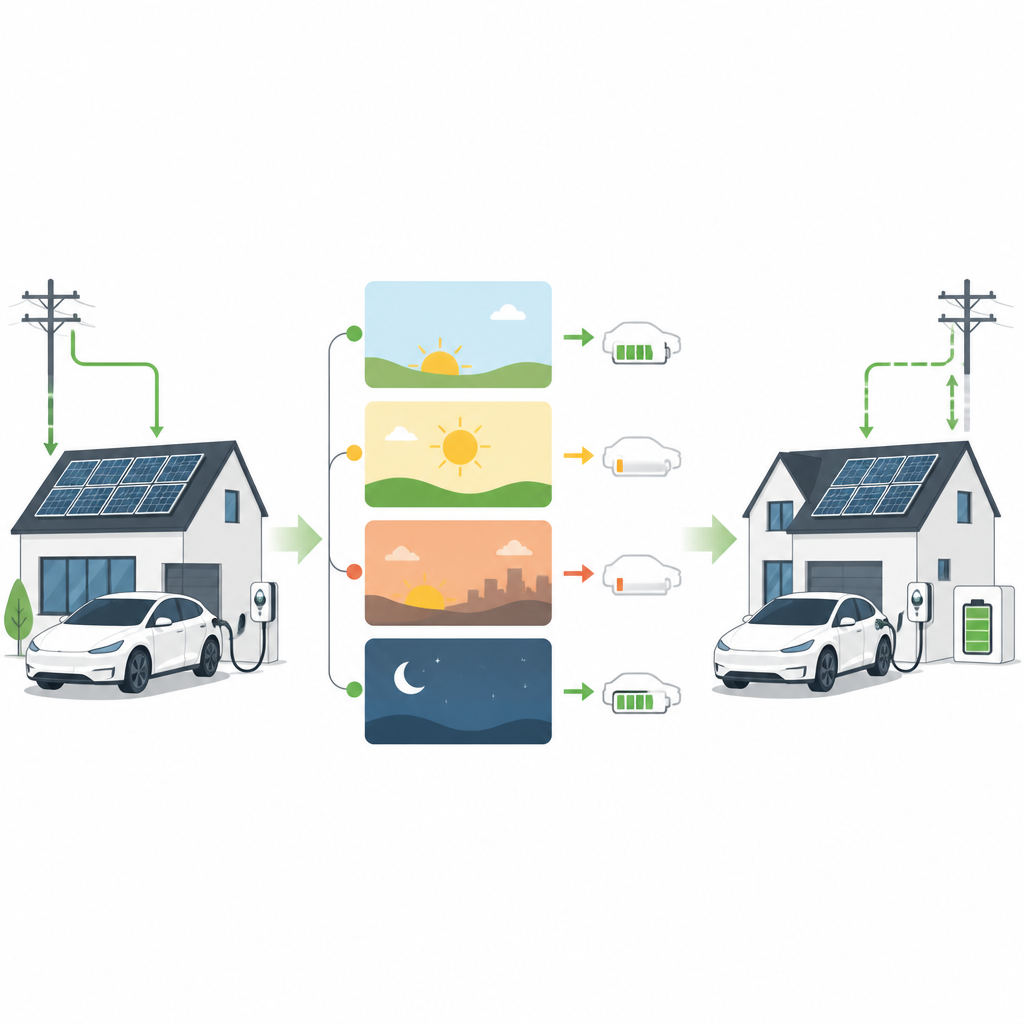
A third family of strategies, called “prosumer-oriented” in the paper, focuses on households that produce their own electricity, most often with rooftop solar panels. By aligning car charging with sunny hours, homes can use far more of their own solar power instead of exporting it at a low price and buying back grid power later at a higher one. Some setups allow bidirectional charging, where the car battery can also supply the home during expensive evening peaks, further reducing bills and easing strain on the grid. Studies reviewed in the article report big boosts in solar self-use and sizeable cuts in peak demand when EVs, solar panels, and sometimes home batteries are managed together by a smart control system.
What current studies miss about real drivers
Many of the economic models behind these strategies assume that cars are always parked at home, that drivers gladly accept remote control of their charging, and that plenty of homes have solar panels. The authors argue that such assumptions are often too optimistic. Real-world data show that people have varied travel routines, limited parking times, and different attitudes to giving up control over when their car charges or discharges. When models ignore these limits, they can overstate how much flexibility EVs can offer and how large the savings will be. The review also notes that most studies focus on a single goal, such as lowest cost or best grid support, instead of examining how different goals interact, clash, or can be balanced.
Why this matters for policy and everyday life
The article concludes that smart home charging sits at a crossroads between three aims: cheap driving, a stable grid, and greater use of clean energy. No single approach can fully maximize all three at once, so the real task is to design strategies and rules that strike a fair balance. That means recognising real driver behaviour, comparing different national rules and price systems, and finding business models that share benefits fairly between grid operators, energy companies, and households. For everyday drivers, the message is that their driveway can become an important piece of the energy system, but the comfort, cost savings, and sense of control they experience will depend on how this smart charging puzzle is put together.
Citation: Pons-Seres de Brauwer, C., Loock, M. The economics of smart EV charging at home: a review and research agenda. npj. Sustain. Mobil. Transp. 3, 37 (2026). https://doi.org/10.1038/s44333-026-00105-4
Keywords: smart EV charging, home charging, dynamic electricity prices, solar self consumption, vehicle to grid