Clear Sky Science · en
Path dependence and spatial disparities in the shift from gasoline to charging infrastructure
Why charging station maps matter to daily life
As more people and freight companies switch from gasoline and diesel vehicles to electric ones, where we place charging stations will shape who can benefit from cleaner transportation. This study looks at how chargers for cars and trucks are being built across California and asks a simple but important question: are we putting them where people actually drive, or just copying the old gas station map?
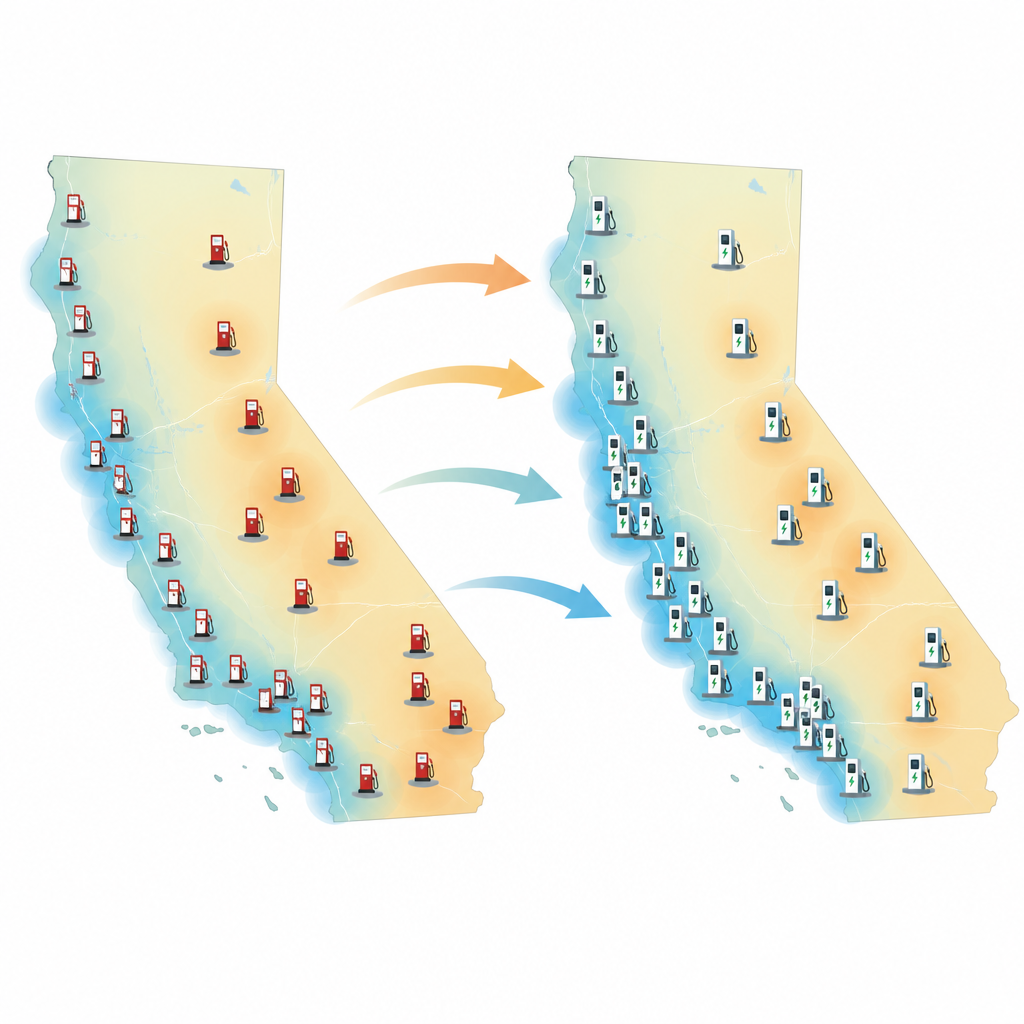
From tailpipes to plugs across California
Transportation is the largest source of climate pollution in California, with everyday cars producing most of the greenhouse gases and heavy trucks adding a big share of both climate and health harming emissions. The state has set aggressive timelines to phase in zero emission cars and trucks, which makes a reliable charging network essential. The authors use California as a test case because it leads the nation in electric vehicle sales and climate rules, making it an early window into how this transition might unfold elsewhere.
Comparing chargers to actual driving
Instead of counting chargers alone, the researchers compare charging capacity in each county to a measure of electric vehicle miles traveled, which captures how much electric driving is expected on local roads. For light duty vehicles, they combine the power of slow, medium, and fast chargers into a single measure of capacity and then see how evenly that capacity lines up with driving. For heavy trucks and buses, where data are thinner and equipment is still emerging, they count the number of available chargers and compare it to expected electric freight activity.
Old gas station patterns leave a mark
The results show that chargers for passenger cars are highly concentrated in a few counties, and that this concentration is growing over time. Fast chargers are somewhat more evenly spread than slower ones, but large gaps remain. When the team compares chargers to electric driving demand, alignment looks reasonable at first but worsens by 2024, suggesting that new installations are no longer closely following where people drive. A key finding is that the locations of gas stations strongly predict where chargers are built, with the link growing tighter over time. In practice, this means the electric network often mirrors the old fossil fuel footprint instead of being tailored to today’s and tomorrow’s needs.
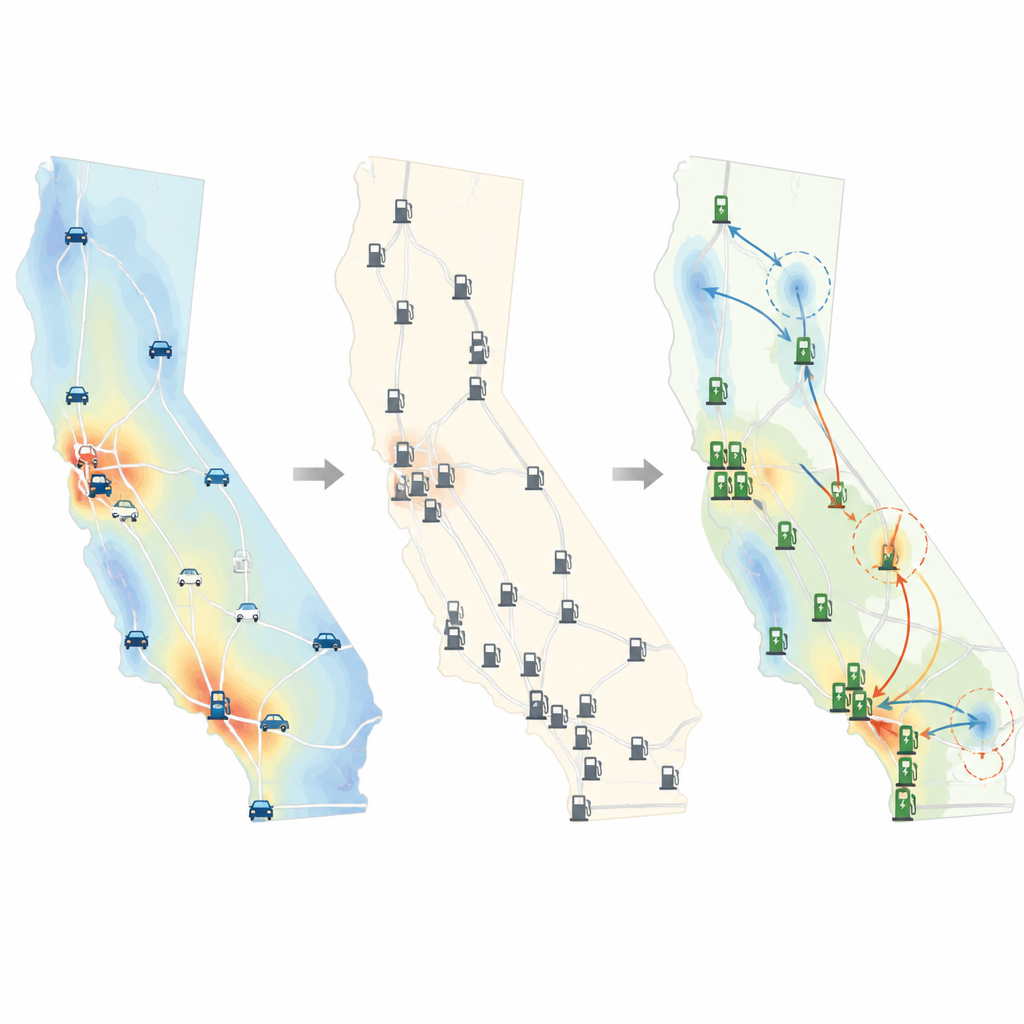
Communities left waiting for plugs
Maps of the differences between expected and actual charger deployment reveal which counties get more chargers than the gas station pattern would suggest and which get fewer. Coastal urban regions like the San Francisco Bay Area and Los Angeles tend to be over served, while inland regions such as the Central Valley, inland Southern California, and the northern interior lag behind. Many of these under served areas are designated as disadvantaged communities that already face higher levels of air pollution and economic stress. The same warning signs appear for heavy duty truck chargers in 2024: although chargers line up fairly well with modeled freight demand overall, they are sparse or missing along several important freight corridors that also pass through burdened communities.
What this means for a fair clean transportation future
For a layperson, the takeaway is that simply building more chargers is not enough; where we place them will decide who can easily drive electric and who stays tied to older, dirtier fuels. This study shows that California’s current pattern of charger deployment risks repeating past inequalities by following the gas station map instead of the map of actual and future electric travel. The authors offer a practical framework based on travel demand, legacy infrastructure, and simple inequality measures to help planners and policymakers spot gaps and steer new investment toward the communities and freight routes that need it most, so the benefits of cleaner air and lower climate pollution are shared more evenly.
Citation: Feng, G., Su, G. Path dependence and spatial disparities in the shift from gasoline to charging infrastructure. npj. Sustain. Mobil. Transp. 3, 35 (2026). https://doi.org/10.1038/s44333-026-00102-7
Keywords: electric vehicle charging, infrastructure equity, California transport, freight electrification, spatial disparities